

50
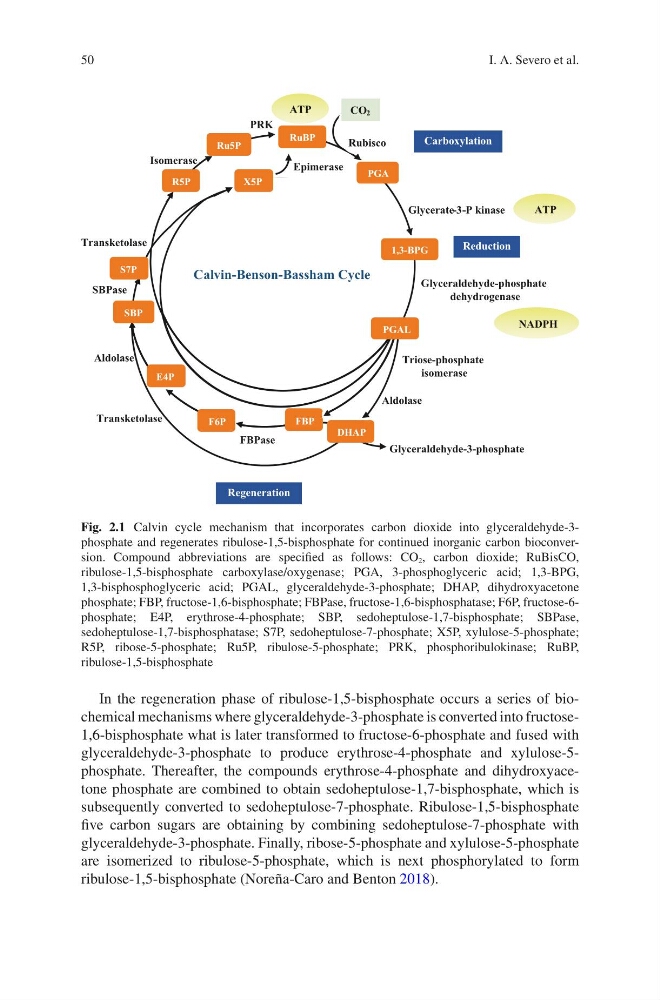
In the regeneration phase of ribulose-1,5-bisphosphate occurs a series of biochemical mechanisms where glyceraldehyde-3-phosphate is converted into fructose1,6-bisphosphate what is later transformed to fructose-6-phosphate and fused with
glyceraldehyde-3-phosphate to produce erythrose-4-phosphate and xylulose- 5phosphate. Thereafter, the compounds erythrose-4-phosphate and dihydroxyacetone phosphate are combined to obtain sedoheptulose-1,7-bisphosphate, which is
subsequently converted to sedoheptulose-7-phosphate. Ribulose-1,5-bisphosphate
five carbon sugars are obtaining by combining sedoheptulose-7-phosphate with
glyceraldehyde-3-phosphate. Finally, ribose-5-phosphate and xylulose-5-phosphate
are isomerized to ribulose-5-phosphate, which is next phosphorylated to form
ribulose- 1,5-bisphosphate (Noreña-Caro and Benton 2018).
PGAL
FBP
DHAP
X5P
Glycerate-3-P kinase
Glyceraldehyde-phosphate
dehydrogenase
Triose-phosphate
isomerase
FBPase
Transketolase
SBPase
Isomerase
Epimerase
PRK
Aldolase
Transketolase
Carboxylation
Reduction
Regeneration
E4P
SBP
S7P
Ru5P
Calvin-Benson-Bassham Cycle
CO 2
Rubisco
ATP
ATP
NADPH
R5P
PGA
1,3-BPG
RuBP
Aldolase
F6P
Glyceraldehyde-3-phosphate
Fig. 2.1 Calvin cycle mechanism that incorporates carbon dioxide into glyceraldehyde-3phosphate and regenerates ribulose-1,5-bisphosphate for continued inorganic carbon bioconversion. Compound abbreviations are specified as follows: CO 2 , carbon dioxide; RuBisCO,
ribulose- 1,5- bisphosphate carboxylase/oxygenase; PGA, 3-phosphoglyceric acid; 1,3-BPG,
1,3- bisphosphoglyceric acid; PGAL, glyceraldehyde-3-phosphate; DHAP, dihydroxyacetone
phosphate; FBP, fructose-1,6-bisphosphate; FBPase, fructose-1,6-bisphosphatase; F6P, fructose- 6phosphate; E4P, erythrose-4-phosphate; SBP, sedoheptulose-1,7-bisphosphate; SBPase,
sedoheptulose- 1,7-bisphosphatase; S7P, sedoheptulose-7-phosphate; X5P, xylulose-5-phosphate;
R5P, ribose-5-phosphate; Ru5P, ribulose-5-phosphate; PRK, phosphoribulokinase; RuBP,
ribulose-1,5-bisphosphate
I. A. Severo et al.
In the regeneration phase of ribulose-1,5-bisphosphate occurs a series of biochemical mechanisms where glyceraldehyde-3-phosphate is converted into fructose1,6-bisphosphate what is later transformed to fructose-6-phosphate and fused with
glyceraldehyde-3-phosphate to produce erythrose-4-phosphate and xylulose- 5phosphate. Thereafter, the compounds erythrose-4-phosphate and dihydroxyacetone phosphate are combined to obtain sedoheptulose-1,7-bisphosphate, which is
subsequently converted to sedoheptulose-7-phosphate. Ribulose-1,5-bisphosphate
five carbon sugars are obtaining by combining sedoheptulose-7-phosphate with
glyceraldehyde-3-phosphate. Finally, ribose-5-phosphate and xylulose-5-phosphate
are isomerized to ribulose-5-phosphate, which is next phosphorylated to form
ribulose- 1,5-bisphosphate (Noreña-Caro and Benton 2018).
PGAL
FBP
DHAP
X5P
Glycerate-3-P kinase
Glyceraldehyde-phosphate
dehydrogenase
Triose-phosphate
isomerase
FBPase
Transketolase
SBPase
Isomerase
Epimerase
PRK
Aldolase
Transketolase
Carboxylation
Reduction
Regeneration
E4P
SBP
S7P
Ru5P
Calvin-Benson-Bassham Cycle
CO 2
Rubisco
ATP
ATP
NADPH
R5P
PGA
1,3-BPG
RuBP
Aldolase
F6P
Glyceraldehyde-3-phosphate
Fig. 2.1 Calvin cycle mechanism that incorporates carbon dioxide into glyceraldehyde-3phosphate and regenerates ribulose-1,5-bisphosphate for continued inorganic carbon bioconversion. Compound abbreviations are specified as follows: CO 2 , carbon dioxide; RuBisCO,
ribulose- 1,5- bisphosphate carboxylase/oxygenase; PGA, 3-phosphoglyceric acid; 1,3-BPG,
1,3- bisphosphoglyceric acid; PGAL, glyceraldehyde-3-phosphate; DHAP, dihydroxyacetone
phosphate; FBP, fructose-1,6-bisphosphate; FBPase, fructose-1,6-bisphosphatase; F6P, fructose- 6phosphate; E4P, erythrose-4-phosphate; SBP, sedoheptulose-1,7-bisphosphate; SBPase,
sedoheptulose- 1,7-bisphosphatase; S7P, sedoheptulose-7-phosphate; X5P, xylulose-5-phosphate;
R5P, ribose-5-phosphate; Ru5P, ribulose-5-phosphate; PRK, phosphoribulokinase; RuBP,
ribulose-1,5-bisphosphate
I. A. Severo et al.