

51
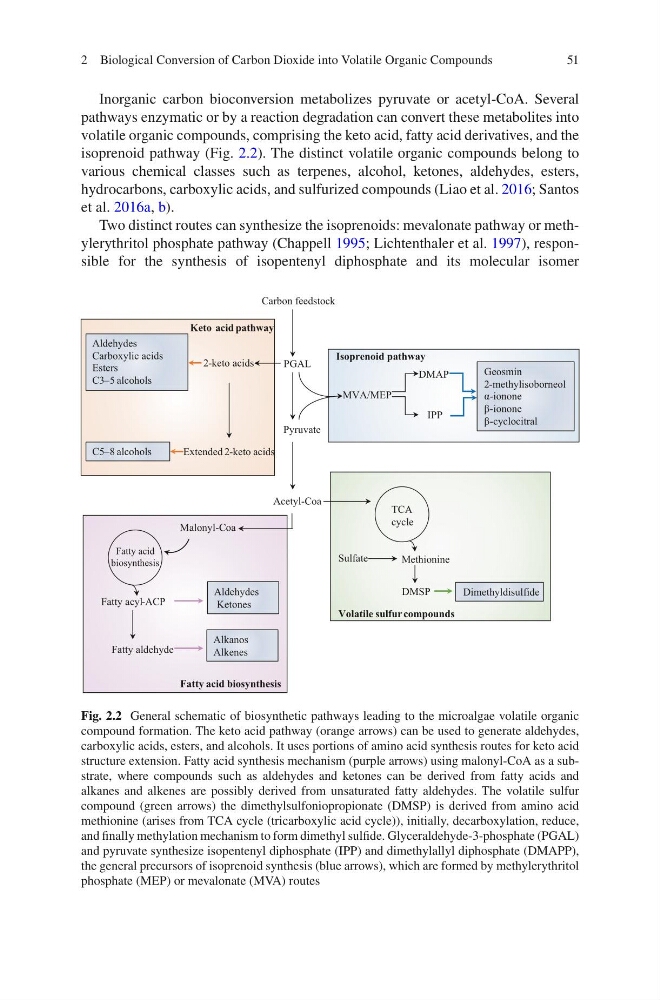
Inorganic carbon bioconversion metabolizes pyruvate or acetyl-CoA. Several
pathways enzymatic or by a reaction degradation can convert these metabolites into
volatile organic compounds, comprising the keto acid, fatty acid derivatives, and the
isoprenoid pathway (Fig. 2.2). The distinct volatile organic compounds belong to
various chemical classes such as terpenes, alcohol, ketones, aldehydes, esters,
hydrocarbons, carboxylic acids, and sulfurized compounds (Liao et al. 2016; Santos
et al. 2016a, b).
Two distinct routes can synthesize the isoprenoids: mevalonate pathway or methylerythritol phosphate pathway (Chappell 1995; Lichtenthaler et al. 1997), responsible for the synthesis of isopentenyl diphosphate and its molecular isomer
Carbon feedstock
PGAL
Pyruvate
Acetyl-Coa
2-keto acids
Aldehydes
Carboxylic acids
Esters
C3–5 alcohols
Malonyl-Coa
Fatty acid
biosynthesis
Fatty acyl-ACP
Fatty aldehyde
MVA/MEP
Aldehydes
Ketones
Alkanos
Alkenes
DMAP
IPP
Geosmin
2-methylisoborneol
α-ionone
β-ionone
β-cyclocitral
C5–8 alcohols
Extended 2-keto acids
TCA
cycle
Sulfate
Dimethyldisulfide
Methionine
DMSP
Keto acid pathway
Fatty acid biosynthesis
Isoprenoid pathway
Volatile sulfur compounds
Fig. 2.2 General schematic of biosynthetic pathways leading to the microalgae volatile organic
compound formation. The keto acid pathway (orange arrows) can be used to generate aldehydes,
carboxylic acids, esters, and alcohols. It uses portions of amino acid synthesis routes for keto acid
structure extension. Fatty acid synthesis mechanism (purple arrows) using malonyl-CoA as a substrate, where compounds such as aldehydes and ketones can be derived from fatty acids and
alkanes and alkenes are possibly derived from unsaturated fatty aldehydes. The volatile sulfur
compound (green arrows) the dimethylsulfoniopropionate (DMSP) is derived from amino acid
methionine (arises from TCA cycle (tricarboxylic acid cycle)), initially, decarboxylation, reduce,
and finally methylation mechanism to form dimethyl sulfide. Glyceraldehyde-3-phosphate (PGAL)
and pyruvate synthesize isopentenyl diphosphate (IPP) and dimethylallyl diphosphate (DMAPP),
the general precursors of isoprenoid synthesis (blue arrows), which are formed by methylerythritol
phosphate (MEP) or mevalonate (MVA) routes
2 Biological Conversion of Carbon Dioxide into Volatile Organic Compounds
Inorganic carbon bioconversion metabolizes pyruvate or acetyl-CoA. Several
pathways enzymatic or by a reaction degradation can convert these metabolites into
volatile organic compounds, comprising the keto acid, fatty acid derivatives, and the
isoprenoid pathway (Fig. 2.2). The distinct volatile organic compounds belong to
various chemical classes such as terpenes, alcohol, ketones, aldehydes, esters,
hydrocarbons, carboxylic acids, and sulfurized compounds (Liao et al. 2016; Santos
et al. 2016a, b).
Two distinct routes can synthesize the isoprenoids: mevalonate pathway or methylerythritol phosphate pathway (Chappell 1995; Lichtenthaler et al. 1997), responsible for the synthesis of isopentenyl diphosphate and its molecular isomer
Carbon feedstock
PGAL
Pyruvate
Acetyl-Coa
2-keto acids
Aldehydes
Carboxylic acids
Esters
C3–5 alcohols
Malonyl-Coa
Fatty acid
biosynthesis
Fatty acyl-ACP
Fatty aldehyde
MVA/MEP
Aldehydes
Ketones
Alkanos
Alkenes
DMAP
IPP
Geosmin
2-methylisoborneol
α-ionone
β-ionone
β-cyclocitral
C5–8 alcohols
Extended 2-keto acids
TCA
cycle
Sulfate
Dimethyldisulfide
Methionine
DMSP
Keto acid pathway
Fatty acid biosynthesis
Isoprenoid pathway
Volatile sulfur compounds
Fig. 2.2 General schematic of biosynthetic pathways leading to the microalgae volatile organic
compound formation. The keto acid pathway (orange arrows) can be used to generate aldehydes,
carboxylic acids, esters, and alcohols. It uses portions of amino acid synthesis routes for keto acid
structure extension. Fatty acid synthesis mechanism (purple arrows) using malonyl-CoA as a substrate, where compounds such as aldehydes and ketones can be derived from fatty acids and
alkanes and alkenes are possibly derived from unsaturated fatty aldehydes. The volatile sulfur
compound (green arrows) the dimethylsulfoniopropionate (DMSP) is derived from amino acid
methionine (arises from TCA cycle (tricarboxylic acid cycle)), initially, decarboxylation, reduce,
and finally methylation mechanism to form dimethyl sulfide. Glyceraldehyde-3-phosphate (PGAL)
and pyruvate synthesize isopentenyl diphosphate (IPP) and dimethylallyl diphosphate (DMAPP),
the general precursors of isoprenoid synthesis (blue arrows), which are formed by methylerythritol
phosphate (MEP) or mevalonate (MVA) routes
2 Biological Conversion of Carbon Dioxide into Volatile Organic Compounds