

145
similar to that for methanol synthesis from natural gas. However, it was designed to
get maximum conversion per pass and minimum catalyst volume per unit product
and to control heat transfer and pressure drop inside a larger catalyst volume within
the restricted manufacturing limit of a high-pressure vessel diameter (Ushikoshi
et al. 2000).
Mitsui Chemicals in Japan also developed a pilot plant for production of methanol from carbon dioxide and hydrogen with a capacity of 100 tons per year at
Mitsui’s Osaka Works (Tursunov et al. 2017; Tremblay 2008). The company has
worked on this technology since the 1990s in a joint research project with Japan’s
New Energy and Industrial Technology Development Organization. To feed the process, hydrogen is produced by photochemical water splitting using solar energy,
while carbon dioxide is recovered from ethylene production (Álvarez et al. 2017).
This pilot began operations in May 2009 (Centi and Perathoner 2011).
The Korea Institute of Science and Technology, Korean Institute of Energy and
Research, and Korea Gas Corporation developed a pilot for the production of
methanol from carbon dioxide and hydrogen via a two-step process. The first step is
the reverse water-gas shift reaction, e.g., hydrogenation of carbon dioxide into carbon monoxide. The second step is the methanol synthesis from carbon monoxide
and hydrogen (Tursunov et al. 2017; Joo et al. 1999; Park et al. 2000; Joo and Jung
2003; Park et al. 2001; Joo et al. 2004; Choi and Cho 2008). The capacity of the
pilot was 100 kg of methanol per day. Figure 5.13 shows a photo of this setup (Saito
1998), and Fig. 5.14 shows the scheme of this pilot (Joo et al. 1999). A more detailed
scheme of this pilot is also available elsewhere (Joo et al. 2004). In the first reactor,
i.e., the reverse water-gas shift reactor of 5 cm internal diameter and 120 cm length,
ZnAl 2 O 4 catalyst was used to convert carbon dioxide and hydrogen into carbon
monoxide and water at 600–700 °C and atmospheric pressure. The reactor was fed
with an initial mixture containing the molar ratio of hydrogen to carbon dioxide of
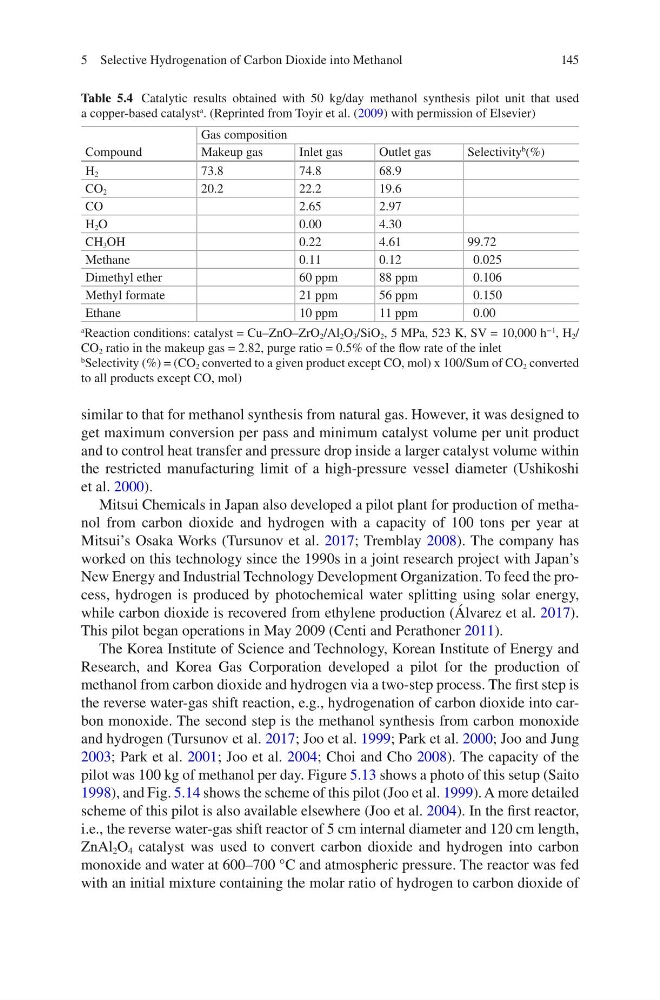
Table 5.4 Catalytic results obtained with 50 kg/day methanol synthesis pilot unit that used
a copper-based catalyst
a
. (Reprinted from Toyir et al. (2009) with permission of Elsevier)
Compound
Gas composition
Makeup gas
Inlet gas
Outlet gas
Selectivity
b
(%)
H 2
73.8
74.8
68.9
CO 2
20.2
22.2
19.6
CO
2.65
2.97
H 2 O
0.00
4.30
CH 3 OH
0.22
4.61
99.72
Methane
0.11
0.12
0.025
Dimethyl ether
60 ppm
88 ppm
0.106
Methyl formate
21 ppm
56 ppm
0.150
Ethane
10 ppm
11 ppm
0.00
a
Reaction conditions: catalyst = Cu–ZnO–ZrO 2 /Al 2 O 3 /SiO 2 , 5 MPa, 523 K, SV = 10,000 h
−1
, H 2 /
CO 2 ratio in the makeup gas = 2.82, purge ratio = 0.5% of the flow rate of the inlet
b
Selectivity (%) = (CO 2 converted to a given product except CO, mol) x 100/Sum of CO 2 converted
to all products except CO, mol)
5 Selective Hydrogenation of Carbon Dioxide into Methanol
similar to that for methanol synthesis from natural gas. However, it was designed to
get maximum conversion per pass and minimum catalyst volume per unit product
and to control heat transfer and pressure drop inside a larger catalyst volume within
the restricted manufacturing limit of a high-pressure vessel diameter (Ushikoshi
et al. 2000).
Mitsui Chemicals in Japan also developed a pilot plant for production of methanol from carbon dioxide and hydrogen with a capacity of 100 tons per year at
Mitsui’s Osaka Works (Tursunov et al. 2017; Tremblay 2008). The company has
worked on this technology since the 1990s in a joint research project with Japan’s
New Energy and Industrial Technology Development Organization. To feed the process, hydrogen is produced by photochemical water splitting using solar energy,
while carbon dioxide is recovered from ethylene production (Álvarez et al. 2017).
This pilot began operations in May 2009 (Centi and Perathoner 2011).
The Korea Institute of Science and Technology, Korean Institute of Energy and
Research, and Korea Gas Corporation developed a pilot for the production of
methanol from carbon dioxide and hydrogen via a two-step process. The first step is
the reverse water-gas shift reaction, e.g., hydrogenation of carbon dioxide into carbon monoxide. The second step is the methanol synthesis from carbon monoxide
and hydrogen (Tursunov et al. 2017; Joo et al. 1999; Park et al. 2000; Joo and Jung
2003; Park et al. 2001; Joo et al. 2004; Choi and Cho 2008). The capacity of the
pilot was 100 kg of methanol per day. Figure 5.13 shows a photo of this setup (Saito
1998), and Fig. 5.14 shows the scheme of this pilot (Joo et al. 1999). A more detailed
scheme of this pilot is also available elsewhere (Joo et al. 2004). In the first reactor,
i.e., the reverse water-gas shift reactor of 5 cm internal diameter and 120 cm length,
ZnAl 2 O 4 catalyst was used to convert carbon dioxide and hydrogen into carbon
monoxide and water at 600–700 °C and atmospheric pressure. The reactor was fed
with an initial mixture containing the molar ratio of hydrogen to carbon dioxide of
Table 5.4 Catalytic results obtained with 50 kg/day methanol synthesis pilot unit that used
a copper-based catalyst
a
. (Reprinted from Toyir et al. (2009) with permission of Elsevier)
Compound
Gas composition
Makeup gas
Inlet gas
Outlet gas
Selectivity
b
(%)
H 2
73.8
74.8
68.9
CO 2
20.2
22.2
19.6
CO
2.65
2.97
H 2 O
0.00
4.30
CH 3 OH
0.22
4.61
99.72
Methane
0.11
0.12
0.025
Dimethyl ether
60 ppm
88 ppm
0.106
Methyl formate
21 ppm
56 ppm
0.150
Ethane
10 ppm
11 ppm
0.00
a
Reaction conditions: catalyst = Cu–ZnO–ZrO 2 /Al 2 O 3 /SiO 2 , 5 MPa, 523 K, SV = 10,000 h
−1
, H 2 /
CO 2 ratio in the makeup gas = 2.82, purge ratio = 0.5% of the flow rate of the inlet
b
Selectivity (%) = (CO 2 converted to a given product except CO, mol) x 100/Sum of CO 2 converted
to all products except CO, mol)
5 Selective Hydrogenation of Carbon Dioxide into Methanol