

146
3 to 1. This step is endothermic and the reactor was heated with electric heaters. The
product from this step was mainly composed of carbon monoxide, hydrogen, and
unreacted carbon dioxide. This mixture was compressed to the working pressure of
the methanol synthesis process. This mixture passed through a catalyst bed of CuO–
ZnO–A1 2 O 3 at 250–300 °C and 50–70 atm to produce methanol (Joo et al. 1999,
2004). For this second step, four fixed-bed reactors, each of 5 cm internal diameter
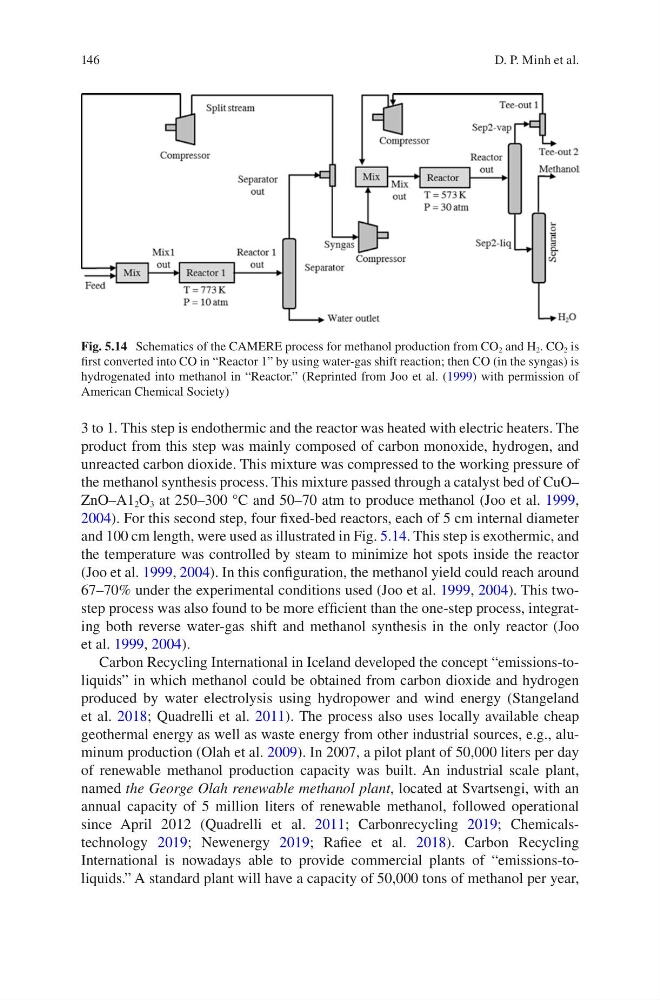
and 100 cm length, were used as illustrated in Fig. 5.14. This step is exothermic, and
the temperature was controlled by steam to minimize hot spots inside the reactor
(Joo et al. 1999, 2004). In this configuration, the methanol yield could reach around
67–70% under the experimental conditions used (Joo et al. 1999, 2004). This twostep process was also found to be more efficient than the one-step process, integrating both reverse water-gas shift and methanol synthesis in the only reactor (Joo
et al. 1999, 2004).
Carbon Recycling International in Iceland developed the concept “emissions-toliquids” in which methanol could be obtained from carbon dioxide and hydrogen
produced by water electrolysis using hydropower and wind energy (Stangeland
et al. 2018; Quadrelli et al. 2011). The process also uses locally available cheap
geothermal energy as well as waste energy from other industrial sources, e.g., aluminum production (Olah et al. 2009). In 2007, a pilot plant of 50,000 liters per day
of renewable methanol production capacity was built. An industrial scale plant,
named the George Olah renewable methanol plant, located at Svartsengi, with an
annual capacity of 5 million liters of renewable methanol, followed operational
since April 2012 (Quadrelli et al. 2011; Carbonrecycling 2019; Chemicalstechnology 2019; Newenergy 2019; Rafiee et al. 2018). Carbon Recycling
International is nowadays able to provide commercial plants of “emissions-toliquids.” A standard plant will have a capacity of 50,000 tons of methanol per year,
Fig. 5.14 Schematics of the CAMERE process for methanol production from CO 2 and H 2 . CO 2 is
first converted into CO in “Reactor 1” by using water-gas shift reaction; then CO (in the syngas) is
hydrogenated into methanol in “Reactor.” (Reprinted from Joo et al. (1999) with permission of
American Chemical Society)
D. P. Minh et al.
3 to 1. This step is endothermic and the reactor was heated with electric heaters. The
product from this step was mainly composed of carbon monoxide, hydrogen, and
unreacted carbon dioxide. This mixture was compressed to the working pressure of
the methanol synthesis process. This mixture passed through a catalyst bed of CuO–
ZnO–A1 2 O 3 at 250–300 °C and 50–70 atm to produce methanol (Joo et al. 1999,
2004). For this second step, four fixed-bed reactors, each of 5 cm internal diameter
and 100 cm length, were used as illustrated in Fig. 5.14. This step is exothermic, and
the temperature was controlled by steam to minimize hot spots inside the reactor
(Joo et al. 1999, 2004). In this configuration, the methanol yield could reach around
67–70% under the experimental conditions used (Joo et al. 1999, 2004). This twostep process was also found to be more efficient than the one-step process, integrating both reverse water-gas shift and methanol synthesis in the only reactor (Joo
et al. 1999, 2004).
Carbon Recycling International in Iceland developed the concept “emissions-toliquids” in which methanol could be obtained from carbon dioxide and hydrogen
produced by water electrolysis using hydropower and wind energy (Stangeland
et al. 2018; Quadrelli et al. 2011). The process also uses locally available cheap
geothermal energy as well as waste energy from other industrial sources, e.g., aluminum production (Olah et al. 2009). In 2007, a pilot plant of 50,000 liters per day
of renewable methanol production capacity was built. An industrial scale plant,
named the George Olah renewable methanol plant, located at Svartsengi, with an
annual capacity of 5 million liters of renewable methanol, followed operational
since April 2012 (Quadrelli et al. 2011; Carbonrecycling 2019; Chemicalstechnology 2019; Newenergy 2019; Rafiee et al. 2018). Carbon Recycling
International is nowadays able to provide commercial plants of “emissions-toliquids.” A standard plant will have a capacity of 50,000 tons of methanol per year,
Fig. 5.14 Schematics of the CAMERE process for methanol production from CO 2 and H 2 . CO 2 is
first converted into CO in “Reactor 1” by using water-gas shift reaction; then CO (in the syngas) is
hydrogenated into methanol in “Reactor.” (Reprinted from Joo et al. (1999) with permission of
American Chemical Society)
D. P. Minh et al.