

144
shape of 3 mm diameter and 3 mm height. Prior to the test, the catalyst was reduced
with a mixture containing 10 vol.% of hydrogen in helium at 300 °C under 5 MPa
for 2 h. The methanol synthesis was performed at 250 °C under the total pressure of
5 MPa with a molar ratio of hydrogen to carbon dioxide 3 to 1 and a space velocity
of 10,000 h
−1
. As represented in Table 5.4, the principal results obtained from this
pilot included a relative low conversion, e.g., hydrogen and carbon dioxide in the
inlet gas equal to 73.8 and 20.2%, respectively, and in the outlet gas equal to 68.9
and 19.6%, respectively, but a very high selectivity to methanol, e.g., above 99%
(Ushikoshi et al. 2000; Toyir et al. 2009).
Basing on the kinetic equations and the selectivity to methanol over the developed catalyst obtained with the 500 kg per day plant, a methanol synthesis plant
from carbon dioxide and hydrogen was designed for a total capacity of 8000 tons
per day (Ushikoshi et al. 2000). This plant was composed of two train facilities,
each having a capacity of 4000 tons per day. A scheme of this plant is available
elsewhere (Ushikoshi et al. 2000). The reactor used was a multistage indirect cooling and radial flow, e.g., MRF-Z®, reactor (Ushikoshi et al. 2000). It was almost
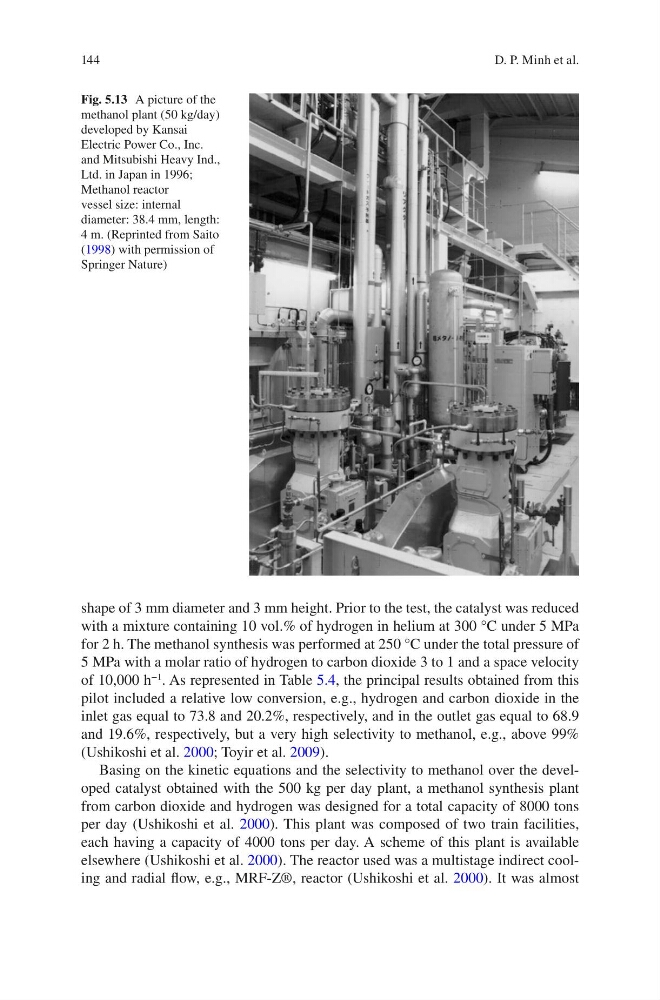
Fig. 5.13 A picture of the
methanol plant (50 kg/day)
developed by Kansai
Electric Power Co., Inc.
and Mitsubishi Heavy Ind.,
Ltd. in Japan in 1996;
Methanol reactor
vessel size: internal
diameter: 38.4 mm, length:
4 m. (Reprinted from Saito
(1998) with permission of
Springer Nature)
D. P. Minh et al.
shape of 3 mm diameter and 3 mm height. Prior to the test, the catalyst was reduced
with a mixture containing 10 vol.% of hydrogen in helium at 300 °C under 5 MPa
for 2 h. The methanol synthesis was performed at 250 °C under the total pressure of
5 MPa with a molar ratio of hydrogen to carbon dioxide 3 to 1 and a space velocity
of 10,000 h
−1
. As represented in Table 5.4, the principal results obtained from this
pilot included a relative low conversion, e.g., hydrogen and carbon dioxide in the
inlet gas equal to 73.8 and 20.2%, respectively, and in the outlet gas equal to 68.9
and 19.6%, respectively, but a very high selectivity to methanol, e.g., above 99%
(Ushikoshi et al. 2000; Toyir et al. 2009).
Basing on the kinetic equations and the selectivity to methanol over the developed catalyst obtained with the 500 kg per day plant, a methanol synthesis plant
from carbon dioxide and hydrogen was designed for a total capacity of 8000 tons
per day (Ushikoshi et al. 2000). This plant was composed of two train facilities,
each having a capacity of 4000 tons per day. A scheme of this plant is available
elsewhere (Ushikoshi et al. 2000). The reactor used was a multistage indirect cooling and radial flow, e.g., MRF-Z®, reactor (Ushikoshi et al. 2000). It was almost
Fig. 5.13 A picture of the
methanol plant (50 kg/day)
developed by Kansai
Electric Power Co., Inc.
and Mitsubishi Heavy Ind.,
Ltd. in Japan in 1996;
Methanol reactor
vessel size: internal
diameter: 38.4 mm, length:
4 m. (Reprinted from Saito
(1998) with permission of
Springer Nature)
D. P. Minh et al.