

143
5.5 Selective Hydrogenation of Carbon Dioxide
into Methanol: Examples of Industrial Pilot Production
The deployment of methanol synthesis from carbon dioxide at pilot and commercial
plant scales has started in the 1980s. This section summarizes some representative
facilities.
Saito’s research team (1998; Ushikoshi et al. 2000; Toyir et al. 2009; Wu et al.
1998; Luo et al. 1998; Saito et al. 1997) reported the development of a stable catalyst based on Cu–ZnO–Al 2 O 3 for the direct hydrogenation of carbon dioxide into
methanol, work initially supported by Kansai Electric Power Co., Inc. and Mitsubishi
Heavy Ind., Ltd. The catalyst was firstly tested in a fixed-bed reactor with a catalyst
volume of 100 mL. The methanol yield reached 90% under the conditions of 512 K,
8 MPa, and the recycle ratio of 4. The work was followed by a bench-scale plant that
was constructed in 1998 with methanol production capacity of 50 kg per day. A
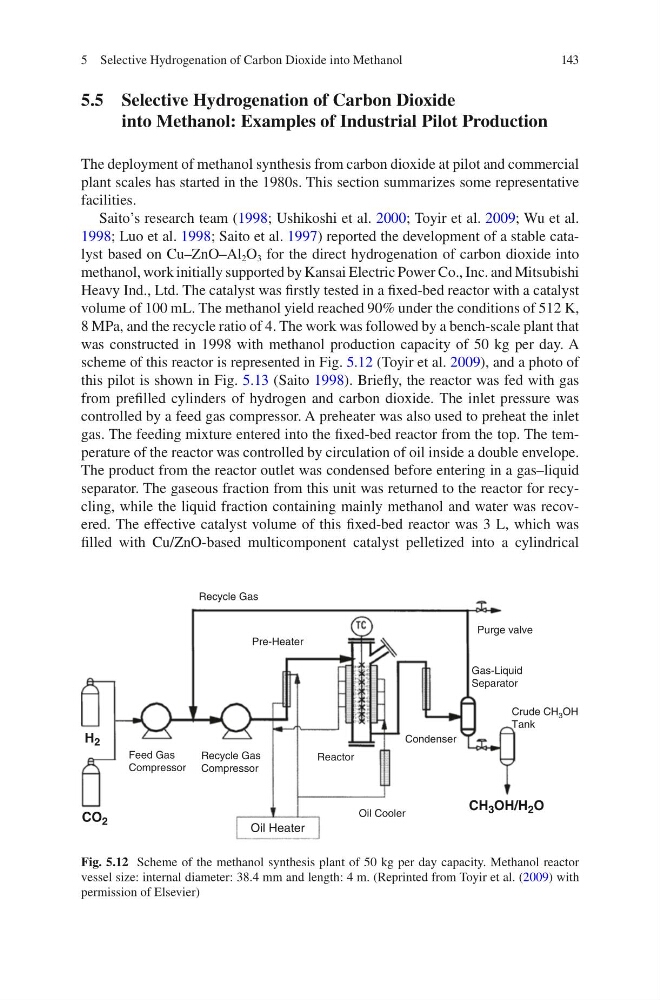
scheme of this reactor is represented in Fig. 5.12 (Toyir et al. 2009), and a photo of
this pilot is shown in Fig. 5.13 (Saito 1998). Briefly, the reactor was fed with gas
from prefilled cylinders of hydrogen and carbon dioxide. The inlet pressure was
controlled by a feed gas compressor. A preheater was also used to preheat the inlet
gas. The feeding mixture entered into the fixed-bed reactor from the top. The temperature of the reactor was controlled by circulation of oil inside a double envelope.
The product from the reactor outlet was condensed before entering in a gas–liquid
separator. The gaseous fraction from this unit was returned to the reactor for recycling, while the liquid fraction containing mainly methanol and water was recovered. The effective catalyst volume of this fixed-bed reactor was 3 L, which was
filled with Cu/ZnO-based multicomponent catalyst pelletized into a cylindrical
Recycle Gas
Pre-Heater
Oil Cooler
Oil Heater
CO 2
CH 3 OH/H 2 O
H 2
Condenser
Purge valve
Gas-Liquid
Separator
Reactor
Recycle Gas
Compressor
Feed Gas
Compressor
Crude CH 3 OH
Tank
Fig. 5.12 Scheme of the methanol synthesis plant of 50 kg per day capacity. Methanol reactor
vessel size: internal diameter: 38.4 mm and length: 4 m. (Reprinted from Toyir et al. (2009) with
permission of Elsevier)
5 Selective Hydrogenation of Carbon Dioxide into Methanol
5.5 Selective Hydrogenation of Carbon Dioxide
into Methanol: Examples of Industrial Pilot Production
The deployment of methanol synthesis from carbon dioxide at pilot and commercial
plant scales has started in the 1980s. This section summarizes some representative
facilities.
Saito’s research team (1998; Ushikoshi et al. 2000; Toyir et al. 2009; Wu et al.
1998; Luo et al. 1998; Saito et al. 1997) reported the development of a stable catalyst based on Cu–ZnO–Al 2 O 3 for the direct hydrogenation of carbon dioxide into
methanol, work initially supported by Kansai Electric Power Co., Inc. and Mitsubishi
Heavy Ind., Ltd. The catalyst was firstly tested in a fixed-bed reactor with a catalyst
volume of 100 mL. The methanol yield reached 90% under the conditions of 512 K,
8 MPa, and the recycle ratio of 4. The work was followed by a bench-scale plant that
was constructed in 1998 with methanol production capacity of 50 kg per day. A
scheme of this reactor is represented in Fig. 5.12 (Toyir et al. 2009), and a photo of
this pilot is shown in Fig. 5.13 (Saito 1998). Briefly, the reactor was fed with gas
from prefilled cylinders of hydrogen and carbon dioxide. The inlet pressure was
controlled by a feed gas compressor. A preheater was also used to preheat the inlet
gas. The feeding mixture entered into the fixed-bed reactor from the top. The temperature of the reactor was controlled by circulation of oil inside a double envelope.
The product from the reactor outlet was condensed before entering in a gas–liquid
separator. The gaseous fraction from this unit was returned to the reactor for recycling, while the liquid fraction containing mainly methanol and water was recovered. The effective catalyst volume of this fixed-bed reactor was 3 L, which was
filled with Cu/ZnO-based multicomponent catalyst pelletized into a cylindrical
Recycle Gas
Pre-Heater
Oil Cooler
Oil Heater
CO 2
CH 3 OH/H 2 O
H 2
Condenser
Purge valve
Gas-Liquid
Separator
Reactor
Recycle Gas
Compressor
Feed Gas
Compressor
Crude CH 3 OH
Tank
Fig. 5.12 Scheme of the methanol synthesis plant of 50 kg per day capacity. Methanol reactor
vessel size: internal diameter: 38.4 mm and length: 4 m. (Reprinted from Toyir et al. (2009) with
permission of Elsevier)
5 Selective Hydrogenation of Carbon Dioxide into Methanol