

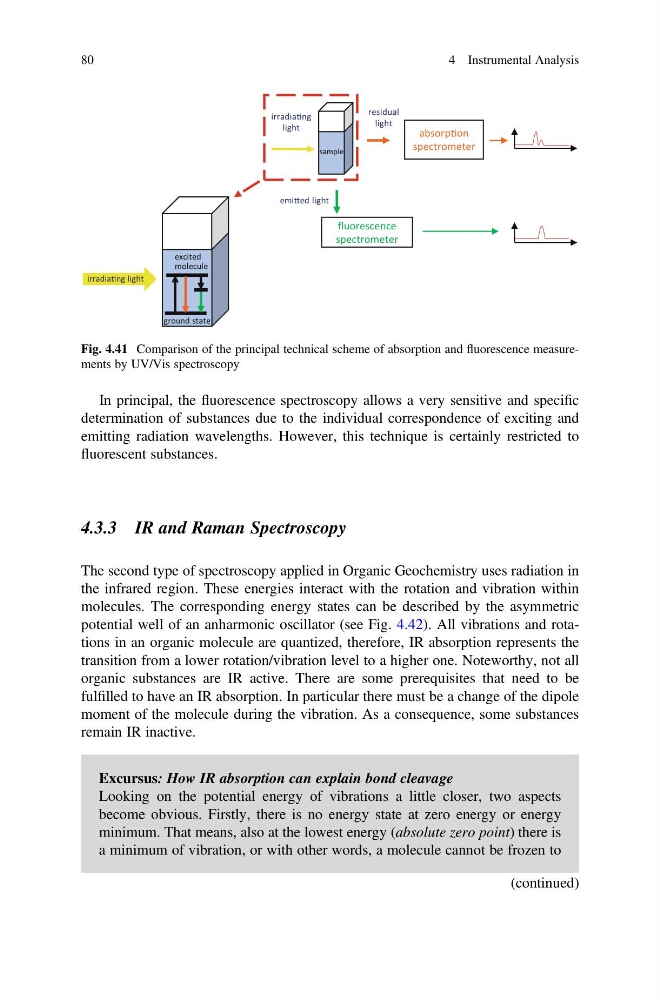
In principal, the fluorescence spectroscopy allows a very sensitive and specific
determination of substances due to the individual correspondence of exciting and
emitting radiation wavelengths. However, this technique is certainly restricted to
fluorescent substances.
4.3.3 IR and Raman Spectroscopy
The second type of spectroscopy applied in Organic Geochemistry uses radiation in
the infrared region. These energies interact with the rotation and vibration within
molecules. The corresponding energy states can be described by the asymmetric
potential well of an anharmonic oscillator (see Fig. 4.42). All vibrations and rotations in an organic molecule are quantized, therefore, IR absorption represents the
transition from a lower rotation/vibration level to a higher one. Noteworthy, not all
organic substances are IR active. There are some prerequisites that need to be
fulfilled to have an IR absorption. In particular there must be a change of the dipole
moment of the molecule during the vibration. As a consequence, some substances
remain IR inactive.
Excursus: How IR absorption can explain bond cleavage
Looking on the potential energy of vibrations a little closer, two aspects
become obvious. Firstly, there is no energy state at zero energy or energy
minimum. That means, also at the lowest energy (absolute zero point) there is
a minimum of vibration, or with other words, a molecule cannot be frozen to
(continued)
fluorescence
spectrometer
absorpƟon
spectrometer
irradiaƟng
light
residual
light
emiƩed light
ground state
excited
molecule
irradiaƟng light
sample
Fig. 4.41 Comparison of the principal technical scheme of absorption and fluorescence measurements by UV/Vis spectroscopy
80
4 Instrumental Analysis
determination of substances due to the individual correspondence of exciting and
emitting radiation wavelengths. However, this technique is certainly restricted to
fluorescent substances.
4.3.3 IR and Raman Spectroscopy
The second type of spectroscopy applied in Organic Geochemistry uses radiation in
the infrared region. These energies interact with the rotation and vibration within
molecules. The corresponding energy states can be described by the asymmetric
potential well of an anharmonic oscillator (see Fig. 4.42). All vibrations and rotations in an organic molecule are quantized, therefore, IR absorption represents the
transition from a lower rotation/vibration level to a higher one. Noteworthy, not all
organic substances are IR active. There are some prerequisites that need to be
fulfilled to have an IR absorption. In particular there must be a change of the dipole
moment of the molecule during the vibration. As a consequence, some substances
remain IR inactive.
Excursus: How IR absorption can explain bond cleavage
Looking on the potential energy of vibrations a little closer, two aspects
become obvious. Firstly, there is no energy state at zero energy or energy
minimum. That means, also at the lowest energy (absolute zero point) there is
a minimum of vibration, or with other words, a molecule cannot be frozen to
(continued)
fluorescence
spectrometer
absorpƟon
spectrometer
irradiaƟng
light
residual
light
emiƩed light
ground state
excited
molecule
irradiaƟng light
sample
Fig. 4.41 Comparison of the principal technical scheme of absorption and fluorescence measurements by UV/Vis spectroscopy
80
4 Instrumental Analysis