

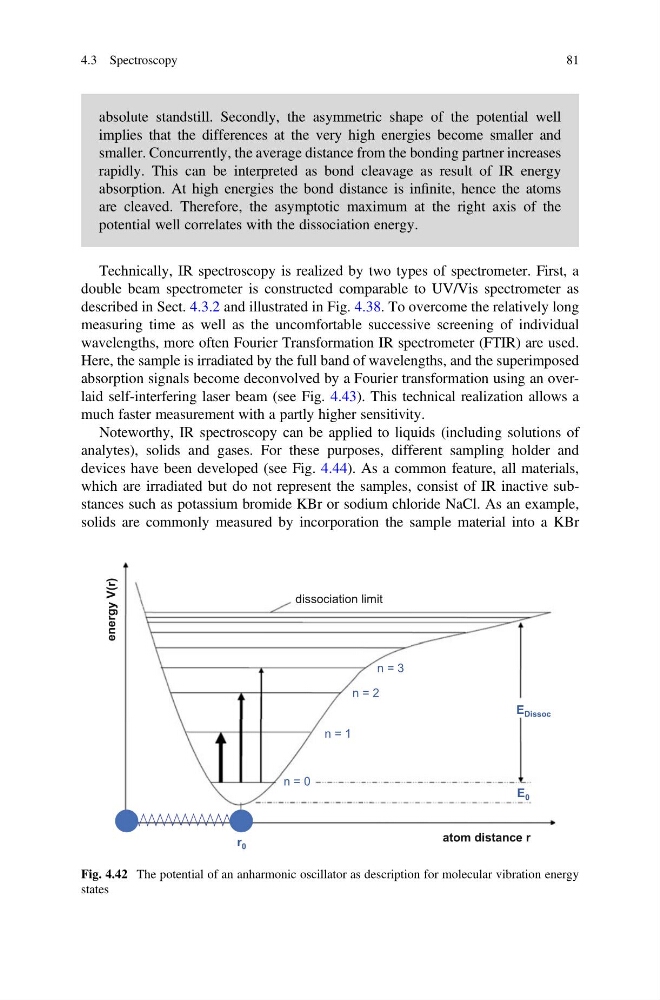
absolute standstill. Secondly, the asymmetric shape of the potential well
implies that the differences at the very high energies become smaller and
smaller. Concurrently, the average distance from the bonding partner increases
rapidly. This can be interpreted as bond cleavage as result of IR energy
absorption. At high energies the bond distance is infinite, hence the atoms
are cleaved. Therefore, the asymptotic maximum at the right axis of the
potential well correlates with the dissociation energy.
Technically, IR spectroscopy is realized by two types of spectrometer. First, a
double beam spectrometer is constructed comparable to UV/Vis spectrometer as
described in Sect. 4.3.2 and illustrated in Fig. 4.38. To overcome the relatively long
measuring time as well as the uncomfortable successive screening of individual
wavelengths, more often Fourier Transformation IR spectrometer (FTIR) are used.
Here, the sample is irradiated by the full band of wavelengths, and the superimposed
absorption signals become deconvolved by a Fourier transformation using an overlaid self-interfering laser beam (see Fig. 4.43). This technical realization allows a
much faster measurement with a partly higher sensitivity.
Noteworthy, IR spectroscopy can be applied to liquids (including solutions of
analytes), solids and gases. For these purposes, different sampling holder and
devices have been developed (see Fig. 4.44). As a common feature, all materials,
which are irradiated but do not represent the samples, consist of IR inactive substances such as potassium bromide KBr or sodium chloride NaCl. As an example,
solids are commonly measured by incorporation the sample material into a KBr
energy V(r)
dissociation limit
atom distance r
E Dissoc
E 0
r 0
n = 0
n = 1
n = 2
n = 3
Fig. 4.42 The potential of an anharmonic oscillator as description for molecular vibration energy
states
4.3 Spectroscopy
81
implies that the differences at the very high energies become smaller and
smaller. Concurrently, the average distance from the bonding partner increases
rapidly. This can be interpreted as bond cleavage as result of IR energy
absorption. At high energies the bond distance is infinite, hence the atoms
are cleaved. Therefore, the asymptotic maximum at the right axis of the
potential well correlates with the dissociation energy.
Technically, IR spectroscopy is realized by two types of spectrometer. First, a
double beam spectrometer is constructed comparable to UV/Vis spectrometer as
described in Sect. 4.3.2 and illustrated in Fig. 4.38. To overcome the relatively long
measuring time as well as the uncomfortable successive screening of individual
wavelengths, more often Fourier Transformation IR spectrometer (FTIR) are used.
Here, the sample is irradiated by the full band of wavelengths, and the superimposed
absorption signals become deconvolved by a Fourier transformation using an overlaid self-interfering laser beam (see Fig. 4.43). This technical realization allows a
much faster measurement with a partly higher sensitivity.
Noteworthy, IR spectroscopy can be applied to liquids (including solutions of
analytes), solids and gases. For these purposes, different sampling holder and
devices have been developed (see Fig. 4.44). As a common feature, all materials,
which are irradiated but do not represent the samples, consist of IR inactive substances such as potassium bromide KBr or sodium chloride NaCl. As an example,
solids are commonly measured by incorporation the sample material into a KBr
energy V(r)
dissociation limit
atom distance r
E Dissoc
E 0
r 0
n = 0
n = 1
n = 2
n = 3
Fig. 4.42 The potential of an anharmonic oscillator as description for molecular vibration energy
states
4.3 Spectroscopy
81