

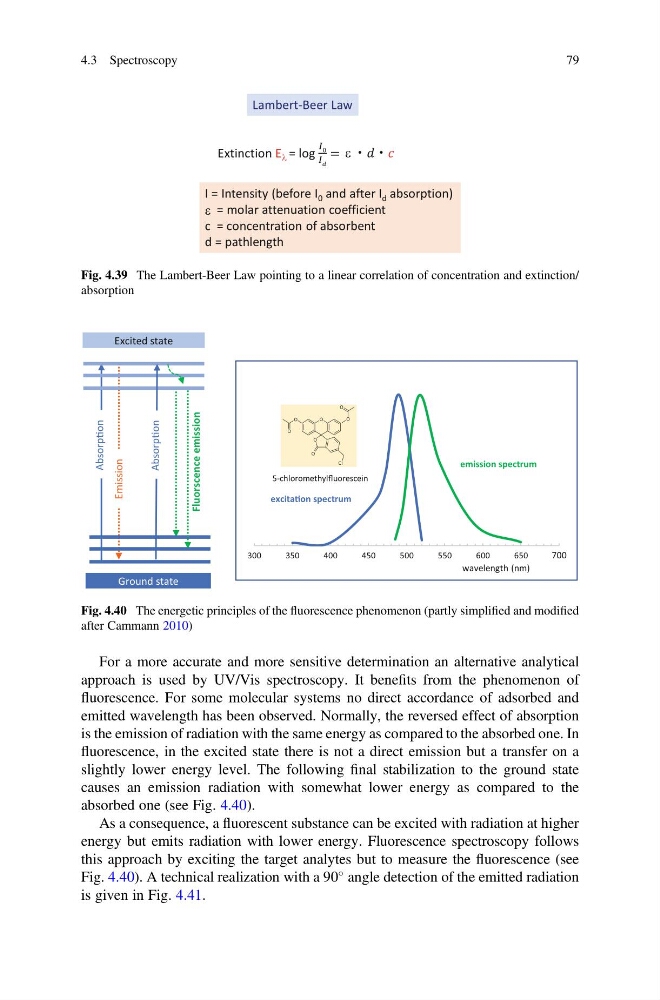
For a more accurate and more sensitive determination an alternative analytical
approach is used by UV/Vis spectroscopy. It benefits from the phenomenon of
fluorescence. For some molecular systems no direct accordance of adsorbed and
emitted wavelength has been observed. Normally, the reversed effect of absorption
is the emission of radiation with the same energy as compared to the absorbed one. In
fluorescence, in the excited state there is not a direct emission but a transfer on a
slightly lower energy level. The following final stabilization to the ground state
causes an emission radiation with somewhat lower energy as compared to the
absorbed one (see Fig. 4.40).
As a consequence, a fluorescent substance can be excited with radiation at higher
energy but emits radiation with lower energy. Fluorescence spectroscopy follows
this approach by exciting the target analytes but to measure the fluorescence (see
Fig. 4.40). A technical realization with a 90
angle detection of the emitted radiation
is given in Fig. 4.41.
Extinction E = log
Lambert-Beer Law
I = Intensity (before I 0 and after I d absorption)
= molar attenuation coefficient
c = concentration of absorbent
d = pathlength
Fig. 4.39 The Lambert-Beer Law pointing to a linear correlation of concentration and extinction/
absorption
300
350
400
450
500
550
600
650
700
emission spectrum
excitaƟon spectrum
wavelength (nm)
5-chloromethylfluorescein
O
O
O
O
O
Cl
O
O
Excited state
Ground state
Emission
AbsorpƟon
Fluorscence emission
AbsorpƟon
Fig. 4.40 The energetic principles of the fluorescence phenomenon (partly simplified and modified
after Cammann 2010)
4.3 Spectroscopy
79
approach is used by UV/Vis spectroscopy. It benefits from the phenomenon of
fluorescence. For some molecular systems no direct accordance of adsorbed and
emitted wavelength has been observed. Normally, the reversed effect of absorption
is the emission of radiation with the same energy as compared to the absorbed one. In
fluorescence, in the excited state there is not a direct emission but a transfer on a
slightly lower energy level. The following final stabilization to the ground state
causes an emission radiation with somewhat lower energy as compared to the
absorbed one (see Fig. 4.40).
As a consequence, a fluorescent substance can be excited with radiation at higher
energy but emits radiation with lower energy. Fluorescence spectroscopy follows
this approach by exciting the target analytes but to measure the fluorescence (see
Fig. 4.40). A technical realization with a 90
angle detection of the emitted radiation
is given in Fig. 4.41.
Extinction E = log
Lambert-Beer Law
I = Intensity (before I 0 and after I d absorption)
= molar attenuation coefficient
c = concentration of absorbent
d = pathlength
Fig. 4.39 The Lambert-Beer Law pointing to a linear correlation of concentration and extinction/
absorption
300
350
400
450
500
550
600
650
700
emission spectrum
excitaƟon spectrum
wavelength (nm)
5-chloromethylfluorescein
O
O
O
O
O
Cl
O
O
Excited state
Ground state
Emission
AbsorpƟon
Fluorscence emission
AbsorpƟon
Fig. 4.40 The energetic principles of the fluorescence phenomenon (partly simplified and modified
after Cammann 2010)
4.3 Spectroscopy
79