

precondition for a successful ionization. Once an ion is generated, it needs to become
stabilized since ions are highly reactive. In order to avoid recombination of ions or
secondary reactions the ions need to be kept in high vacuum, because under this
condition the collision probability for the individual particles is minimized. Therefore, all mass spectrometers are equipped with high vacuum pumps producing low
pressures around 10
À5 to 10
À6 bar. This high vacuum can be easily realized in
GC/MS systems, since the overall gas flow into the ion source is low (around 1 mL/
min). Therefore, ionization in GC/MS systems is performed directly in vacuo.
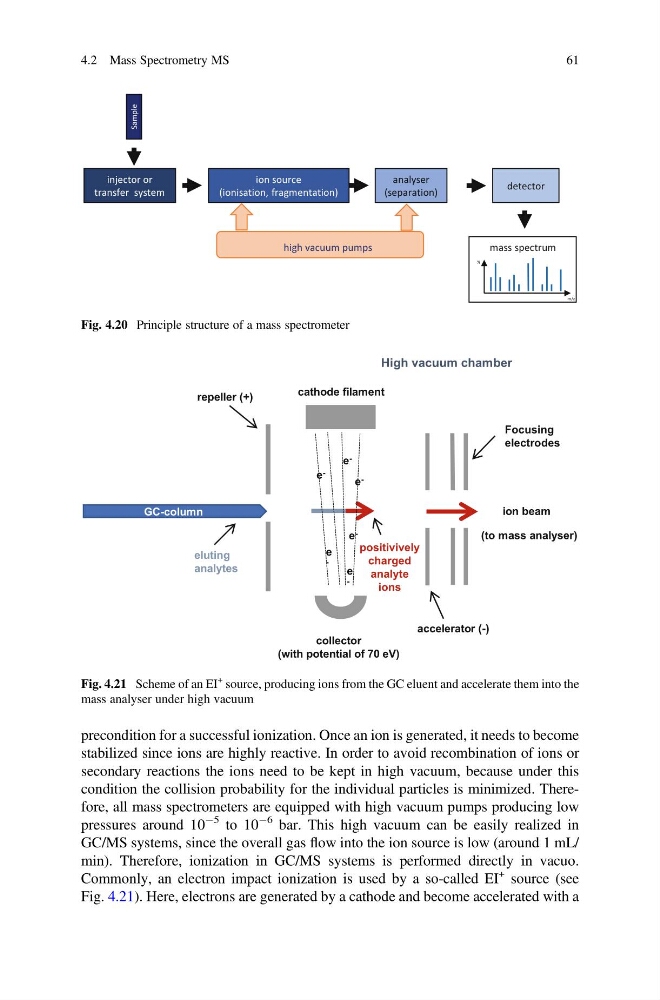
Commonly, an electron impact ionization is used by a so-called EI
+ source (see
Fig. 4.21). Here, electrons are generated by a cathode and become accelerated with a
Sample
injector or
transfer system
ion source
(ionisation, fragmentation)
analyser
(separation)
detector
mass spectrum
%
m/z
high vacuum pumps
Fig. 4.20 Principle structure of a mass spectrometer
GC-column
High vacuum chamber
e -
e -
e -
e -
e
-
e
-
ion beam
(to mass analyser)
Focusing
electrodes
cathode filament
repeller (+)
collector
(with potential of 70 eV)
positivively
charged
analyte
ions
accelerator (-)
eluting
analytes
Fig. 4.21 Scheme of an EI
+ source, producing ions from the GC eluent and accelerate them into the
mass analyser under high vacuum
4.2 Mass Spectrometry MS
61
stabilized since ions are highly reactive. In order to avoid recombination of ions or
secondary reactions the ions need to be kept in high vacuum, because under this
condition the collision probability for the individual particles is minimized. Therefore, all mass spectrometers are equipped with high vacuum pumps producing low
pressures around 10
À5 to 10
À6 bar. This high vacuum can be easily realized in
GC/MS systems, since the overall gas flow into the ion source is low (around 1 mL/
min). Therefore, ionization in GC/MS systems is performed directly in vacuo.
Commonly, an electron impact ionization is used by a so-called EI
+ source (see
Fig. 4.21). Here, electrons are generated by a cathode and become accelerated with a
Sample
injector or
transfer system
ion source
(ionisation, fragmentation)
analyser
(separation)
detector
mass spectrum
%
m/z
high vacuum pumps
Fig. 4.20 Principle structure of a mass spectrometer
GC-column
High vacuum chamber
e -
e -
e -
e -
e
-
e
-
ion beam
(to mass analyser)
Focusing
electrodes
cathode filament
repeller (+)
collector
(with potential of 70 eV)
positivively
charged
analyte
ions
accelerator (-)
eluting
analytes
Fig. 4.21 Scheme of an EI
+ source, producing ions from the GC eluent and accelerate them into the
mass analyser under high vacuum
4.2 Mass Spectrometry MS
61