

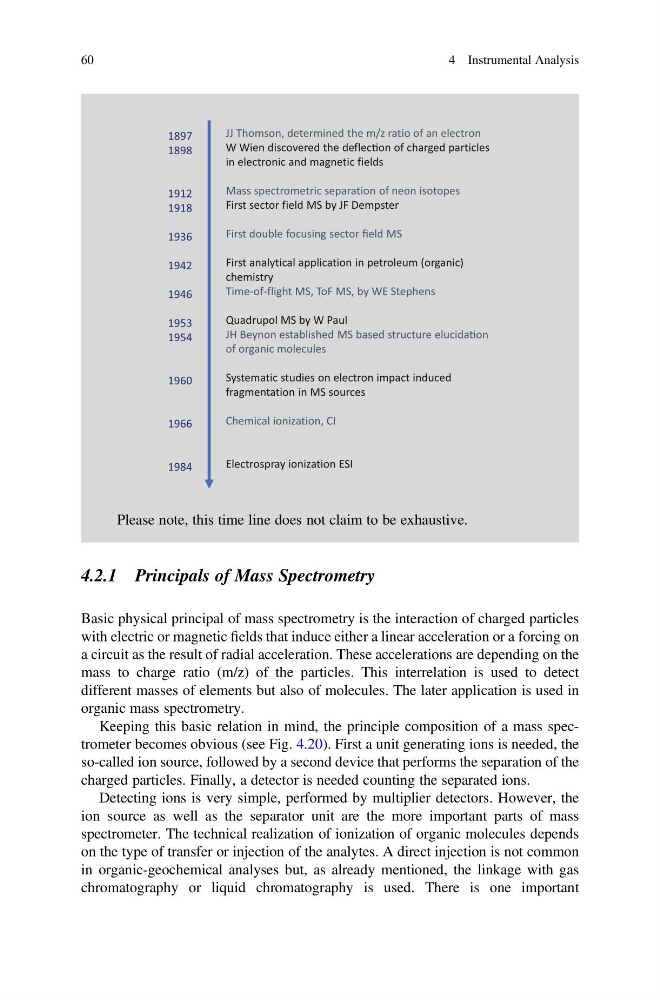
1897
1898
1912
1918
1936
1942
1946
1953
1954
1960
1966
1984
JJ Thomson, determined the m/z rat io of an electron
W Wien discovered the def lecƟon of charged part icles
in electronic and magnet ic f ields
Mass spectrometric separat ion of neon isotopes
First sector f ield MS by JF Dempster
First double focusing sector field MS
First analyt ical applicat ion in petroleum (organic)
chemistry
Time-of-f light MS, ToF MS, by WE Stephens
Quadrupol MS by W Paul
JH Beynon established MS based structure elucidaƟon
of organic molecules
Systemat ic studies on electron impact induced
fragmentat ion in MS sources
Chemical ionizat ion, CI
Electrospray ionizat ion ESI
Please note, this time line does not claim to be exhaustive.
4.2.1 Principals of Mass Spectrometry
Basic physical principal of mass spectrometry is the interaction of charged particles
with electric or magnetic fields that induce either a linear acceleration or a forcing on
a circuit as the result of radial acceleration. These accelerations are depending on the
mass to charge ratio (m/z) of the particles. This interrelation is used to detect
different masses of elements but also of molecules. The later application is used in
organic mass spectrometry.
Keeping this basic relation in mind, the principle composition of a mass spectrometer becomes obvious (see Fig. 4.20). First a unit generating ions is needed, the
so-called ion source, followed by a second device that performs the separation of the
charged particles. Finally, a detector is needed counting the separated ions.
Detecting ions is very simple, performed by multiplier detectors. However, the
ion source as well as the separator unit are the more important parts of mass
spectrometer. The technical realization of ionization of organic molecules depends
on the type of transfer or injection of the analytes. A direct injection is not common
in organic-geochemical analyses but, as already mentioned, the linkage with gas
chromatography or liquid chromatography is used. There is one important
60
4 Instrumental Analysis
1898
1912
1918
1936
1942
1946
1953
1954
1960
1966
1984
JJ Thomson, determined the m/z rat io of an electron
W Wien discovered the def lecƟon of charged part icles
in electronic and magnet ic f ields
Mass spectrometric separat ion of neon isotopes
First sector f ield MS by JF Dempster
First double focusing sector field MS
First analyt ical applicat ion in petroleum (organic)
chemistry
Time-of-f light MS, ToF MS, by WE Stephens
Quadrupol MS by W Paul
JH Beynon established MS based structure elucidaƟon
of organic molecules
Systemat ic studies on electron impact induced
fragmentat ion in MS sources
Chemical ionizat ion, CI
Electrospray ionizat ion ESI
Please note, this time line does not claim to be exhaustive.
4.2.1 Principals of Mass Spectrometry
Basic physical principal of mass spectrometry is the interaction of charged particles
with electric or magnetic fields that induce either a linear acceleration or a forcing on
a circuit as the result of radial acceleration. These accelerations are depending on the
mass to charge ratio (m/z) of the particles. This interrelation is used to detect
different masses of elements but also of molecules. The later application is used in
organic mass spectrometry.
Keeping this basic relation in mind, the principle composition of a mass spectrometer becomes obvious (see Fig. 4.20). First a unit generating ions is needed, the
so-called ion source, followed by a second device that performs the separation of the
charged particles. Finally, a detector is needed counting the separated ions.
Detecting ions is very simple, performed by multiplier detectors. However, the
ion source as well as the separator unit are the more important parts of mass
spectrometer. The technical realization of ionization of organic molecules depends
on the type of transfer or injection of the analytes. A direct injection is not common
in organic-geochemical analyses but, as already mentioned, the linkage with gas
chromatography or liquid chromatography is used. There is one important
60
4 Instrumental Analysis