

4.2 Mass Spectrometry MS
Outlook
Mass spectrometry is the most important method for identification of organic
compounds in Organic Geochemistry. In combination with gas chromatography (as GC/MS) it is also the basic method for quantification. Fundamental
technical aspects and applications are presented and discussed here.
Mass spectrometry (MS) is the by far most important instrumental analysis technique in Organic Geochemistry. Its importance is based on two major characteristics:
mass spectrometry is fast and very sensitive. The fast measuring allowed at a very
early stage (mid of the twentieth century) to link mass spectrometry with the very
efficient separation technique of gas chromatography forming so-called GC/MS
systems. In addition, the high sensitivity of detection fits ideally the sensitivity of
capillary GC. As a consequence, these sensitive GC/MS systems opened a wide field
for analyzing organic compounds in complex mixtures and at low concentration
levels.
Excursus: Brief historical development of mass spectrometry
As all other analytical techniques mass spectrometry has been developed over
decades. To get an impression of this process, a brief historical summary is
given below that points to some important steps in mass spectrometry from the
discovery of the fundamental physical processes towards modern technical
set-ups:
(continued)
Isocratic and gradient elution
time
isocraƟc eluƟon
gradient eluƟon
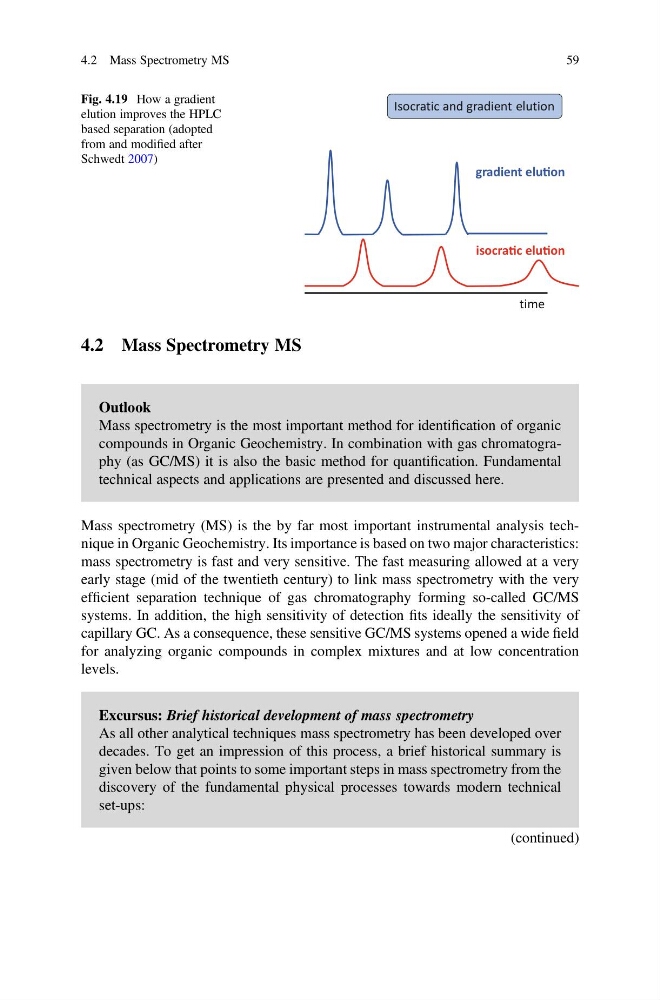
Fig. 4.19 How a gradient
elution improves the HPLC
based separation (adopted
from and modified after
Schwedt 2007)
4.2 Mass Spectrometry MS
59
Outlook
Mass spectrometry is the most important method for identification of organic
compounds in Organic Geochemistry. In combination with gas chromatography (as GC/MS) it is also the basic method for quantification. Fundamental
technical aspects and applications are presented and discussed here.
Mass spectrometry (MS) is the by far most important instrumental analysis technique in Organic Geochemistry. Its importance is based on two major characteristics:
mass spectrometry is fast and very sensitive. The fast measuring allowed at a very
early stage (mid of the twentieth century) to link mass spectrometry with the very
efficient separation technique of gas chromatography forming so-called GC/MS
systems. In addition, the high sensitivity of detection fits ideally the sensitivity of
capillary GC. As a consequence, these sensitive GC/MS systems opened a wide field
for analyzing organic compounds in complex mixtures and at low concentration
levels.
Excursus: Brief historical development of mass spectrometry
As all other analytical techniques mass spectrometry has been developed over
decades. To get an impression of this process, a brief historical summary is
given below that points to some important steps in mass spectrometry from the
discovery of the fundamental physical processes towards modern technical
set-ups:
(continued)
Isocratic and gradient elution
time
isocraƟc eluƟon
gradient eluƟon
Fig. 4.19 How a gradient
elution improves the HPLC
based separation (adopted
from and modified after
Schwedt 2007)
4.2 Mass Spectrometry MS
59