

a trend towards smaller columns became obvious resulting in ultra-high-performance liquid chromatography UHPLC using columns with diameters down to
2 mm but also higher pressure (up to 1200 bar).
General Note
HPLC represents a chromatographic method highly complementary to GC. It
allows to detect those substance classes that are not accessible for analysis by
GC—the polar compounds and the higher molecular weight compounds.
The effectiveness of HPLC separation depends in particular on the dimension and
quality of the particles acting as solid phase. Particle size and porosity are main
parameters. HPLC normally uses particles around 5 μm, whereas UHPLC is
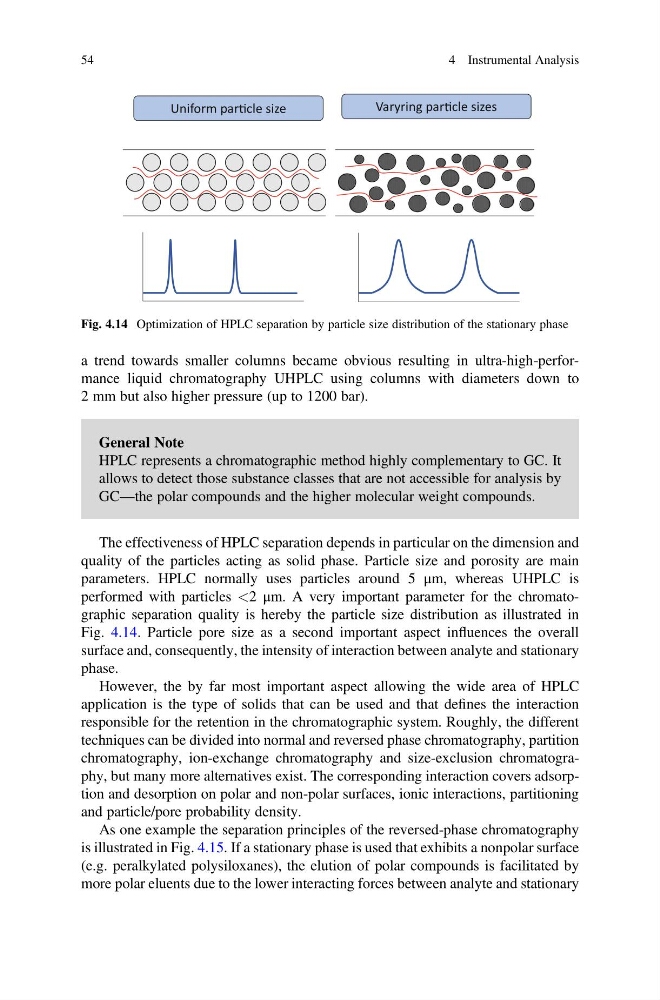
performed with particles <2 μm. A very important parameter for the chromatographic separation quality is hereby the particle size distribution as illustrated in
Fig. 4.14. Particle pore size as a second important aspect influences the overall
surface and, consequently, the intensity of interaction between analyte and stationary
phase.
However, the by far most important aspect allowing the wide area of HPLC
application is the type of solids that can be used and that defines the interaction
responsible for the retention in the chromatographic system. Roughly, the different
techniques can be divided into normal and reversed phase chromatography, partition
chromatography, ion-exchange chromatography and size-exclusion chromatography, but many more alternatives exist. The corresponding interaction covers adsorption and desorption on polar and non-polar surfaces, ionic interactions, partitioning
and particle/pore probability density.
As one example the separation principles of the reversed-phase chromatography
is illustrated in Fig. 4.15. If a stationary phase is used that exhibits a nonpolar surface
(e.g. peralkylated polysiloxanes), the elution of polar compounds is facilitated by
more polar eluents due to the lower interacting forces between analyte and stationary
Uniform parƟcle size
Varyring parƟcle sizes
Fig. 4.14 Optimization of HPLC separation by particle size distribution of the stationary phase
54
4 Instrumental Analysis
2 mm but also higher pressure (up to 1200 bar).
General Note
HPLC represents a chromatographic method highly complementary to GC. It
allows to detect those substance classes that are not accessible for analysis by
GC—the polar compounds and the higher molecular weight compounds.
The effectiveness of HPLC separation depends in particular on the dimension and
quality of the particles acting as solid phase. Particle size and porosity are main
parameters. HPLC normally uses particles around 5 μm, whereas UHPLC is
performed with particles <2 μm. A very important parameter for the chromatographic separation quality is hereby the particle size distribution as illustrated in
Fig. 4.14. Particle pore size as a second important aspect influences the overall
surface and, consequently, the intensity of interaction between analyte and stationary
phase.
However, the by far most important aspect allowing the wide area of HPLC
application is the type of solids that can be used and that defines the interaction
responsible for the retention in the chromatographic system. Roughly, the different
techniques can be divided into normal and reversed phase chromatography, partition
chromatography, ion-exchange chromatography and size-exclusion chromatography, but many more alternatives exist. The corresponding interaction covers adsorption and desorption on polar and non-polar surfaces, ionic interactions, partitioning
and particle/pore probability density.
As one example the separation principles of the reversed-phase chromatography
is illustrated in Fig. 4.15. If a stationary phase is used that exhibits a nonpolar surface
(e.g. peralkylated polysiloxanes), the elution of polar compounds is facilitated by
more polar eluents due to the lower interacting forces between analyte and stationary
Uniform parƟcle size
Varyring parƟcle sizes
Fig. 4.14 Optimization of HPLC separation by particle size distribution of the stationary phase
54
4 Instrumental Analysis