

4.1.2 High Performance Liquid Chromatography HPLC
As already mentioned, gas chromatography has a major restriction, it is only
applicable on volatile substances. Compounds with elevated polarity (e.g. glucose)
exhibit normally high boiling points or even just decomposition points. Hence, they
cannot be vaporized under normal conditions and, consequently, cannot be analyzed
by GC. The same accounts for high molecular weight compounds such as
biomacromolecules (e.g. cellulose) or synthetic polymers (e.g. polystyrene).
An alternative separation technique for these compound groups is the liquid
chromatography, normally performed as high-performance liquid chromatograph
HPLC. The importance of HPLC increased enormously end of the 90s, because the
first well working systems linking HPLC and mass spectrometry (LC/MS) became
commercially available.
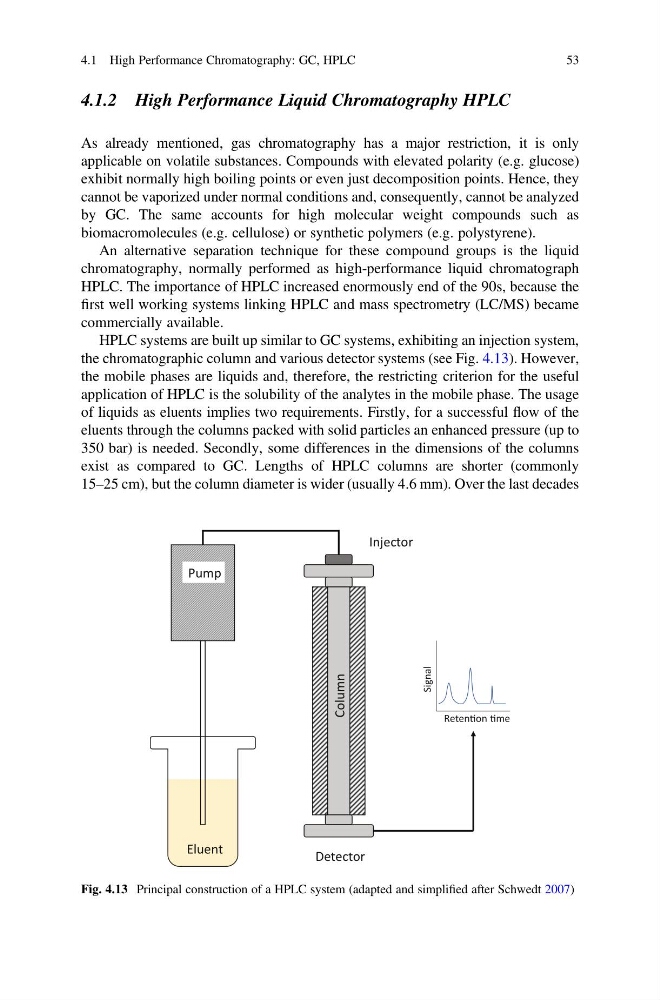
HPLC systems are built up similar to GC systems, exhibiting an injection system,
the chromatographic column and various detector systems (see Fig. 4.13). However,
the mobile phases are liquids and, therefore, the restricting criterion for the useful
application of HPLC is the solubility of the analytes in the mobile phase. The usage
of liquids as eluents implies two requirements. Firstly, for a successful flow of the
eluents through the columns packed with solid particles an enhanced pressure (up to
350 bar) is needed. Secondly, some differences in the dimensions of the columns
exist as compared to GC. Lengths of HPLC columns are shorter (commonly
15–25 cm), but the column diameter is wider (usually 4.6 mm). Over the last decades
RetenƟon Ɵme
Signal
Pump
Eluent
Injector
Column
Detector
Fig. 4.13 Principal construction of a HPLC system (adapted and simplified after Schwedt 2007)
4.1 High Performance Chromatography: GC, HPLC
53
As already mentioned, gas chromatography has a major restriction, it is only
applicable on volatile substances. Compounds with elevated polarity (e.g. glucose)
exhibit normally high boiling points or even just decomposition points. Hence, they
cannot be vaporized under normal conditions and, consequently, cannot be analyzed
by GC. The same accounts for high molecular weight compounds such as
biomacromolecules (e.g. cellulose) or synthetic polymers (e.g. polystyrene).
An alternative separation technique for these compound groups is the liquid
chromatography, normally performed as high-performance liquid chromatograph
HPLC. The importance of HPLC increased enormously end of the 90s, because the
first well working systems linking HPLC and mass spectrometry (LC/MS) became
commercially available.
HPLC systems are built up similar to GC systems, exhibiting an injection system,
the chromatographic column and various detector systems (see Fig. 4.13). However,
the mobile phases are liquids and, therefore, the restricting criterion for the useful
application of HPLC is the solubility of the analytes in the mobile phase. The usage
of liquids as eluents implies two requirements. Firstly, for a successful flow of the
eluents through the columns packed with solid particles an enhanced pressure (up to
350 bar) is needed. Secondly, some differences in the dimensions of the columns
exist as compared to GC. Lengths of HPLC columns are shorter (commonly
15–25 cm), but the column diameter is wider (usually 4.6 mm). Over the last decades
RetenƟon Ɵme
Signal
Pump
Eluent
Injector
Column
Detector
Fig. 4.13 Principal construction of a HPLC system (adapted and simplified after Schwedt 2007)
4.1 High Performance Chromatography: GC, HPLC
53