

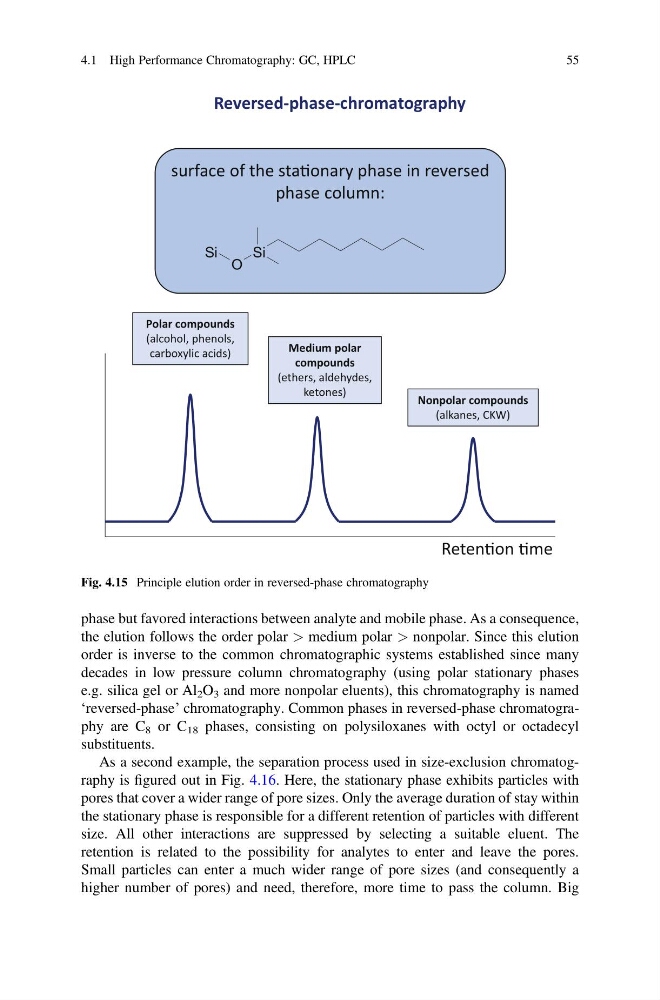
phase but favored interactions between analyte and mobile phase. As a consequence,
the elution follows the order polar > medium polar > nonpolar. Since this elution
order is inverse to the common chromatographic systems established since many
decades in low pressure column chromatography (using polar stationary phases
e.g. silica gel or Al 2 O 3 and more nonpolar eluents), this chromatography is named
‘reversed-phase’ chromatography. Common phases in reversed-phase chromatography are C 8 or C 18 phases, consisting on polysiloxanes with octyl or octadecyl
substituents.
As a second example, the separation process used in size-exclusion chromatography is figured out in Fig. 4.16. Here, the stationary phase exhibits particles with
pores that cover a wider range of pore sizes. Only the average duration of stay within
the stationary phase is responsible for a different retention of particles with different
size. All other interactions are suppressed by selecting a suitable eluent. The
retention is related to the possibility for analytes to enter and leave the pores.
Small particles can enter a much wider range of pore sizes (and consequently a
higher number of pores) and need, therefore, more time to pass the column. Big
surface of the staƟonary phase in reversed
phase column:
O
Si
Si
Reversed-phase-chromatography
RetenƟon Ɵme
Polar compounds
(alcohol, phenols,
carboxylic acids)
Medium polar
compounds
(ethers, aldehydes,
ketones)
Nonpolar compounds
(alkanes, CKW)
Fig. 4.15 Principle elution order in reversed-phase chromatography
4.1 High Performance Chromatography: GC, HPLC
55
the elution follows the order polar > medium polar > nonpolar. Since this elution
order is inverse to the common chromatographic systems established since many
decades in low pressure column chromatography (using polar stationary phases
e.g. silica gel or Al 2 O 3 and more nonpolar eluents), this chromatography is named
‘reversed-phase’ chromatography. Common phases in reversed-phase chromatography are C 8 or C 18 phases, consisting on polysiloxanes with octyl or octadecyl
substituents.
As a second example, the separation process used in size-exclusion chromatography is figured out in Fig. 4.16. Here, the stationary phase exhibits particles with
pores that cover a wider range of pore sizes. Only the average duration of stay within
the stationary phase is responsible for a different retention of particles with different
size. All other interactions are suppressed by selecting a suitable eluent. The
retention is related to the possibility for analytes to enter and leave the pores.
Small particles can enter a much wider range of pore sizes (and consequently a
higher number of pores) and need, therefore, more time to pass the column. Big
surface of the staƟonary phase in reversed
phase column:
O
Si
Si
Reversed-phase-chromatography
RetenƟon Ɵme
Polar compounds
(alcohol, phenols,
carboxylic acids)
Medium polar
compounds
(ethers, aldehydes,
ketones)
Nonpolar compounds
(alkanes, CKW)
Fig. 4.15 Principle elution order in reversed-phase chromatography
4.1 High Performance Chromatography: GC, HPLC
55