

56
G. Murtaza et al.
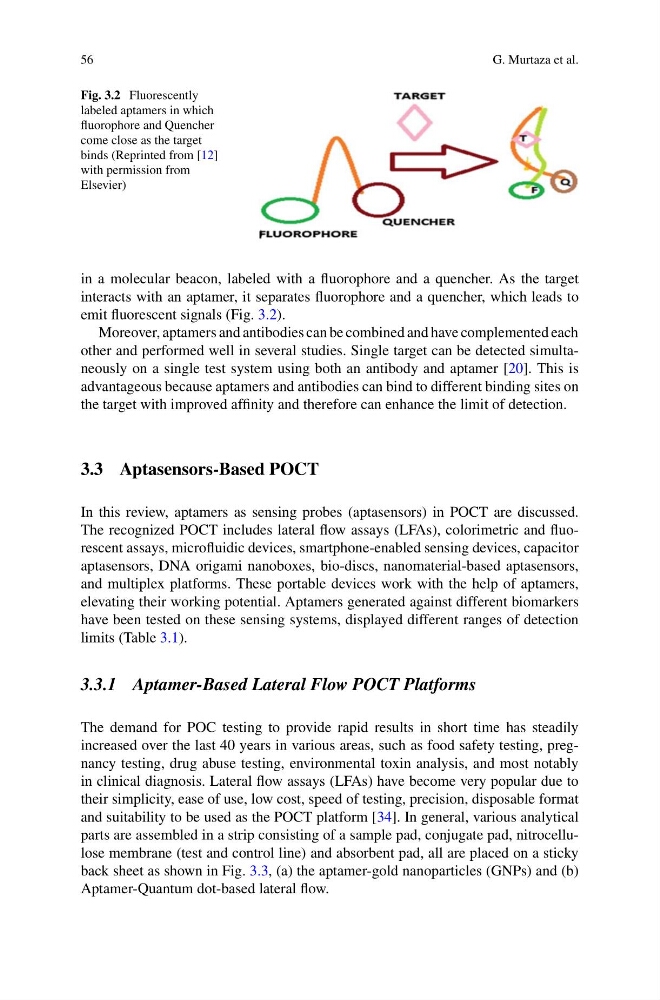
Fig. 3.2 Fluorescently
labeled aptamers in which
fluorophore and Quencher
come close as the target
binds (Reprinted from [12]
with permission from
Elsevier)
in a molecular beacon, labeled with a fluorophore and a quencher. As the target
interacts with an aptamer, it separates fluorophore and a quencher, which leads to
emit fluorescent signals (Fig. 3.2).
Moreover, aptamers and antibodies can be combined and have complemented each
other and performed well in several studies. Single target can be detected simultaneously on a single test system using both an antibody and aptamer [20]. This is
advantageous because aptamers and antibodies can bind to different binding sites on
the target with improved affinity and therefore can enhance the limit of detection.
3.3 Aptasensors-Based POCT
In this review, aptamers as sensing probes (aptasensors) in POCT are discussed.
The recognized POCT includes lateral flow assays (LFAs), colorimetric and fluorescent assays, microfluidic devices, smartphone-enabled sensing devices, capacitor
aptasensors, DNA origami nanoboxes, bio-discs, nanomaterial-based aptasensors,
and multiplex platforms. These portable devices work with the help of aptamers,
elevating their working potential. Aptamers generated against different biomarkers
have been tested on these sensing systems, displayed different ranges of detection
limits (Table 3.1).
3.3.1 Aptamer-Based Lateral Flow POCT Platforms
The demand for POC testing to provide rapid results in short time has steadily
increased over the last 40 years in various areas, such as food safety testing, pregnancy testing, drug abuse testing, environmental toxin analysis, and most notably
in clinical diagnosis. Lateral flow assays (LFAs) have become very popular due to
their simplicity, ease of use, low cost, speed of testing, precision, disposable format
and suitability to be used as the POCT platform [34]. In general, various analytical
parts are assembled in a strip consisting of a sample pad, conjugate pad, nitrocellulose membrane (test and control line) and absorbent pad, all are placed on a sticky
back sheet as shown in Fig. 3.3, (a) the aptamer-gold nanoparticles (GNPs) and (b)
Aptamer-Quantum dot-based lateral flow.
G. Murtaza et al.
Fig. 3.2 Fluorescently
labeled aptamers in which
fluorophore and Quencher
come close as the target
binds (Reprinted from [12]
with permission from
Elsevier)
in a molecular beacon, labeled with a fluorophore and a quencher. As the target
interacts with an aptamer, it separates fluorophore and a quencher, which leads to
emit fluorescent signals (Fig. 3.2).
Moreover, aptamers and antibodies can be combined and have complemented each
other and performed well in several studies. Single target can be detected simultaneously on a single test system using both an antibody and aptamer [20]. This is
advantageous because aptamers and antibodies can bind to different binding sites on
the target with improved affinity and therefore can enhance the limit of detection.
3.3 Aptasensors-Based POCT
In this review, aptamers as sensing probes (aptasensors) in POCT are discussed.
The recognized POCT includes lateral flow assays (LFAs), colorimetric and fluorescent assays, microfluidic devices, smartphone-enabled sensing devices, capacitor
aptasensors, DNA origami nanoboxes, bio-discs, nanomaterial-based aptasensors,
and multiplex platforms. These portable devices work with the help of aptamers,
elevating their working potential. Aptamers generated against different biomarkers
have been tested on these sensing systems, displayed different ranges of detection
limits (Table 3.1).
3.3.1 Aptamer-Based Lateral Flow POCT Platforms
The demand for POC testing to provide rapid results in short time has steadily
increased over the last 40 years in various areas, such as food safety testing, pregnancy testing, drug abuse testing, environmental toxin analysis, and most notably
in clinical diagnosis. Lateral flow assays (LFAs) have become very popular due to
their simplicity, ease of use, low cost, speed of testing, precision, disposable format
and suitability to be used as the POCT platform [34]. In general, various analytical
parts are assembled in a strip consisting of a sample pad, conjugate pad, nitrocellulose membrane (test and control line) and absorbent pad, all are placed on a sticky
back sheet as shown in Fig. 3.3, (a) the aptamer-gold nanoparticles (GNPs) and (b)
Aptamer-Quantum dot-based lateral flow.