

3 Aptamer-Based Point of Care Testing Schemes
55
and the terms ALISA (aptamer-linked immunosorbent essay), ELONA (enzymelinked oligonucleotide assay), ELASA (enzyme-linked apta-sorbent assay) and
ELAA(enzyme-linked aptamer assay) were coined and used for aptamer-based rapid
detection of food contaminants including bacteria [15], and fungal toxins [16], viruses
[17] and blood markers [18].
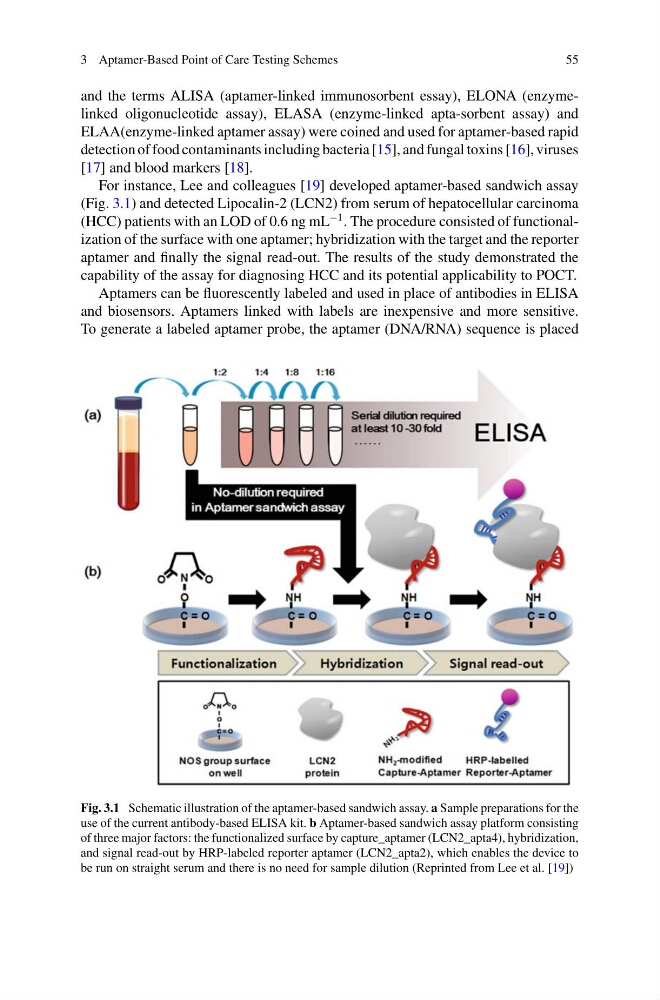
For instance, Lee and colleagues [19] developed aptamer-based sandwich assay
(Fig. 3.1) and detected Lipocalin-2 (LCN2) from serum of hepatocellular carcinoma
(HCC) patients with an LOD of 0.6 ng mL
−1 . The procedure consisted of functionalization of the surface with one aptamer; hybridization with the target and the reporter
aptamer and finally the signal read-out. The results of the study demonstrated the
capability of the assay for diagnosing HCC and its potential applicability to POCT.
Aptamers can be fluorescently labeled and used in place of antibodies in ELISA
and biosensors. Aptamers linked with labels are inexpensive and more sensitive.
To generate a labeled aptamer probe, the aptamer (DNA/RNA) sequence is placed
Fig. 3.1 Schematic illustration of the aptamer-based sandwich assay. a Sample preparations for the
use of the current antibody-based ELISA kit. b Aptamer-based sandwich assay platform consisting
of three major factors: the functionalized surface by capture_aptamer (LCN2_apta4), hybridization,
and signal read-out by HRP-labeled reporter aptamer (LCN2_apta2), which enables the device to
be run on straight serum and there is no need for sample dilution (Reprinted from Lee et al. [19])
55
and the terms ALISA (aptamer-linked immunosorbent essay), ELONA (enzymelinked oligonucleotide assay), ELASA (enzyme-linked apta-sorbent assay) and
ELAA(enzyme-linked aptamer assay) were coined and used for aptamer-based rapid
detection of food contaminants including bacteria [15], and fungal toxins [16], viruses
[17] and blood markers [18].
For instance, Lee and colleagues [19] developed aptamer-based sandwich assay
(Fig. 3.1) and detected Lipocalin-2 (LCN2) from serum of hepatocellular carcinoma
(HCC) patients with an LOD of 0.6 ng mL
−1 . The procedure consisted of functionalization of the surface with one aptamer; hybridization with the target and the reporter
aptamer and finally the signal read-out. The results of the study demonstrated the
capability of the assay for diagnosing HCC and its potential applicability to POCT.
Aptamers can be fluorescently labeled and used in place of antibodies in ELISA
and biosensors. Aptamers linked with labels are inexpensive and more sensitive.
To generate a labeled aptamer probe, the aptamer (DNA/RNA) sequence is placed
Fig. 3.1 Schematic illustration of the aptamer-based sandwich assay. a Sample preparations for the
use of the current antibody-based ELISA kit. b Aptamer-based sandwich assay platform consisting
of three major factors: the functionalized surface by capture_aptamer (LCN2_apta4), hybridization,
and signal read-out by HRP-labeled reporter aptamer (LCN2_apta2), which enables the device to
be run on straight serum and there is no need for sample dilution (Reprinted from Lee et al. [19])