

398
Y. Dong et al.
binding and structural information of aptamer-target complexes cannot be easily
procured for successive medical investigations.
Native mass spectrometry, with its name coined in 2004 [25], is actually a small
niche of biomolecular mass spectrometry that advanced rapidly and became a potential complementary tool to modern X-ray crystallography or NMR in recent years.
Either electro-spray (ESI) or nano-electrospray ionization (nano-ESI) source will
render the non-covalent binding and formation of aptamer-target complex with its
native higher order state retained in the gaseous phase; different m/z peaks can be
utilized to identify definitely the existence of aptamer-target complex, peak intensities
in ESI mass spectra correlate with the target molecule amounts in the samples, which
enables further determination of aptamer-target dissociation constants. Compared to
other approaches, native mass spectrometry demonstrates its unique advantages:
only small sample volumes (10–100 µL) and concentrations (low-µM to low-nM)
are needed, no chemical labeling is needed, and measurements are fulfilled within a
short time (5–10 s).
13.4.1 Native ESI-MS of Aptamer and Tetracycline Complex
In the author’s lab, the inclusion complex of aptamer and small molecule target as
exemplified by tetracycline was studied by the native electrospray ionization mass
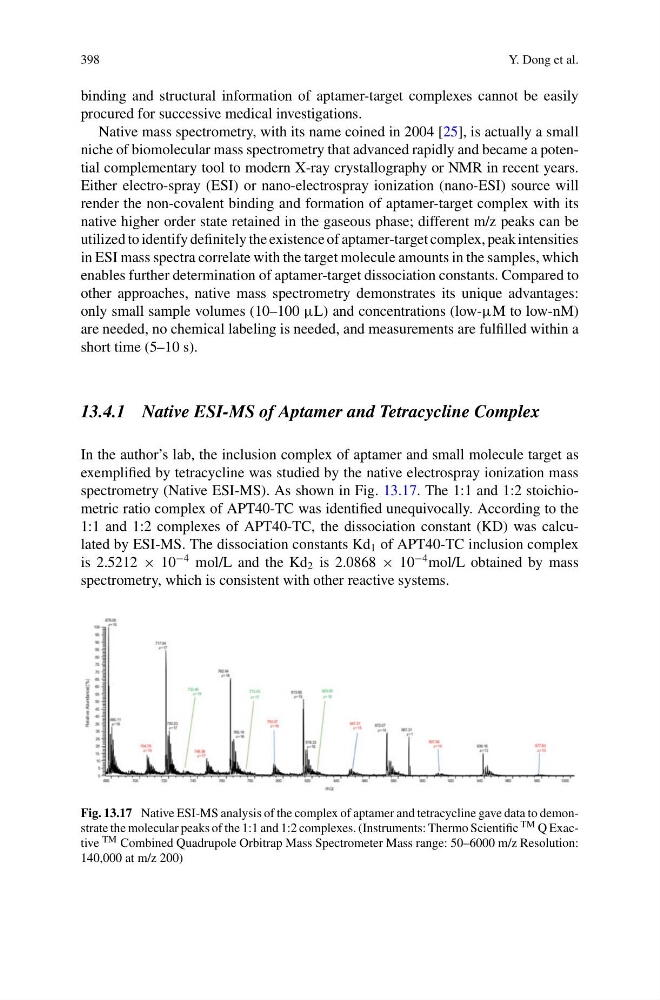
spectrometry (Native ESI-MS). As shown in Fig. 13.17. The 1:1 and 1:2 stoichiometric ratio complex of APT40-TC was identified unequivocally. According to the
1:1 and 1:2 complexes of APT40-TC, the dissociation constant (KD) was calculated by ESI-MS. The dissociation constants Kd 1 of APT40-TC inclusion complex
is 2.5212 × 10
−4 mol/L and the Kd 2 is 2.0868 × 10
−4 mol/L obtained by mass
spectrometry, which is consistent with other reactive systems.
Fig. 13.17 Native ESI-MS analysis of the complex of aptamer and tetracycline gave data to demonstrate the molecular peaks of the 1:1 and 1:2 complexes. (Instruments: Thermo Scientific TM Q Exactive TM Combined Quadrupole Orbitrap Mass Spectrometer Mass range: 50–6000 m/z Resolution:
140,000 at m/z 200)
Y. Dong et al.
binding and structural information of aptamer-target complexes cannot be easily
procured for successive medical investigations.
Native mass spectrometry, with its name coined in 2004 [25], is actually a small
niche of biomolecular mass spectrometry that advanced rapidly and became a potential complementary tool to modern X-ray crystallography or NMR in recent years.
Either electro-spray (ESI) or nano-electrospray ionization (nano-ESI) source will
render the non-covalent binding and formation of aptamer-target complex with its
native higher order state retained in the gaseous phase; different m/z peaks can be
utilized to identify definitely the existence of aptamer-target complex, peak intensities
in ESI mass spectra correlate with the target molecule amounts in the samples, which
enables further determination of aptamer-target dissociation constants. Compared to
other approaches, native mass spectrometry demonstrates its unique advantages:
only small sample volumes (10–100 µL) and concentrations (low-µM to low-nM)
are needed, no chemical labeling is needed, and measurements are fulfilled within a
short time (5–10 s).
13.4.1 Native ESI-MS of Aptamer and Tetracycline Complex
In the author’s lab, the inclusion complex of aptamer and small molecule target as
exemplified by tetracycline was studied by the native electrospray ionization mass
spectrometry (Native ESI-MS). As shown in Fig. 13.17. The 1:1 and 1:2 stoichiometric ratio complex of APT40-TC was identified unequivocally. According to the
1:1 and 1:2 complexes of APT40-TC, the dissociation constant (KD) was calculated by ESI-MS. The dissociation constants Kd 1 of APT40-TC inclusion complex
is 2.5212 × 10
−4 mol/L and the Kd 2 is 2.0868 × 10
−4 mol/L obtained by mass
spectrometry, which is consistent with other reactive systems.
Fig. 13.17 Native ESI-MS analysis of the complex of aptamer and tetracycline gave data to demonstrate the molecular peaks of the 1:1 and 1:2 complexes. (Instruments: Thermo Scientific TM Q Exactive TM Combined Quadrupole Orbitrap Mass Spectrometer Mass range: 50–6000 m/z Resolution:
140,000 at m/z 200)