

13 Some Frontier Technologies for Aptamers in Medical Applications
397
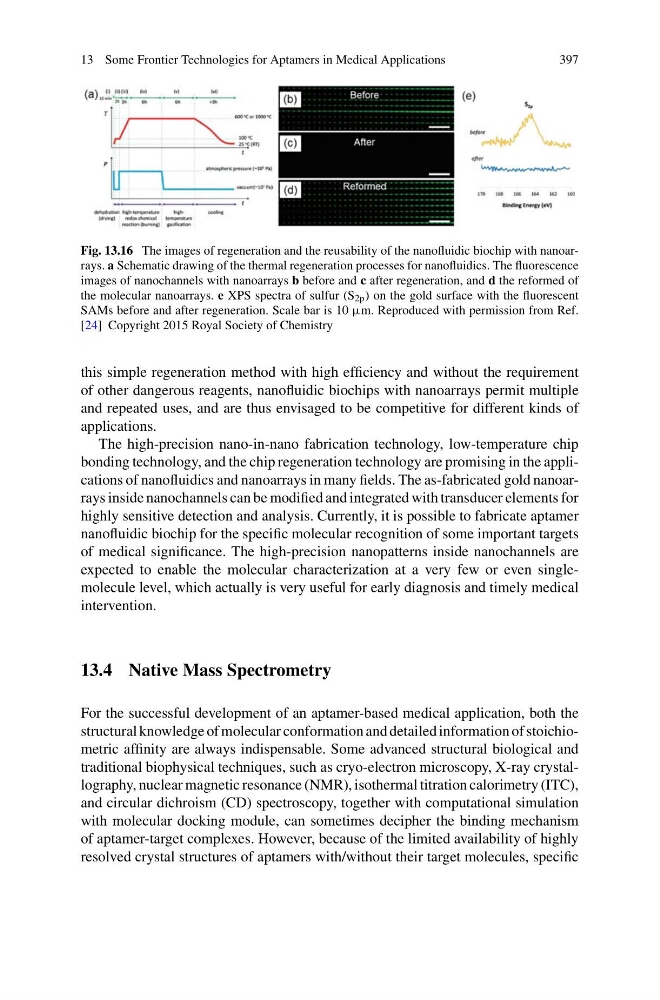
Fig. 13.16 The images of regeneration and the reusability of the nanofluidic biochip with nanoarrays. a Schematic drawing of the thermal regeneration processes for nanofluidics. The fluorescence
images of nanochannels with nanoarrays b before and c after regeneration, and d the reformed of
the molecular nanoarrays. e XPS spectra of sulfur (S 2p ) on the gold surface with the fluorescent
SAMs before and after regeneration. Scale bar is 10 µm. Reproduced with permission from Ref.
[24] Copyright 2015 Royal Society of Chemistry
this simple regeneration method with high efficiency and without the requirement
of other dangerous reagents, nanofluidic biochips with nanoarrays permit multiple
and repeated uses, and are thus envisaged to be competitive for different kinds of
applications.
The high-precision nano-in-nano fabrication technology, low-temperature chip
bonding technology, and the chip regeneration technology are promising in the applications of nanofluidics and nanoarrays in many fields. The as-fabricated gold nanoarrays inside nanochannels can be modified and integrated with transducer elements for
highly sensitive detection and analysis. Currently, it is possible to fabricate aptamer
nanofluidic biochip for the specific molecular recognition of some important targets
of medical significance. The high-precision nanopatterns inside nanochannels are
expected to enable the molecular characterization at a very few or even singlemolecule level, which actually is very useful for early diagnosis and timely medical
intervention.
13.4 Native Mass Spectrometry
For the successful development of an aptamer-based medical application, both the
structural knowledge of molecular conformation and detailed information of stoichiometric affinity are always indispensable. Some advanced structural biological and
traditional biophysical techniques, such as cryo-electron microscopy, X-ray crystallography, nuclear magnetic resonance (NMR), isothermal titration calorimetry (ITC),
and circular dichroism (CD) spectroscopy, together with computational simulation
with molecular docking module, can sometimes decipher the binding mechanism
of aptamer-target complexes. However, because of the limited availability of highly
resolved crystal structures of aptamers with/without their target molecules, specific
397
Fig. 13.16 The images of regeneration and the reusability of the nanofluidic biochip with nanoarrays. a Schematic drawing of the thermal regeneration processes for nanofluidics. The fluorescence
images of nanochannels with nanoarrays b before and c after regeneration, and d the reformed of
the molecular nanoarrays. e XPS spectra of sulfur (S 2p ) on the gold surface with the fluorescent
SAMs before and after regeneration. Scale bar is 10 µm. Reproduced with permission from Ref.
[24] Copyright 2015 Royal Society of Chemistry
this simple regeneration method with high efficiency and without the requirement
of other dangerous reagents, nanofluidic biochips with nanoarrays permit multiple
and repeated uses, and are thus envisaged to be competitive for different kinds of
applications.
The high-precision nano-in-nano fabrication technology, low-temperature chip
bonding technology, and the chip regeneration technology are promising in the applications of nanofluidics and nanoarrays in many fields. The as-fabricated gold nanoarrays inside nanochannels can be modified and integrated with transducer elements for
highly sensitive detection and analysis. Currently, it is possible to fabricate aptamer
nanofluidic biochip for the specific molecular recognition of some important targets
of medical significance. The high-precision nanopatterns inside nanochannels are
expected to enable the molecular characterization at a very few or even singlemolecule level, which actually is very useful for early diagnosis and timely medical
intervention.
13.4 Native Mass Spectrometry
For the successful development of an aptamer-based medical application, both the
structural knowledge of molecular conformation and detailed information of stoichiometric affinity are always indispensable. Some advanced structural biological and
traditional biophysical techniques, such as cryo-electron microscopy, X-ray crystallography, nuclear magnetic resonance (NMR), isothermal titration calorimetry (ITC),
and circular dichroism (CD) spectroscopy, together with computational simulation
with molecular docking module, can sometimes decipher the binding mechanism
of aptamer-target complexes. However, because of the limited availability of highly
resolved crystal structures of aptamers with/without their target molecules, specific