

13 Some Frontier Technologies for Aptamers in Medical Applications
399
13.4.2 Calculation of Dissociation Constants of Complexes
As per the dynamic equilibrium of binding and dissociation in the experiment,
aptamer was designated as A, the small molecule target ligand as L, the number
of binding small molecule ligands as n, and [L] 0 is the initial concentration of the
target, [A] 0 indicates the initial concentration of the aptamer, Kd n indicates the dissociation constant of the 1:n stoichiometric binding of the aptamer to the target small
molecule, e.g., Kd 2 aptamer is the dissociation constant representing the 1:2 binding
of the aptamer to the ligand molecule.
was utilized to represent the ionic intensity
in the mass spectrum. From the mass spectrum, we can obtain the molecular ratio of
the aptamer and the small molecule target in the dynamic equilibrium.
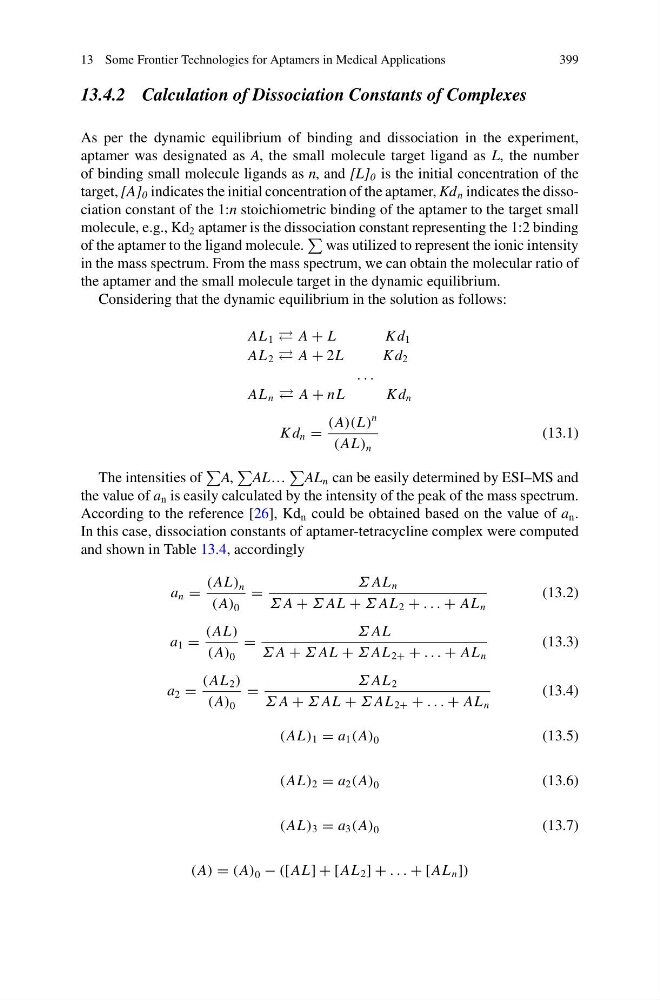
Considering that the dynamic equilibrium in the solution as follows:
AL 1 A + L
Kd 1
AL 2 A + 2L
Kd 2
. . .
AL n A + nL
K d n
K d n =
(A)(L)
n
(AL) n
(13.1)
The intensities of
A,
AL…
AL n can be easily determined by ESI–MS and
the value of a n is easily calculated by the intensity of the peak of the mass spectrum.
According to the reference [26], Kd n could be obtained based on the value of a n .
In this case, dissociation constants of aptamer-tetracycline complex were computed
and shown in Table 13.4, accordingly
a n =
(AL) n
(A) 0
=
Σ AL n
Σ A + Σ AL + Σ AL 2 + . . . + AL n
(13.2)
a 1 =
(AL)
(A) 0
=
Σ AL
Σ A + Σ AL + Σ AL 2+ + . . . + AL n
(13.3)
a 2 =
(AL 2 )
(A) 0
=
Σ AL 2
Σ A + Σ AL + Σ AL 2+ + . . . + AL n
(13.4)
(AL) 1 = a 1 (A) 0
(13.5)
(AL) 2 = a 2 (A) 0
(13.6)
(AL) 3 = a 3 (A) 0
(13.7)
(A) = (A) 0 − ([AL] + [AL 2 ] + . . . + [AL n ])
399
13.4.2 Calculation of Dissociation Constants of Complexes
As per the dynamic equilibrium of binding and dissociation in the experiment,
aptamer was designated as A, the small molecule target ligand as L, the number
of binding small molecule ligands as n, and [L] 0 is the initial concentration of the
target, [A] 0 indicates the initial concentration of the aptamer, Kd n indicates the dissociation constant of the 1:n stoichiometric binding of the aptamer to the target small
molecule, e.g., Kd 2 aptamer is the dissociation constant representing the 1:2 binding
of the aptamer to the ligand molecule.
was utilized to represent the ionic intensity
in the mass spectrum. From the mass spectrum, we can obtain the molecular ratio of
the aptamer and the small molecule target in the dynamic equilibrium.
Considering that the dynamic equilibrium in the solution as follows:
AL 1 A + L
Kd 1
AL 2 A + 2L
Kd 2
. . .
AL n A + nL
K d n
K d n =
(A)(L)
n
(AL) n
(13.1)
The intensities of
A,
AL…
AL n can be easily determined by ESI–MS and
the value of a n is easily calculated by the intensity of the peak of the mass spectrum.
According to the reference [26], Kd n could be obtained based on the value of a n .
In this case, dissociation constants of aptamer-tetracycline complex were computed
and shown in Table 13.4, accordingly
a n =
(AL) n
(A) 0
=
Σ AL n
Σ A + Σ AL + Σ AL 2 + . . . + AL n
(13.2)
a 1 =
(AL)
(A) 0
=
Σ AL
Σ A + Σ AL + Σ AL 2+ + . . . + AL n
(13.3)
a 2 =
(AL 2 )
(A) 0
=
Σ AL 2
Σ A + Σ AL + Σ AL 2+ + . . . + AL n
(13.4)
(AL) 1 = a 1 (A) 0
(13.5)
(AL) 2 = a 2 (A) 0
(13.6)
(AL) 3 = a 3 (A) 0
(13.7)
(A) = (A) 0 − ([AL] + [AL 2 ] + . . . + [AL n ])