

384
Y. Dong et al.
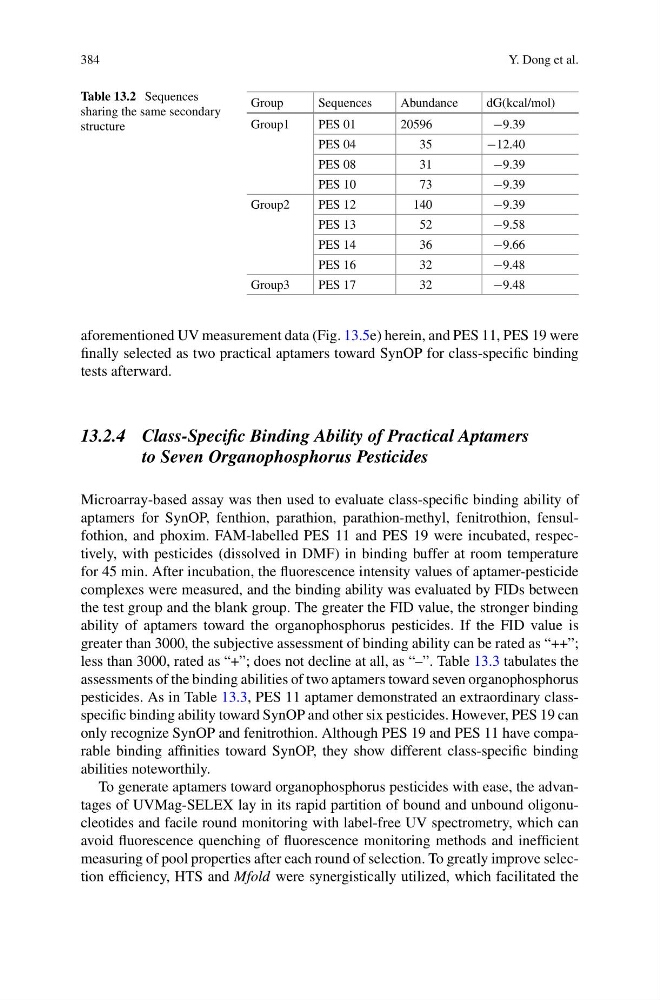
Table 13.2 Sequences
sharing the same secondary
structure
Group
Sequences
Abundance
dG(kcal/mol)
Group1
PES 01
20596
−9.39
PES 04
35
−12.40
PES 08
31
−9.39
PES 10
73
−9.39
Group2
PES 12
140
−9.39
PES 13
52
−9.58
PES 14
36
−9.66
PES 16
32
−9.48
Group3
PES 17
32
−9.48
aforementioned UV measurement data (Fig. 13.5e) herein, and PES 11, PES 19 were
finally selected as two practical aptamers toward SynOP for class-specific binding
tests afterward.
13.2.4 Class-Specific Binding Ability of Practical Aptamers
to Seven Organophosphorus Pesticides
Microarray-based assay was then used to evaluate class-specific binding ability of
aptamers for SynOP, fenthion, parathion, parathion-methyl, fenitrothion, fensulfothion, and phoxim. FAM-labelled PES 11 and PES 19 were incubated, respectively, with pesticides (dissolved in DMF) in binding buffer at room temperature
for 45 min. After incubation, the fluorescence intensity values of aptamer-pesticide
complexes were measured, and the binding ability was evaluated by FIDs between
the test group and the blank group. The greater the FID value, the stronger binding
ability of aptamers toward the organophosphorus pesticides. If the FID value is
greater than 3000, the subjective assessment of binding ability can be rated as “++”;
less than 3000, rated as “+”; does not decline at all, as “–”. Table 13.3 tabulates the
assessments of the binding abilities of two aptamers toward seven organophosphorus
pesticides. As in Table 13.3, PES 11 aptamer demonstrated an extraordinary classspecific binding ability toward SynOP and other six pesticides. However, PES 19 can
only recognize SynOP and fenitrothion. Although PES 19 and PES 11 have comparable binding affinities toward SynOP, they show different class-specific binding
abilities noteworthily.
To generate aptamers toward organophosphorus pesticides with ease, the advantages of UVMag-SELEX lay in its rapid partition of bound and unbound oligonucleotides and facile round monitoring with label-free UV spectrometry, which can
avoid fluorescence quenching of fluorescence monitoring methods and inefficient
measuring of pool properties after each round of selection. To greatly improve selection efficiency, HTS and Mfold were synergistically utilized, which facilitated the
Y. Dong et al.
Table 13.2 Sequences
sharing the same secondary
structure
Group
Sequences
Abundance
dG(kcal/mol)
Group1
PES 01
20596
−9.39
PES 04
35
−12.40
PES 08
31
−9.39
PES 10
73
−9.39
Group2
PES 12
140
−9.39
PES 13
52
−9.58
PES 14
36
−9.66
PES 16
32
−9.48
Group3
PES 17
32
−9.48
aforementioned UV measurement data (Fig. 13.5e) herein, and PES 11, PES 19 were
finally selected as two practical aptamers toward SynOP for class-specific binding
tests afterward.
13.2.4 Class-Specific Binding Ability of Practical Aptamers
to Seven Organophosphorus Pesticides
Microarray-based assay was then used to evaluate class-specific binding ability of
aptamers for SynOP, fenthion, parathion, parathion-methyl, fenitrothion, fensulfothion, and phoxim. FAM-labelled PES 11 and PES 19 were incubated, respectively, with pesticides (dissolved in DMF) in binding buffer at room temperature
for 45 min. After incubation, the fluorescence intensity values of aptamer-pesticide
complexes were measured, and the binding ability was evaluated by FIDs between
the test group and the blank group. The greater the FID value, the stronger binding
ability of aptamers toward the organophosphorus pesticides. If the FID value is
greater than 3000, the subjective assessment of binding ability can be rated as “++”;
less than 3000, rated as “+”; does not decline at all, as “–”. Table 13.3 tabulates the
assessments of the binding abilities of two aptamers toward seven organophosphorus
pesticides. As in Table 13.3, PES 11 aptamer demonstrated an extraordinary classspecific binding ability toward SynOP and other six pesticides. However, PES 19 can
only recognize SynOP and fenitrothion. Although PES 19 and PES 11 have comparable binding affinities toward SynOP, they show different class-specific binding
abilities noteworthily.
To generate aptamers toward organophosphorus pesticides with ease, the advantages of UVMag-SELEX lay in its rapid partition of bound and unbound oligonucleotides and facile round monitoring with label-free UV spectrometry, which can
avoid fluorescence quenching of fluorescence monitoring methods and inefficient
measuring of pool properties after each round of selection. To greatly improve selection efficiency, HTS and Mfold were synergistically utilized, which facilitated the