

378
Y. Dong et al.
For instance, it is well-known that organophosphorus pesticides (OPs) can
inhibit esterase enzymes, especially acetylcholinesterase in synapses and on red-cell
membranes, and diagnosis of organophosphorus poisoning shall ideally be confirmed
with an assay to measure a reduced butyryl-cholinesterase or acetyl-cholinesterase
activity in plasma. Unfortunately, on the basis of clinical suspicion, the characteristic clinical signs or smell of pesticides or solvents, the results of such cholinesterase
assays are still rarely available in time to make clinical decisions, and novel analytical
methods based on OPs aptamers selected by UVMag-SELEX could be developed as
the alternative thereof.
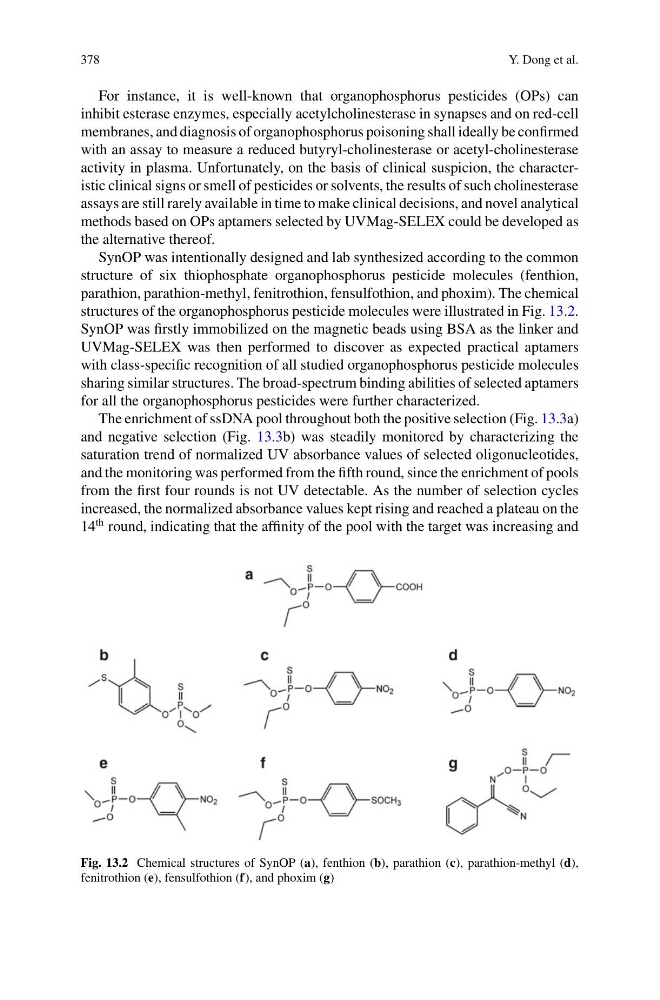
SynOP was intentionally designed and lab synthesized according to the common
structure of six thiophosphate organophosphorus pesticide molecules (fenthion,
parathion, parathion-methyl, fenitrothion, fensulfothion, and phoxim). The chemical
structures of the organophosphorus pesticide molecules were illustrated in Fig. 13.2.
SynOP was firstly immobilized on the magnetic beads using BSA as the linker and
UVMag-SELEX was then performed to discover as expected practical aptamers
with class-specific recognition of all studied organophosphorus pesticide molecules
sharing similar structures. The broad-spectrum binding abilities of selected aptamers
for all the organophosphorus pesticides were further characterized.
The enrichment of ssDNA pool throughout both the positive selection (Fig. 13.3a)
and negative selection (Fig. 13.3b) was steadily monitored by characterizing the
saturation trend of normalized UV absorbance values of selected oligonucleotides,
and the monitoring was performed from the fifth round, since the enrichment of pools
from the first four rounds is not UV detectable. As the number of selection cycles
increased, the normalized absorbance values kept rising and reached a plateau on the
14
th round, indicating that the affinity of the pool with the target was increasing and
Fig. 13.2 Chemical structures of SynOP (a), fenthion (b), parathion (c), parathion-methyl (d),
fenitrothion (e), fensulfothion (f), and phoxim (g)
Y. Dong et al.
For instance, it is well-known that organophosphorus pesticides (OPs) can
inhibit esterase enzymes, especially acetylcholinesterase in synapses and on red-cell
membranes, and diagnosis of organophosphorus poisoning shall ideally be confirmed
with an assay to measure a reduced butyryl-cholinesterase or acetyl-cholinesterase
activity in plasma. Unfortunately, on the basis of clinical suspicion, the characteristic clinical signs or smell of pesticides or solvents, the results of such cholinesterase
assays are still rarely available in time to make clinical decisions, and novel analytical
methods based on OPs aptamers selected by UVMag-SELEX could be developed as
the alternative thereof.
SynOP was intentionally designed and lab synthesized according to the common
structure of six thiophosphate organophosphorus pesticide molecules (fenthion,
parathion, parathion-methyl, fenitrothion, fensulfothion, and phoxim). The chemical
structures of the organophosphorus pesticide molecules were illustrated in Fig. 13.2.
SynOP was firstly immobilized on the magnetic beads using BSA as the linker and
UVMag-SELEX was then performed to discover as expected practical aptamers
with class-specific recognition of all studied organophosphorus pesticide molecules
sharing similar structures. The broad-spectrum binding abilities of selected aptamers
for all the organophosphorus pesticides were further characterized.
The enrichment of ssDNA pool throughout both the positive selection (Fig. 13.3a)
and negative selection (Fig. 13.3b) was steadily monitored by characterizing the
saturation trend of normalized UV absorbance values of selected oligonucleotides,
and the monitoring was performed from the fifth round, since the enrichment of pools
from the first four rounds is not UV detectable. As the number of selection cycles
increased, the normalized absorbance values kept rising and reached a plateau on the
14
th round, indicating that the affinity of the pool with the target was increasing and
Fig. 13.2 Chemical structures of SynOP (a), fenthion (b), parathion (c), parathion-methyl (d),
fenitrothion (e), fensulfothion (f), and phoxim (g)