

13 Some Frontier Technologies for Aptamers in Medical Applications
377
can not only enable a much simpler monitoring process of SELEX, but also preserve
the advantage of separation rapidness for bound and unbound oligonucleotides. Most
importantly, because the immobilized target was deliberately designed and synthesized based on the common structure of studied molecules, the aptamers selected by
UVMag-SELEX will preserve broad-spectrum or class-specific recognition capability, which is deemed to be rather crucial for successful medical applications as
well.
13.2.1 Pool Enrichment and Round Determination
for UVMag-SELEX
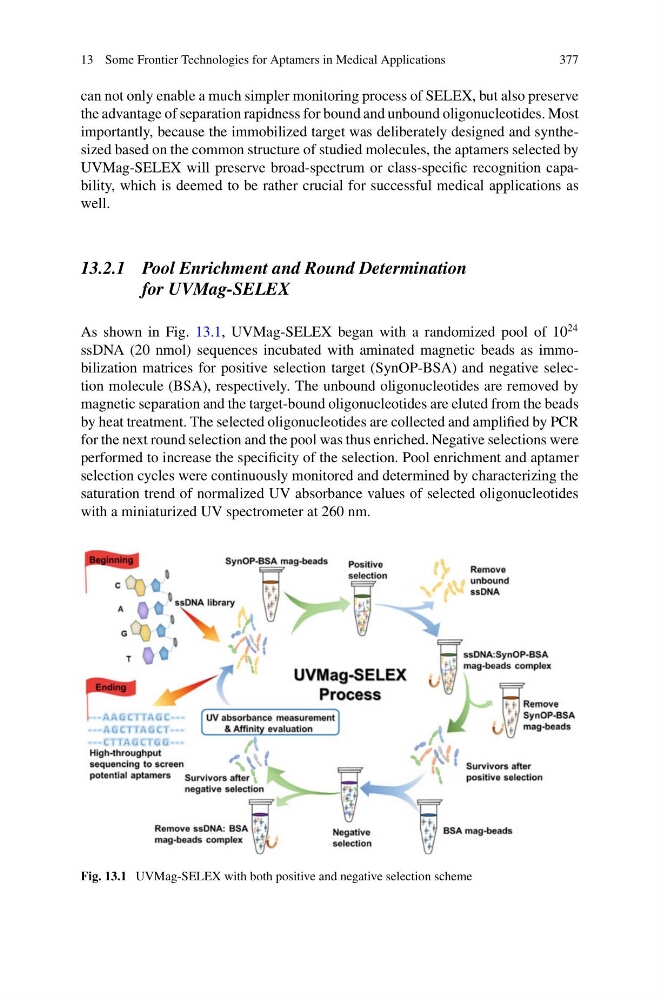
As shown in Fig. 13.1, UVMag-SELEX began with a randomized pool of 10
24
ssDNA (20 nmol) sequences incubated with aminated magnetic beads as immobilization matrices for positive selection target (SynOP-BSA) and negative selection molecule (BSA), respectively. The unbound oligonucleotides are removed by
magnetic separation and the target-bound oligonucleotides are eluted from the beads
by heat treatment. The selected oligonucleotides are collected and amplified by PCR
for the next round selection and the pool was thus enriched. Negative selections were
performed to increase the specificity of the selection. Pool enrichment and aptamer
selection cycles were continuously monitored and determined by characterizing the
saturation trend of normalized UV absorbance values of selected oligonucleotides
with a miniaturized UV spectrometer at 260 nm.
Fig. 13.1 UVMag-SELEX with both positive and negative selection scheme
377
can not only enable a much simpler monitoring process of SELEX, but also preserve
the advantage of separation rapidness for bound and unbound oligonucleotides. Most
importantly, because the immobilized target was deliberately designed and synthesized based on the common structure of studied molecules, the aptamers selected by
UVMag-SELEX will preserve broad-spectrum or class-specific recognition capability, which is deemed to be rather crucial for successful medical applications as
well.
13.2.1 Pool Enrichment and Round Determination
for UVMag-SELEX
As shown in Fig. 13.1, UVMag-SELEX began with a randomized pool of 10
24
ssDNA (20 nmol) sequences incubated with aminated magnetic beads as immobilization matrices for positive selection target (SynOP-BSA) and negative selection molecule (BSA), respectively. The unbound oligonucleotides are removed by
magnetic separation and the target-bound oligonucleotides are eluted from the beads
by heat treatment. The selected oligonucleotides are collected and amplified by PCR
for the next round selection and the pool was thus enriched. Negative selections were
performed to increase the specificity of the selection. Pool enrichment and aptamer
selection cycles were continuously monitored and determined by characterizing the
saturation trend of normalized UV absorbance values of selected oligonucleotides
with a miniaturized UV spectrometer at 260 nm.
Fig. 13.1 UVMag-SELEX with both positive and negative selection scheme