

13 Some Frontier Technologies for Aptamers in Medical Applications
379
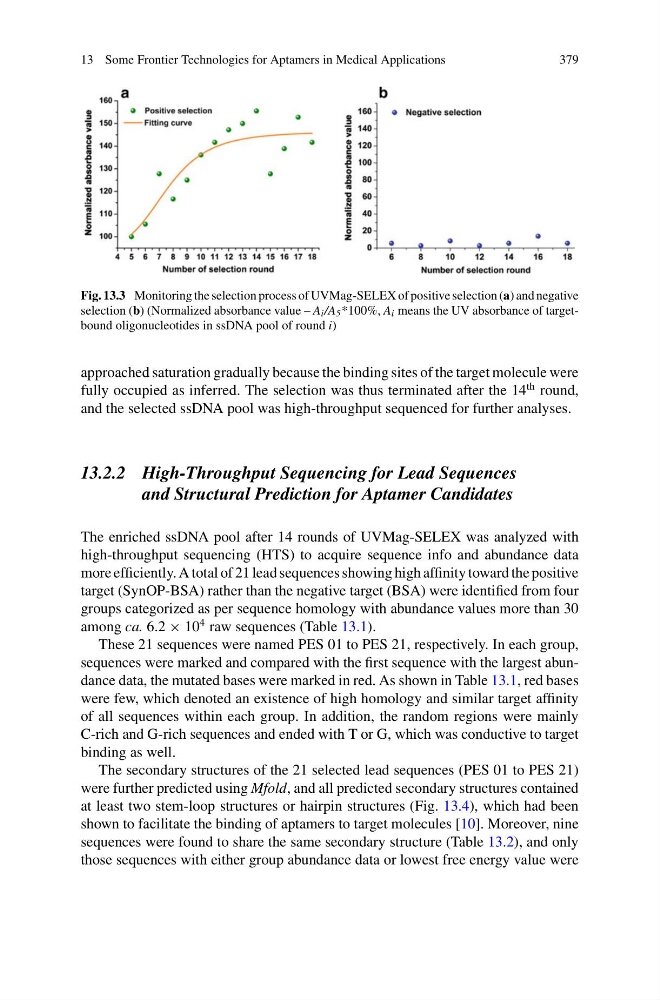
Fig. 13.3 Monitoring the selection process of UVMag-SELEX of positive selection (a) and negative
selection (b) (Normalized absorbance value – A i /A 5 *100%, A i means the UV absorbance of targetbound oligonucleotides in ssDNA pool of round i)
approached saturation gradually because the binding sites of the target molecule were
fully occupied as inferred. The selection was thus terminated after the 14
th round,
and the selected ssDNA pool was high-throughput sequenced for further analyses.
13.2.2 High-Throughput Sequencing for Lead Sequences
and Structural Prediction for Aptamer Candidates
The enriched ssDNA pool after 14 rounds of UVMag-SELEX was analyzed with
high-throughput sequencing (HTS) to acquire sequence info and abundance data
more efficiently. A total of 21 lead sequences showing high affinity toward the positive
target (SynOP-BSA) rather than the negative target (BSA) were identified from four
groups categorized as per sequence homology with abundance values more than 30
among ca. 6.2 × 10
4 raw sequences (Table 13.1).
These 21 sequences were named PES 01 to PES 21, respectively. In each group,
sequences were marked and compared with the first sequence with the largest abundance data, the mutated bases were marked in red. As shown in Table 13.1, red bases
were few, which denoted an existence of high homology and similar target affinity
of all sequences within each group. In addition, the random regions were mainly
C-rich and G-rich sequences and ended with T or G, which was conductive to target
binding as well.
The secondary structures of the 21 selected lead sequences (PES 01 to PES 21)
were further predicted using Mfold, and all predicted secondary structures contained
at least two stem-loop structures or hairpin structures (Fig. 13.4), which had been
shown to facilitate the binding of aptamers to target molecules [10]. Moreover, nine
sequences were found to share the same secondary structure (Table 13.2), and only
those sequences with either group abundance data or lowest free energy value were
379
Fig. 13.3 Monitoring the selection process of UVMag-SELEX of positive selection (a) and negative
selection (b) (Normalized absorbance value – A i /A 5 *100%, A i means the UV absorbance of targetbound oligonucleotides in ssDNA pool of round i)
approached saturation gradually because the binding sites of the target molecule were
fully occupied as inferred. The selection was thus terminated after the 14
th round,
and the selected ssDNA pool was high-throughput sequenced for further analyses.
13.2.2 High-Throughput Sequencing for Lead Sequences
and Structural Prediction for Aptamer Candidates
The enriched ssDNA pool after 14 rounds of UVMag-SELEX was analyzed with
high-throughput sequencing (HTS) to acquire sequence info and abundance data
more efficiently. A total of 21 lead sequences showing high affinity toward the positive
target (SynOP-BSA) rather than the negative target (BSA) were identified from four
groups categorized as per sequence homology with abundance values more than 30
among ca. 6.2 × 10
4 raw sequences (Table 13.1).
These 21 sequences were named PES 01 to PES 21, respectively. In each group,
sequences were marked and compared with the first sequence with the largest abundance data, the mutated bases were marked in red. As shown in Table 13.1, red bases
were few, which denoted an existence of high homology and similar target affinity
of all sequences within each group. In addition, the random regions were mainly
C-rich and G-rich sequences and ended with T or G, which was conductive to target
binding as well.
The secondary structures of the 21 selected lead sequences (PES 01 to PES 21)
were further predicted using Mfold, and all predicted secondary structures contained
at least two stem-loop structures or hairpin structures (Fig. 13.4), which had been
shown to facilitate the binding of aptamers to target molecules [10]. Moreover, nine
sequences were found to share the same secondary structure (Table 13.2), and only
those sequences with either group abundance data or lowest free energy value were