

8 Aptamers for the Diagnosis of Infectious Diseases
215
BAS-6R, which could confer a LOD of approximately 30,000–60,000 B. anthraces
spores per mL. These two aptamers can be further applied to develop PA sensors for
anthrax diagnosis.
Fluorescent assays have attracted considerable attention because of the advantages
including rapidness, simplicity and homogeneous reaction conditions [49, 50]. Kim
et al. [46] developed a homogeneous fluorescence assay for PA detection. With the
assay, PA could be detected through using OliGreen as a fluorophore in HEPES
buffer at 1 nM. Moreover, the assay could be utilized in PA ratio in blood serum. The
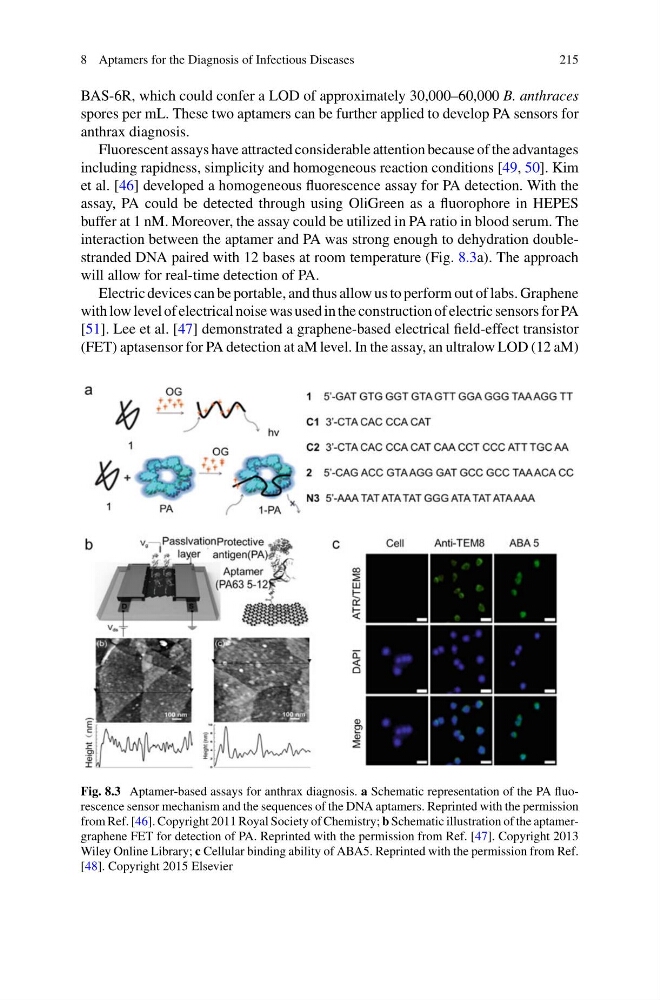
interaction between the aptamer and PA was strong enough to dehydration doublestranded DNA paired with 12 bases at room temperature (Fig. 8.3a). The approach
will allow for real-time detection of PA.
Electric devices can be portable, and thus allow us to perform out of labs. Graphene
with low level of electrical noise was used in the construction of electric sensors for PA
[51]. Lee et al. [47] demonstrated a graphene-based electrical field-effect transistor
(FET) aptasensor for PA detection at aM level. In the assay, an ultralow LOD (12 aM)
Fig. 8.3 Aptamer-based assays for anthrax diagnosis. a Schematic representation of the PA fluorescence sensor mechanism and the sequences of the DNA aptamers. Reprinted with the permission
from Ref. [46]. Copyright 2011 Royal Society of Chemistry; b Schematic illustration of the aptamergraphene FET for detection of PA. Reprinted with the permission from Ref. [47]. Copyright 2013
Wiley Online Library; c Cellular binding ability of ABA5. Reprinted with the permission from Ref.
[48]. Copyright 2015 Elsevier
215
BAS-6R, which could confer a LOD of approximately 30,000–60,000 B. anthraces
spores per mL. These two aptamers can be further applied to develop PA sensors for
anthrax diagnosis.
Fluorescent assays have attracted considerable attention because of the advantages
including rapidness, simplicity and homogeneous reaction conditions [49, 50]. Kim
et al. [46] developed a homogeneous fluorescence assay for PA detection. With the
assay, PA could be detected through using OliGreen as a fluorophore in HEPES
buffer at 1 nM. Moreover, the assay could be utilized in PA ratio in blood serum. The
interaction between the aptamer and PA was strong enough to dehydration doublestranded DNA paired with 12 bases at room temperature (Fig. 8.3a). The approach
will allow for real-time detection of PA.
Electric devices can be portable, and thus allow us to perform out of labs. Graphene
with low level of electrical noise was used in the construction of electric sensors for PA
[51]. Lee et al. [47] demonstrated a graphene-based electrical field-effect transistor
(FET) aptasensor for PA detection at aM level. In the assay, an ultralow LOD (12 aM)
Fig. 8.3 Aptamer-based assays for anthrax diagnosis. a Schematic representation of the PA fluorescence sensor mechanism and the sequences of the DNA aptamers. Reprinted with the permission
from Ref. [46]. Copyright 2011 Royal Society of Chemistry; b Schematic illustration of the aptamergraphene FET for detection of PA. Reprinted with the permission from Ref. [47]. Copyright 2013
Wiley Online Library; c Cellular binding ability of ABA5. Reprinted with the permission from Ref.
[48]. Copyright 2015 Elsevier