

8 Aptamers for the Diagnosis of Infectious Diseases
211
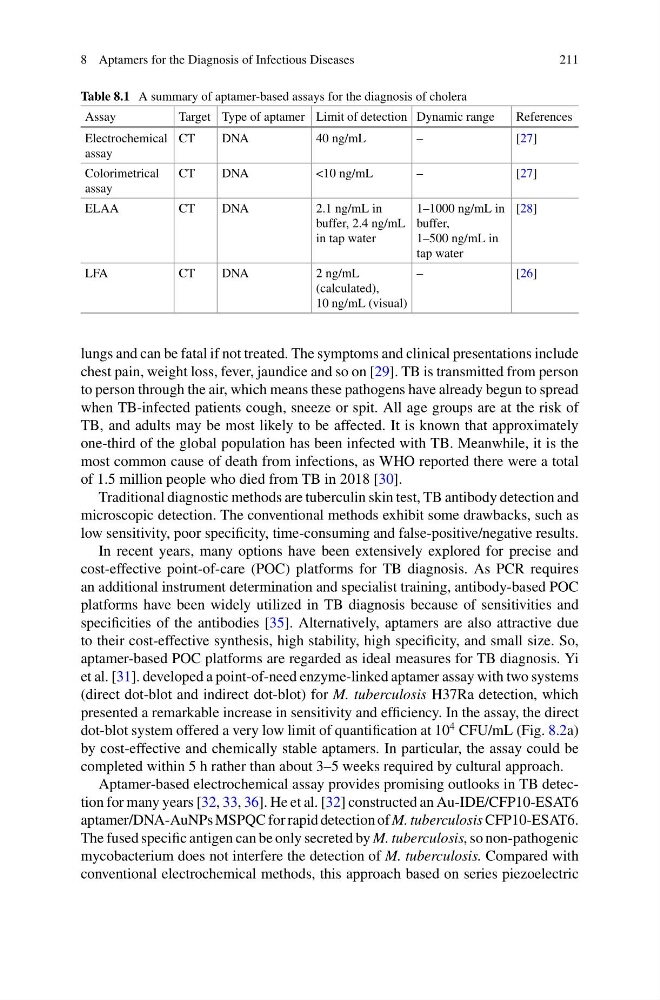
Table 8.1 A summary of aptamer-based assays for the diagnosis of cholera
Assay
Target Type of aptamer Limit of detection Dynamic range
References
Electrochemical
assay
CT
DNA
40 ng/mL
–
[27]
Colorimetrical
assay
CT
DNA
<10 ng/mL
–
[27]
ELAA
CT
DNA
2.1 ng/mL in
buffer, 2.4 ng/mL
in tap water
1–1000 ng/mL in
buffer,
1–500 ng/mL in
tap water
[28]
LFA
CT
DNA
2 ng/mL
(calculated),
10 ng/mL (visual)
–
[26]
lungs and can be fatal if not treated. The symptoms and clinical presentations include
chest pain, weight loss, fever, jaundice and so on [29]. TB is transmitted from person
to person through the air, which means these pathogens have already begun to spread
when TB-infected patients cough, sneeze or spit. All age groups are at the risk of
TB, and adults may be most likely to be affected. It is known that approximately
one-third of the global population has been infected with TB. Meanwhile, it is the
most common cause of death from infections, as WHO reported there were a total
of 1.5 million people who died from TB in 2018 [30].
Traditional diagnostic methods are tuberculin skin test, TB antibody detection and
microscopic detection. The conventional methods exhibit some drawbacks, such as
low sensitivity, poor specificity, time-consuming and false-positive/negative results.
In recent years, many options have been extensively explored for precise and
cost-effective point-of-care (POC) platforms for TB diagnosis. As PCR requires
an additional instrument determination and specialist training, antibody-based POC
platforms have been widely utilized in TB diagnosis because of sensitivities and
specificities of the antibodies [35]. Alternatively, aptamers are also attractive due
to their cost-effective synthesis, high stability, high specificity, and small size. So,
aptamer-based POC platforms are regarded as ideal measures for TB diagnosis. Yi
et al. [31]. developed a point-of-need enzyme-linked aptamer assay with two systems
(direct dot-blot and indirect dot-blot) for M. tuberculosis H37Ra detection, which
presented a remarkable increase in sensitivity and efficiency. In the assay, the direct
dot-blot system offered a very low limit of quantification at 10
4 CFU/mL (Fig. 8.2a)
by cost-effective and chemically stable aptamers. In particular, the assay could be
completed within 5 h rather than about 3–5 weeks required by cultural approach.
Aptamer-based electrochemical assay provides promising outlooks in TB detection for many years [32, 33, 36]. He et al. [32] constructed an Au-IDE/CFP10-ESAT6
aptamer/DNA-AuNPs MSPQC for rapid detection of M. tuberculosis CFP10-ESAT6.
The fused specific antigen can be only secreted by M. tuberculosis, so non-pathogenic
mycobacterium does not interfere the detection of M. tuberculosis. Compared with
conventional electrochemical methods, this approach based on series piezoelectric
211
Table 8.1 A summary of aptamer-based assays for the diagnosis of cholera
Assay
Target Type of aptamer Limit of detection Dynamic range
References
Electrochemical
assay
CT
DNA
40 ng/mL
–
[27]
Colorimetrical
assay
CT
DNA
<10 ng/mL
–
[27]
ELAA
CT
DNA
2.1 ng/mL in
buffer, 2.4 ng/mL
in tap water
1–1000 ng/mL in
buffer,
1–500 ng/mL in
tap water
[28]
LFA
CT
DNA
2 ng/mL
(calculated),
10 ng/mL (visual)
–
[26]
lungs and can be fatal if not treated. The symptoms and clinical presentations include
chest pain, weight loss, fever, jaundice and so on [29]. TB is transmitted from person
to person through the air, which means these pathogens have already begun to spread
when TB-infected patients cough, sneeze or spit. All age groups are at the risk of
TB, and adults may be most likely to be affected. It is known that approximately
one-third of the global population has been infected with TB. Meanwhile, it is the
most common cause of death from infections, as WHO reported there were a total
of 1.5 million people who died from TB in 2018 [30].
Traditional diagnostic methods are tuberculin skin test, TB antibody detection and
microscopic detection. The conventional methods exhibit some drawbacks, such as
low sensitivity, poor specificity, time-consuming and false-positive/negative results.
In recent years, many options have been extensively explored for precise and
cost-effective point-of-care (POC) platforms for TB diagnosis. As PCR requires
an additional instrument determination and specialist training, antibody-based POC
platforms have been widely utilized in TB diagnosis because of sensitivities and
specificities of the antibodies [35]. Alternatively, aptamers are also attractive due
to their cost-effective synthesis, high stability, high specificity, and small size. So,
aptamer-based POC platforms are regarded as ideal measures for TB diagnosis. Yi
et al. [31]. developed a point-of-need enzyme-linked aptamer assay with two systems
(direct dot-blot and indirect dot-blot) for M. tuberculosis H37Ra detection, which
presented a remarkable increase in sensitivity and efficiency. In the assay, the direct
dot-blot system offered a very low limit of quantification at 10
4 CFU/mL (Fig. 8.2a)
by cost-effective and chemically stable aptamers. In particular, the assay could be
completed within 5 h rather than about 3–5 weeks required by cultural approach.
Aptamer-based electrochemical assay provides promising outlooks in TB detection for many years [32, 33, 36]. He et al. [32] constructed an Au-IDE/CFP10-ESAT6
aptamer/DNA-AuNPs MSPQC for rapid detection of M. tuberculosis CFP10-ESAT6.
The fused specific antigen can be only secreted by M. tuberculosis, so non-pathogenic
mycobacterium does not interfere the detection of M. tuberculosis. Compared with
conventional electrochemical methods, this approach based on series piezoelectric