

210
T. Zhang et al.
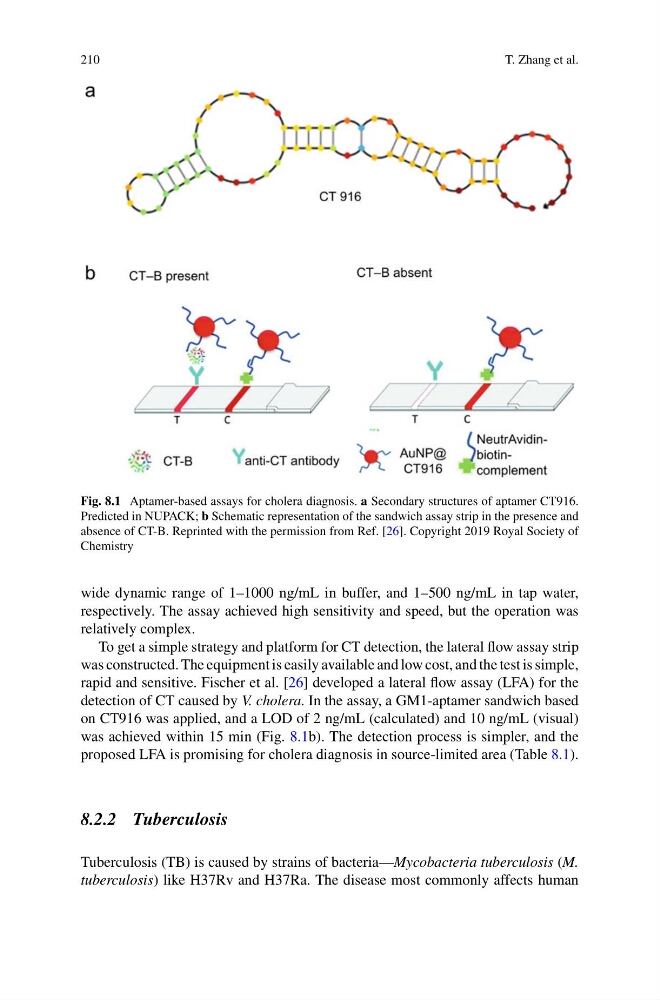
Fig. 8.1 Aptamer-based assays for cholera diagnosis. a Secondary structures of aptamer CT916.
Predicted in NUPACK; b Schematic representation of the sandwich assay strip in the presence and
absence of CT-B. Reprinted with the permission from Ref. [26]. Copyright 2019 Royal Society of
Chemistry
wide dynamic range of 1–1000 ng/mL in buffer, and 1–500 ng/mL in tap water,
respectively. The assay achieved high sensitivity and speed, but the operation was
relatively complex.
To get a simple strategy and platform for CT detection, the lateral flow assay strip
was constructed. The equipment is easily available and low cost, and the test is simple,
rapid and sensitive. Fischer et al. [26] developed a lateral flow assay (LFA) for the
detection of CT caused by V. cholera. In the assay, a GM1-aptamer sandwich based
on CT916 was applied, and a LOD of 2 ng/mL (calculated) and 10 ng/mL (visual)
was achieved within 15 min (Fig. 8.1b). The detection process is simpler, and the
proposed LFA is promising for cholera diagnosis in source-limited area (Table 8.1).
8.2.2 Tuberculosis
Tuberculosis (TB) is caused by strains of bacteria—Mycobacteria tuberculosis (M.
tuberculosis) like H37Rv and H37Ra. The disease most commonly affects human
T. Zhang et al.
Fig. 8.1 Aptamer-based assays for cholera diagnosis. a Secondary structures of aptamer CT916.
Predicted in NUPACK; b Schematic representation of the sandwich assay strip in the presence and
absence of CT-B. Reprinted with the permission from Ref. [26]. Copyright 2019 Royal Society of
Chemistry
wide dynamic range of 1–1000 ng/mL in buffer, and 1–500 ng/mL in tap water,
respectively. The assay achieved high sensitivity and speed, but the operation was
relatively complex.
To get a simple strategy and platform for CT detection, the lateral flow assay strip
was constructed. The equipment is easily available and low cost, and the test is simple,
rapid and sensitive. Fischer et al. [26] developed a lateral flow assay (LFA) for the
detection of CT caused by V. cholera. In the assay, a GM1-aptamer sandwich based
on CT916 was applied, and a LOD of 2 ng/mL (calculated) and 10 ng/mL (visual)
was achieved within 15 min (Fig. 8.1b). The detection process is simpler, and the
proposed LFA is promising for cholera diagnosis in source-limited area (Table 8.1).
8.2.2 Tuberculosis
Tuberculosis (TB) is caused by strains of bacteria—Mycobacteria tuberculosis (M.
tuberculosis) like H37Rv and H37Ra. The disease most commonly affects human