

212
T. Zhang et al.
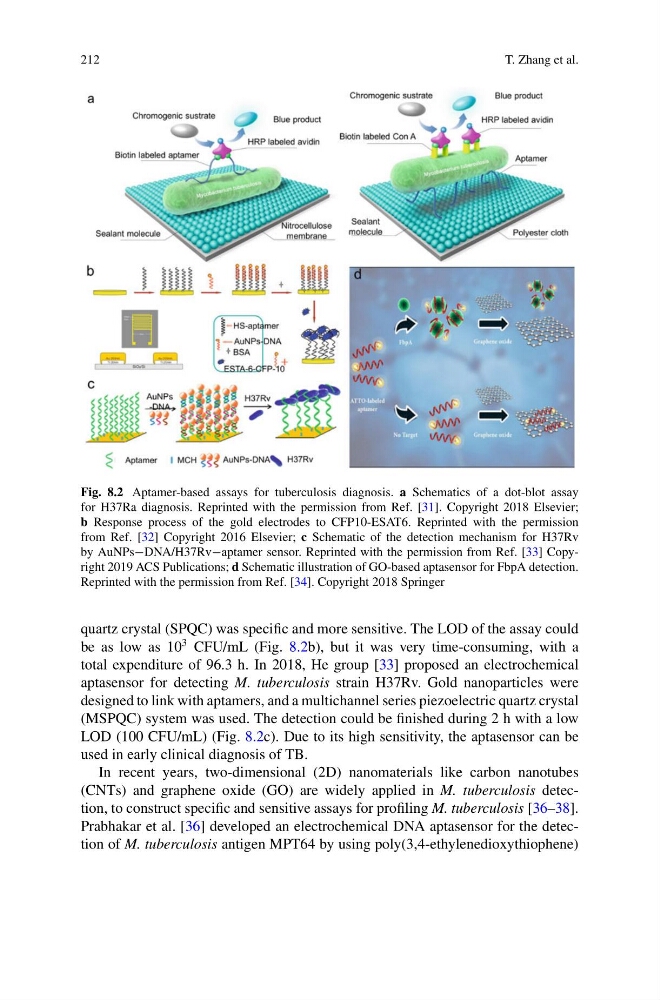
Fig. 8.2 Aptamer-based assays for tuberculosis diagnosis. a Schematics of a dot-blot assay
for H37Ra diagnosis. Reprinted with the permission from Ref. [31]. Copyright 2018 Elsevier;
b Response process of the gold electrodes to CFP10-ESAT6. Reprinted with the permission
from Ref. [32] Copyright 2016 Elsevier; c Schematic of the detection mechanism for H37Rv
by AuNPs−DNA/H37Rv−aptamer sensor. Reprinted with the permission from Ref. [33] Copyright 2019 ACS Publications; d Schematic illustration of GO-based aptasensor for FbpA detection.
Reprinted with the permission from Ref. [34]. Copyright 2018 Springer
quartz crystal (SPQC) was specific and more sensitive. The LOD of the assay could
be as low as 10
3 CFU/mL (Fig. 8.2b), but it was very time-consuming, with a
total expenditure of 96.3 h. In 2018, He group [33] proposed an electrochemical
aptasensor for detecting M. tuberculosis strain H37Rv. Gold nanoparticles were
designed to link with aptamers, and a multichannel series piezoelectric quartz crystal
(MSPQC) system was used. The detection could be finished during 2 h with a low
LOD (100 CFU/mL) (Fig. 8.2c). Due to its high sensitivity, the aptasensor can be
used in early clinical diagnosis of TB.
In recent years, two-dimensional (2D) nanomaterials like carbon nanotubes
(CNTs) and graphene oxide (GO) are widely applied in M. tuberculosis detection, to construct specific and sensitive assays for profiling M. tuberculosis [36–38].
Prabhakar et al. [36] developed an electrochemical DNA aptasensor for the detection of M. tuberculosis antigen MPT64 by using poly(3,4-ethylenedioxythiophene)
T. Zhang et al.
Fig. 8.2 Aptamer-based assays for tuberculosis diagnosis. a Schematics of a dot-blot assay
for H37Ra diagnosis. Reprinted with the permission from Ref. [31]. Copyright 2018 Elsevier;
b Response process of the gold electrodes to CFP10-ESAT6. Reprinted with the permission
from Ref. [32] Copyright 2016 Elsevier; c Schematic of the detection mechanism for H37Rv
by AuNPs−DNA/H37Rv−aptamer sensor. Reprinted with the permission from Ref. [33] Copyright 2019 ACS Publications; d Schematic illustration of GO-based aptasensor for FbpA detection.
Reprinted with the permission from Ref. [34]. Copyright 2018 Springer
quartz crystal (SPQC) was specific and more sensitive. The LOD of the assay could
be as low as 10
3 CFU/mL (Fig. 8.2b), but it was very time-consuming, with a
total expenditure of 96.3 h. In 2018, He group [33] proposed an electrochemical
aptasensor for detecting M. tuberculosis strain H37Rv. Gold nanoparticles were
designed to link with aptamers, and a multichannel series piezoelectric quartz crystal
(MSPQC) system was used. The detection could be finished during 2 h with a low
LOD (100 CFU/mL) (Fig. 8.2c). Due to its high sensitivity, the aptasensor can be
used in early clinical diagnosis of TB.
In recent years, two-dimensional (2D) nanomaterials like carbon nanotubes
(CNTs) and graphene oxide (GO) are widely applied in M. tuberculosis detection, to construct specific and sensitive assays for profiling M. tuberculosis [36–38].
Prabhakar et al. [36] developed an electrochemical DNA aptasensor for the detection of M. tuberculosis antigen MPT64 by using poly(3,4-ethylenedioxythiophene)