

10
L. Hao and H. Gu
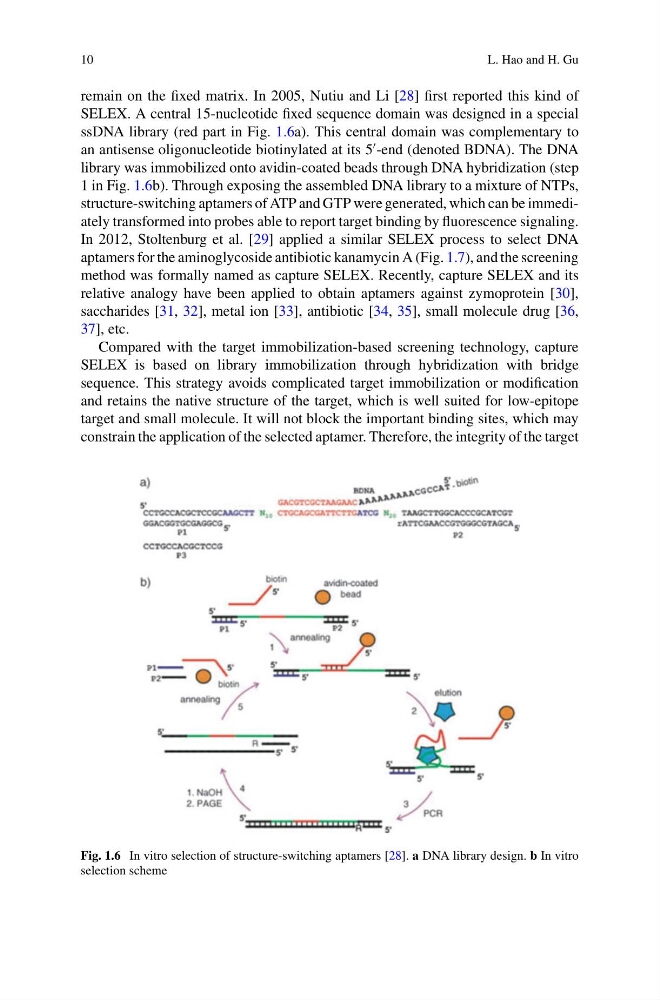
remain on the fixed matrix. In 2005, Nutiu and Li [28] first reported this kind of
SELEX. A central 15-nucleotide fixed sequence domain was designed in a special
ssDNA library (red part in Fig. 1.6a). This central domain was complementary to
an antisense oligonucleotide biotinylated at its 5
-end (denoted BDNA). The DNA
library was immobilized onto avidin-coated beads through DNA hybridization (step
1 in Fig. 1.6b). Through exposing the assembled DNA library to a mixture of NTPs,
structure-switching aptamers of ATP and GTP were generated, which can be immediately transformed into probes able to report target binding by fluorescence signaling.
In 2012, Stoltenburg et al. [29] applied a similar SELEX process to select DNA
aptamers for the aminoglycoside antibiotic kanamycin A (Fig. 1.7), and the screening
method was formally named as capture SELEX. Recently, capture SELEX and its
relative analogy have been applied to obtain aptamers against zymoprotein [30],
saccharides [31, 32], metal ion [33], antibiotic [34, 35], small molecule drug [36,
37], etc.
Compared with the target immobilization-based screening technology, capture
SELEX is based on library immobilization through hybridization with bridge
sequence. This strategy avoids complicated target immobilization or modification
and retains the native structure of the target, which is well suited for low-epitope
target and small molecule. It will not block the important binding sites, which may
constrain the application of the selected aptamer. Therefore, the integrity of the target
Fig. 1.6 In vitro selection of structure-switching aptamers [28]. a DNA library design. b In vitro
selection scheme
L. Hao and H. Gu
remain on the fixed matrix. In 2005, Nutiu and Li [28] first reported this kind of
SELEX. A central 15-nucleotide fixed sequence domain was designed in a special
ssDNA library (red part in Fig. 1.6a). This central domain was complementary to
an antisense oligonucleotide biotinylated at its 5
-end (denoted BDNA). The DNA
library was immobilized onto avidin-coated beads through DNA hybridization (step
1 in Fig. 1.6b). Through exposing the assembled DNA library to a mixture of NTPs,
structure-switching aptamers of ATP and GTP were generated, which can be immediately transformed into probes able to report target binding by fluorescence signaling.
In 2012, Stoltenburg et al. [29] applied a similar SELEX process to select DNA
aptamers for the aminoglycoside antibiotic kanamycin A (Fig. 1.7), and the screening
method was formally named as capture SELEX. Recently, capture SELEX and its
relative analogy have been applied to obtain aptamers against zymoprotein [30],
saccharides [31, 32], metal ion [33], antibiotic [34, 35], small molecule drug [36,
37], etc.
Compared with the target immobilization-based screening technology, capture
SELEX is based on library immobilization through hybridization with bridge
sequence. This strategy avoids complicated target immobilization or modification
and retains the native structure of the target, which is well suited for low-epitope
target and small molecule. It will not block the important binding sites, which may
constrain the application of the selected aptamer. Therefore, the integrity of the target
Fig. 1.6 In vitro selection of structure-switching aptamers [28]. a DNA library design. b In vitro
selection scheme