

124
B. Liu et al.
5.3 Aptamer-Based Medical Devices for Therapeutics
Taking together the aforementioned advantages, within the scope of medical devices,
it can be found that aptamers also have another promising potential in targeted
therapeutics.
Kim et al. [28] developed a target-specific photosensitizer (i.e., Chlorin e6, Ce6)
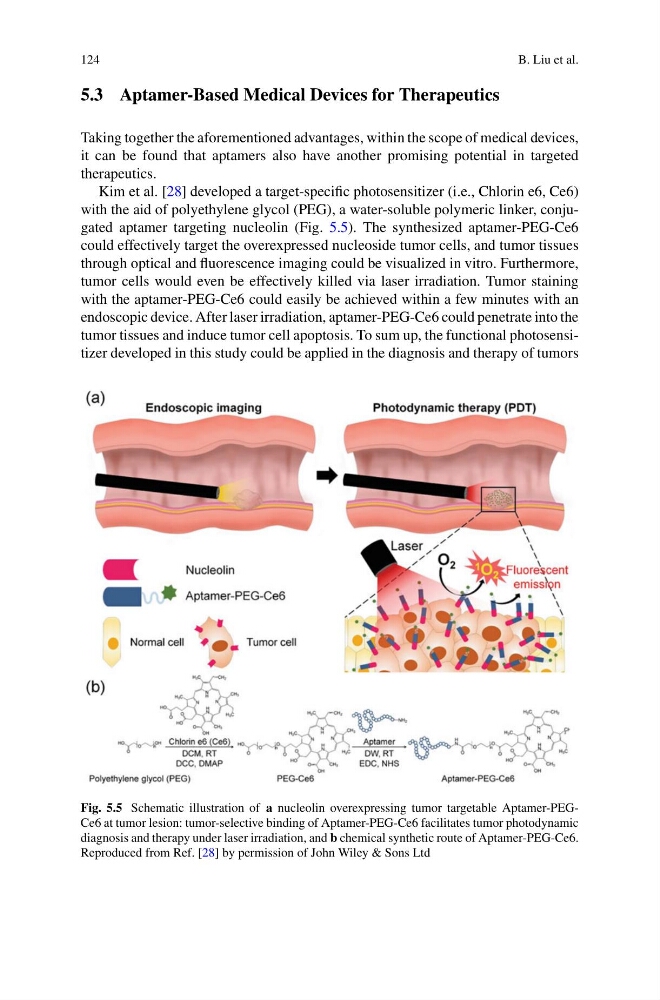
with the aid of polyethylene glycol (PEG), a water-soluble polymeric linker, conjugated aptamer targeting nucleolin (Fig. 5.5). The synthesized aptamer-PEG-Ce6
could effectively target the overexpressed nucleoside tumor cells, and tumor tissues
through optical and fluorescence imaging could be visualized in vitro. Furthermore,
tumor cells would even be effectively killed via laser irradiation. Tumor staining
with the aptamer-PEG-Ce6 could easily be achieved within a few minutes with an
endoscopic device. After laser irradiation, aptamer-PEG-Ce6 could penetrate into the
tumor tissues and induce tumor cell apoptosis. To sum up, the functional photosensitizer developed in this study could be applied in the diagnosis and therapy of tumors
Fig. 5.5 Schematic illustration of a nucleolin overexpressing tumor targetable Aptamer-PEGCe6 at tumor lesion: tumor-selective binding of Aptamer-PEG-Ce6 facilitates tumor photodynamic
diagnosis and therapy under laser irradiation, and b chemical synthetic route of Aptamer-PEG-Ce6.
Reproduced from Ref. [28] by permission of John Wiley & Sons Ltd
B. Liu et al.
5.3 Aptamer-Based Medical Devices for Therapeutics
Taking together the aforementioned advantages, within the scope of medical devices,
it can be found that aptamers also have another promising potential in targeted
therapeutics.
Kim et al. [28] developed a target-specific photosensitizer (i.e., Chlorin e6, Ce6)
with the aid of polyethylene glycol (PEG), a water-soluble polymeric linker, conjugated aptamer targeting nucleolin (Fig. 5.5). The synthesized aptamer-PEG-Ce6
could effectively target the overexpressed nucleoside tumor cells, and tumor tissues
through optical and fluorescence imaging could be visualized in vitro. Furthermore,
tumor cells would even be effectively killed via laser irradiation. Tumor staining
with the aptamer-PEG-Ce6 could easily be achieved within a few minutes with an
endoscopic device. After laser irradiation, aptamer-PEG-Ce6 could penetrate into the
tumor tissues and induce tumor cell apoptosis. To sum up, the functional photosensitizer developed in this study could be applied in the diagnosis and therapy of tumors
Fig. 5.5 Schematic illustration of a nucleolin overexpressing tumor targetable Aptamer-PEGCe6 at tumor lesion: tumor-selective binding of Aptamer-PEG-Ce6 facilitates tumor photodynamic
diagnosis and therapy under laser irradiation, and b chemical synthetic route of Aptamer-PEG-Ce6.
Reproduced from Ref. [28] by permission of John Wiley & Sons Ltd