

5 Aptamer-Based Medical Devices
125
under clinical endoscopy. Therefore, the development of intelligent photosensitizer
that can be applied to endoscopy will meet the existing unmet clinical needs of an
aptamer-based medical device.
Besides the phototherapy, aptamer-based technology has been applied in drug
delivery devices. For example, Bloembergen et al. [29] developed a drug delivery
device for active agents comprises nanoparticles based on a biopolymer. This drug
delivery device could be divided into three parts. The first part was the nanoparticle
comprising crosslinked biocompatible or resorbable polymers, which was modified
after the formation of the particles by chemical or enzymatic modification. The
second part was an encapsulated active agent within the colloidal hydrogel. Third
was an aptamer attached to the cross-linked polymers for the targeted drug delivery.
The delivery device could survive for a period of time in the body, which was sufficient
to allow for the sustained release of the drug and for the transportation and uptake
of the conjugate into targeted cells.
5.4 Perspectives and Insights
In the course of writing this chapter, we visited some hospitals and consulted relevant experts, in order to understand the requirements for medical devices from the
front-line medical practitioners. Their opinions basically focused on three aspects:
reliability of results, easy operation and low cost. With regard to aptamer-based
medical devices, aptamers as the core element can satisfy the demand of cost better
than antibodies when performing the same functions, and the appropriate design
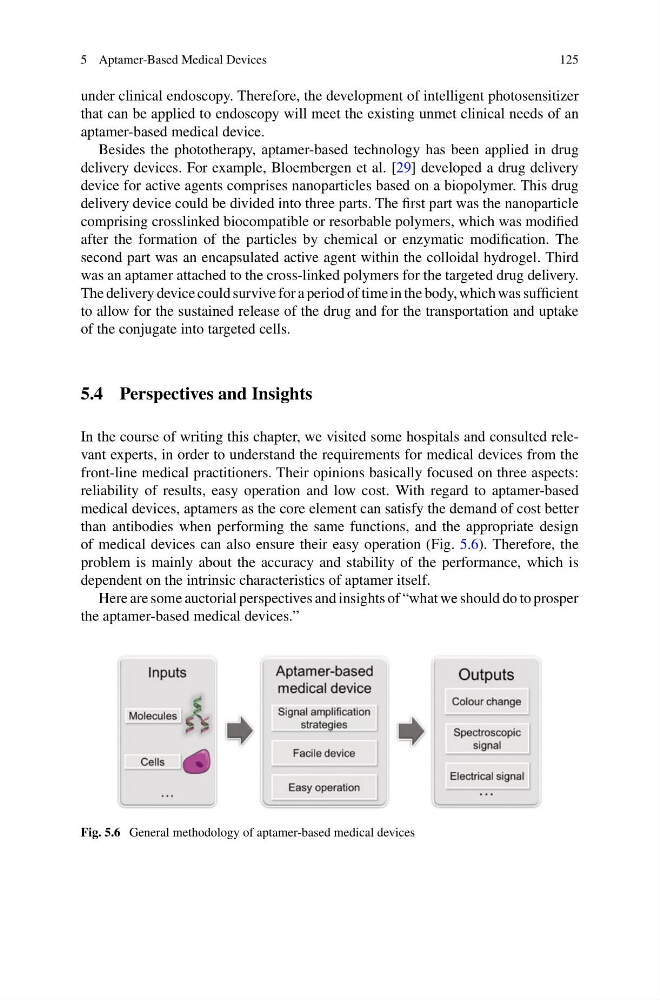
of medical devices can also ensure their easy operation (Fig. 5.6). Therefore, the
problem is mainly about the accuracy and stability of the performance, which is
dependent on the intrinsic characteristics of aptamer itself.
Here are some auctorial perspectives and insights of “what we should do to prosper
the aptamer-based medical devices.”
Fig. 5.6 General methodology of aptamer-based medical devices
125
under clinical endoscopy. Therefore, the development of intelligent photosensitizer
that can be applied to endoscopy will meet the existing unmet clinical needs of an
aptamer-based medical device.
Besides the phototherapy, aptamer-based technology has been applied in drug
delivery devices. For example, Bloembergen et al. [29] developed a drug delivery
device for active agents comprises nanoparticles based on a biopolymer. This drug
delivery device could be divided into three parts. The first part was the nanoparticle
comprising crosslinked biocompatible or resorbable polymers, which was modified
after the formation of the particles by chemical or enzymatic modification. The
second part was an encapsulated active agent within the colloidal hydrogel. Third
was an aptamer attached to the cross-linked polymers for the targeted drug delivery.
The delivery device could survive for a period of time in the body, which was sufficient
to allow for the sustained release of the drug and for the transportation and uptake
of the conjugate into targeted cells.
5.4 Perspectives and Insights
In the course of writing this chapter, we visited some hospitals and consulted relevant experts, in order to understand the requirements for medical devices from the
front-line medical practitioners. Their opinions basically focused on three aspects:
reliability of results, easy operation and low cost. With regard to aptamer-based
medical devices, aptamers as the core element can satisfy the demand of cost better
than antibodies when performing the same functions, and the appropriate design
of medical devices can also ensure their easy operation (Fig. 5.6). Therefore, the
problem is mainly about the accuracy and stability of the performance, which is
dependent on the intrinsic characteristics of aptamer itself.
Here are some auctorial perspectives and insights of “what we should do to prosper
the aptamer-based medical devices.”
Fig. 5.6 General methodology of aptamer-based medical devices