

5 Aptamer-Based Medical Devices
123
The urine could contact one or more aptamers within the medical toilet after the
normal urination of the user. The aptamers included at least one binding site for one
or more components of a user’s urine. The aptamers might be related to the generation
of an electrochemical signal, a fluorescent signal, or a colorimetric signal.
Being easy in operation, rapid in detection and competitive in cost, lateral flow
immunoassay (LFIA) strip is a kind of convenient medical device widely applied in
diagnosis. Exosomes are extracellular vesicles secreted by various cells under normal
and pathological conditions. They have a variety of structural and functional features,
which have gradually promoted them to become the hot research spot in recent years.
Tumor-derived exosomes participate in some crucial pathological processes and lead
to the growth and invasion of tumors. These exosomes can be medically identified
through the specific characterization of membrane proteins. Inspired by LFIA and
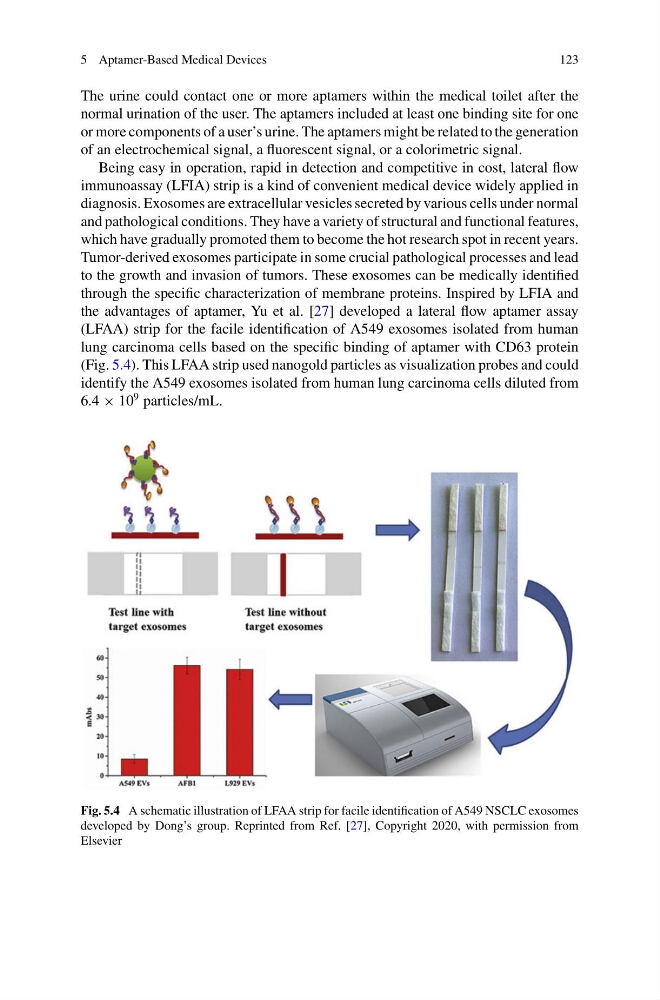
the advantages of aptamer, Yu et al. [27] developed a lateral flow aptamer assay
(LFAA) strip for the facile identification of A549 exosomes isolated from human
lung carcinoma cells based on the specific binding of aptamer with CD63 protein
(Fig. 5.4). This LFAA strip used nanogold particles as visualization probes and could
identify the A549 exosomes isolated from human lung carcinoma cells diluted from
6.4 × 10
9 particles/mL.
Fig. 5.4 A schematic illustration of LFAA strip for facile identification of A549 NSCLC exosomes
developed by Dong’s group. Reprinted from Ref. [27], Copyright 2020, with permission from
Elsevier
123
The urine could contact one or more aptamers within the medical toilet after the
normal urination of the user. The aptamers included at least one binding site for one
or more components of a user’s urine. The aptamers might be related to the generation
of an electrochemical signal, a fluorescent signal, or a colorimetric signal.
Being easy in operation, rapid in detection and competitive in cost, lateral flow
immunoassay (LFIA) strip is a kind of convenient medical device widely applied in
diagnosis. Exosomes are extracellular vesicles secreted by various cells under normal
and pathological conditions. They have a variety of structural and functional features,
which have gradually promoted them to become the hot research spot in recent years.
Tumor-derived exosomes participate in some crucial pathological processes and lead
to the growth and invasion of tumors. These exosomes can be medically identified
through the specific characterization of membrane proteins. Inspired by LFIA and
the advantages of aptamer, Yu et al. [27] developed a lateral flow aptamer assay
(LFAA) strip for the facile identification of A549 exosomes isolated from human
lung carcinoma cells based on the specific binding of aptamer with CD63 protein
(Fig. 5.4). This LFAA strip used nanogold particles as visualization probes and could
identify the A549 exosomes isolated from human lung carcinoma cells diluted from
6.4 × 10
9 particles/mL.
Fig. 5.4 A schematic illustration of LFAA strip for facile identification of A549 NSCLC exosomes
developed by Dong’s group. Reprinted from Ref. [27], Copyright 2020, with permission from
Elsevier