

Kinematic and Kinetic Analysis of a Biomechanical Model
57
loading mesh files of skeletons (i.e. individual bones). Animatlab also provides a platform
to design a synthetic nervous system (SNS) to actuate muscles and receive proprioceptive
feedback. Our model has a simplified skeleton as described previously [1] to reduce
simulation time needed to tune the neural parameters. The segments have biologically
appropriate dimensional and inertial properties but are implemented with simplified
geometrical shapes to speed the simulation. Also, the rat hindlimb model is limited to
motion in the sagittal plane. All the muscle properties and insertion points come from
the work of Johnson [8] and are transformed from bone centric coordinate systems to
Animatlab local coordinate systems to better fit our model [9].
Before this work, there was few biomechanical hindlimb models simulating walking
with biarticular muscles, and the neural control strategies used to control them are not
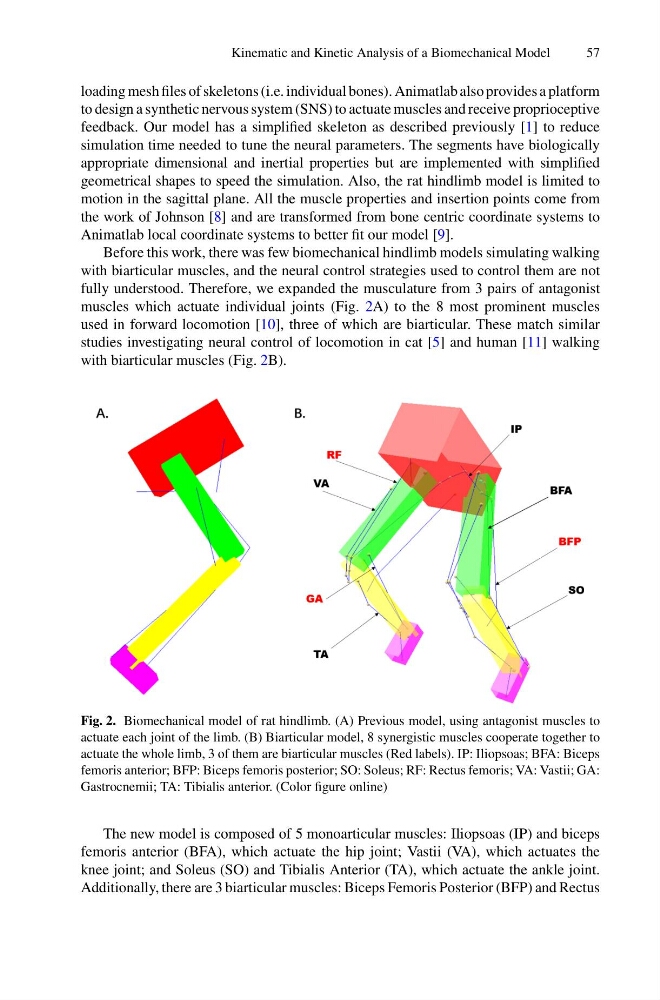
fully understood. Therefore, we expanded the musculature from 3 pairs of antagonist
muscles which actuate individual joints (Fig. 2A) to the 8 most prominent muscles
used in forward locomotion [10], three of which are biarticular. These match similar
studies investigating neural control of locomotion in cat [5] and human [11] walking
with biarticular muscles (Fig. 2B).
Fig. 2. Biomechanical model of rat hindlimb. (A) Previous model, using antagonist muscles to
actuate each joint of the limb. (B) Biarticular model, 8 synergistic muscles cooperate together to
actuate the whole limb, 3 of them are biarticular muscles (Red labels). IP: Iliopsoas; BFA: Biceps
femoris anterior; BFP: Biceps femoris posterior; SO: Soleus; RF: Rectus femoris; VA: Vastii; GA:
Gastrocnemii; TA: Tibialis anterior. (Color figure online)
The new model is composed of 5 monoarticular muscles: Iliopsoas (IP) and biceps
femoris anterior (BFA), which actuate the hip joint; Vastii (VA), which actuates the
knee joint; and Soleus (SO) and Tibialis Anterior (TA), which actuate the ankle joint.
Additionally, there are 3 biarticular muscles: Biceps Femoris Posterior (BFP) and Rectus
57
loading mesh files of skeletons (i.e. individual bones). Animatlab also provides a platform
to design a synthetic nervous system (SNS) to actuate muscles and receive proprioceptive
feedback. Our model has a simplified skeleton as described previously [1] to reduce
simulation time needed to tune the neural parameters. The segments have biologically
appropriate dimensional and inertial properties but are implemented with simplified
geometrical shapes to speed the simulation. Also, the rat hindlimb model is limited to
motion in the sagittal plane. All the muscle properties and insertion points come from
the work of Johnson [8] and are transformed from bone centric coordinate systems to
Animatlab local coordinate systems to better fit our model [9].
Before this work, there was few biomechanical hindlimb models simulating walking
with biarticular muscles, and the neural control strategies used to control them are not
fully understood. Therefore, we expanded the musculature from 3 pairs of antagonist
muscles which actuate individual joints (Fig. 2A) to the 8 most prominent muscles
used in forward locomotion [10], three of which are biarticular. These match similar
studies investigating neural control of locomotion in cat [5] and human [11] walking
with biarticular muscles (Fig. 2B).
Fig. 2. Biomechanical model of rat hindlimb. (A) Previous model, using antagonist muscles to
actuate each joint of the limb. (B) Biarticular model, 8 synergistic muscles cooperate together to
actuate the whole limb, 3 of them are biarticular muscles (Red labels). IP: Iliopsoas; BFA: Biceps
femoris anterior; BFP: Biceps femoris posterior; SO: Soleus; RF: Rectus femoris; VA: Vastii; GA:
Gastrocnemii; TA: Tibialis anterior. (Color figure online)
The new model is composed of 5 monoarticular muscles: Iliopsoas (IP) and biceps
femoris anterior (BFA), which actuate the hip joint; Vastii (VA), which actuates the
knee joint; and Soleus (SO) and Tibialis Anterior (TA), which actuate the ankle joint.
Additionally, there are 3 biarticular muscles: Biceps Femoris Posterior (BFP) and Rectus