

56
K. Deng et al.
walking, hopping, and non-resetting deletions when periodic motions were perturbed.
Also, its kinematics more closely matched those of the animal than the kinematics of
the former model (Fig. 1). However, the newer model still failed to produce animal-like
kinematics. It is possible that one major reason for this shortcoming is that it was actuated
by pairs of antagonistic muscles at each joint, unlike the legs of mammals, which are
overactuated. This poor kinematic modeling can also be found in other simplified models
[2–5].
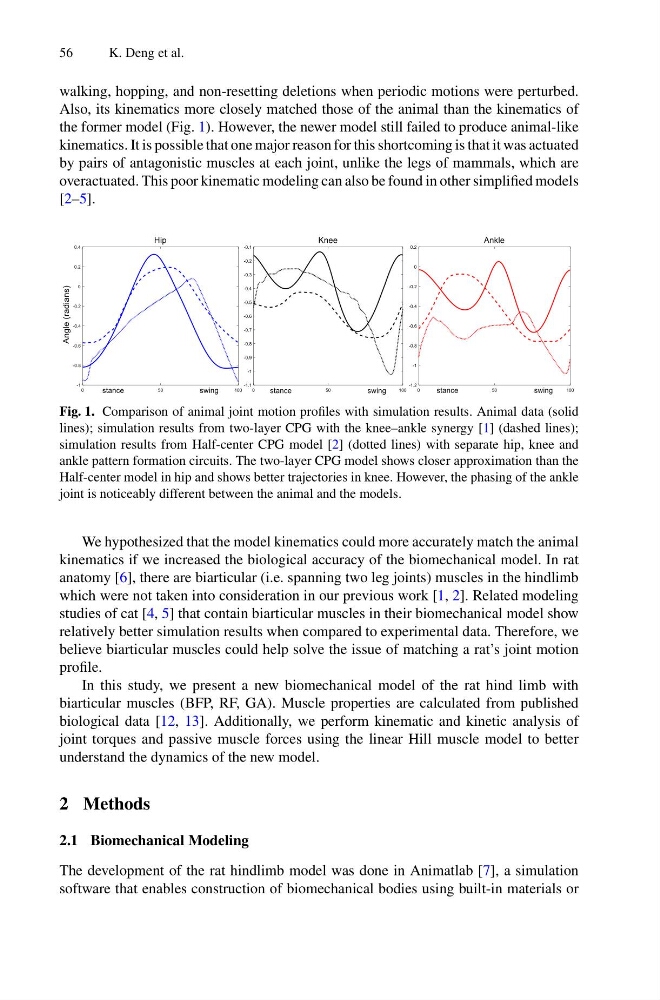
Fig. 1. Comparison of animal joint motion profiles with simulation results. Animal data (solid
lines); simulation results from two-layer CPG with the knee–ankle synergy [1] (dashed lines);
simulation results from Half-center CPG model [2] (dotted lines) with separate hip, knee and
ankle pattern formation circuits. The two-layer CPG model shows closer approximation than the
Half-center model in hip and shows better trajectories in knee. However, the phasing of the ankle
joint is noticeably different between the animal and the models.
We hypothesized that the model kinematics could more accurately match the animal
kinematics if we increased the biological accuracy of the biomechanical model. In rat
anatomy [6], there are biarticular (i.e. spanning two leg joints) muscles in the hindlimb
which were not taken into consideration in our previous work [1, 2]. Related modeling
studies of cat [4, 5] that contain biarticular muscles in their biomechanical model show
relatively better simulation results when compared to experimental data. Therefore, we
believe biarticular muscles could help solve the issue of matching a rat’s joint motion
profile.
In this study, we present a new biomechanical model of the rat hind limb with
biarticular muscles (BFP, RF, GA). Muscle properties are calculated from published
biological data [12, 13]. Additionally, we perform kinematic and kinetic analysis of
joint torques and passive muscle forces using the linear Hill muscle model to better
understand the dynamics of the new model.
2 Methods
2.1 Biomechanical Modeling
The development of the rat hindlimb model was done in Animatlab [7], a simulation
software that enables construction of biomechanical bodies using built-in materials or
K. Deng et al.
walking, hopping, and non-resetting deletions when periodic motions were perturbed.
Also, its kinematics more closely matched those of the animal than the kinematics of
the former model (Fig. 1). However, the newer model still failed to produce animal-like
kinematics. It is possible that one major reason for this shortcoming is that it was actuated
by pairs of antagonistic muscles at each joint, unlike the legs of mammals, which are
overactuated. This poor kinematic modeling can also be found in other simplified models
[2–5].
Fig. 1. Comparison of animal joint motion profiles with simulation results. Animal data (solid
lines); simulation results from two-layer CPG with the knee–ankle synergy [1] (dashed lines);
simulation results from Half-center CPG model [2] (dotted lines) with separate hip, knee and
ankle pattern formation circuits. The two-layer CPG model shows closer approximation than the
Half-center model in hip and shows better trajectories in knee. However, the phasing of the ankle
joint is noticeably different between the animal and the models.
We hypothesized that the model kinematics could more accurately match the animal
kinematics if we increased the biological accuracy of the biomechanical model. In rat
anatomy [6], there are biarticular (i.e. spanning two leg joints) muscles in the hindlimb
which were not taken into consideration in our previous work [1, 2]. Related modeling
studies of cat [4, 5] that contain biarticular muscles in their biomechanical model show
relatively better simulation results when compared to experimental data. Therefore, we
believe biarticular muscles could help solve the issue of matching a rat’s joint motion
profile.
In this study, we present a new biomechanical model of the rat hind limb with
biarticular muscles (BFP, RF, GA). Muscle properties are calculated from published
biological data [12, 13]. Additionally, we perform kinematic and kinetic analysis of
joint torques and passive muscle forces using the linear Hill muscle model to better
understand the dynamics of the new model.
2 Methods
2.1 Biomechanical Modeling
The development of the rat hindlimb model was done in Animatlab [7], a simulation
software that enables construction of biomechanical bodies using built-in materials or