

Spatio-Temporal Memory for Navigation in a Mushroom Body Model
423
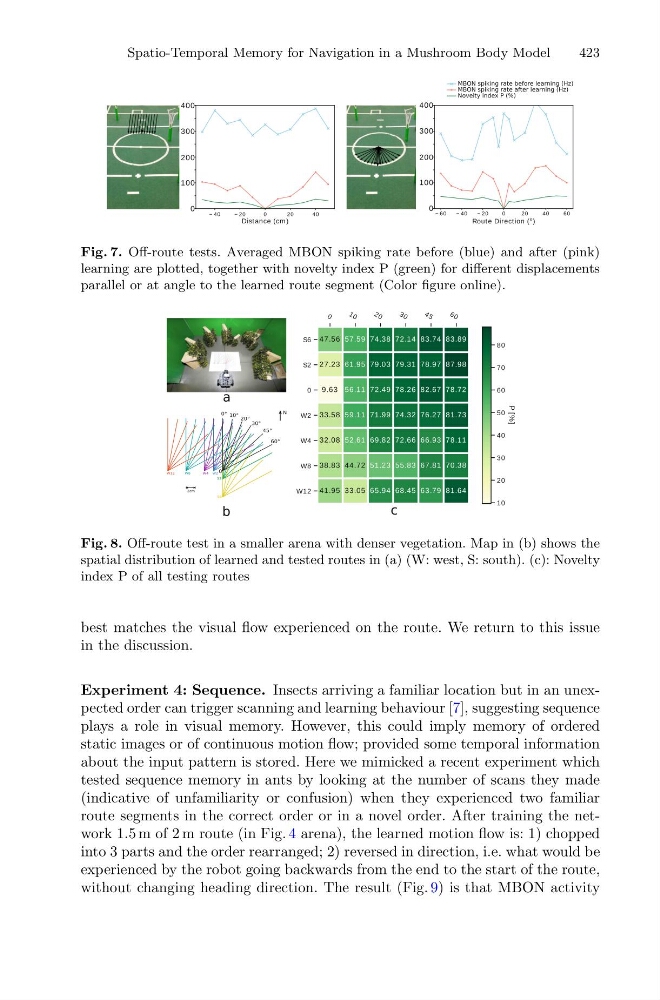
Fig. 7. Off-route tests. Averaged MBON spiking rate before (blue) and after (pink)
learning are plotted, together with novelty index P (green) for different displacements
parallel or at angle to the learned route segment (Color figure online).
Fig. 8. Off-route test in a smaller arena with denser vegetation. Map in (b) shows the
spatial distribution of learned and tested routes in (a) (W: west, S: south). (c): Novelty
index P of all testing routes
best matches the visual flow experienced on the route. We return to this issue
in the discussion.
Experiment 4: Sequence. Insects arriving a familiar location but in an unexpected order can trigger scanning and learning behaviour [7], suggesting sequence
plays a role in visual memory. However, this could imply memory of ordered
static images or of continuous motion flow; provided some temporal information
about the input pattern is stored. Here we mimicked a recent experiment which
tested sequence memory in ants by looking at the number of scans they made
(indicative of unfamiliarity or confusion) when they experienced two familiar
route segments in the correct order or in a novel order. After training the network 1.5 m of 2 m route (in Fig. 4 arena), the learned motion flow is: 1) chopped
into 3 parts and the order rearranged; 2) reversed in direction, i.e. what would be
experienced by the robot going backwards from the end to the start of the route,
without changing heading direction. The result (Fig. 9) is that MBON activity
423
Fig. 7. Off-route tests. Averaged MBON spiking rate before (blue) and after (pink)
learning are plotted, together with novelty index P (green) for different displacements
parallel or at angle to the learned route segment (Color figure online).
Fig. 8. Off-route test in a smaller arena with denser vegetation. Map in (b) shows the
spatial distribution of learned and tested routes in (a) (W: west, S: south). (c): Novelty
index P of all testing routes
best matches the visual flow experienced on the route. We return to this issue
in the discussion.
Experiment 4: Sequence. Insects arriving a familiar location but in an unexpected order can trigger scanning and learning behaviour [7], suggesting sequence
plays a role in visual memory. However, this could imply memory of ordered
static images or of continuous motion flow; provided some temporal information
about the input pattern is stored. Here we mimicked a recent experiment which
tested sequence memory in ants by looking at the number of scans they made
(indicative of unfamiliarity or confusion) when they experienced two familiar
route segments in the correct order or in a novel order. After training the network 1.5 m of 2 m route (in Fig. 4 arena), the learned motion flow is: 1) chopped
into 3 parts and the order rearranged; 2) reversed in direction, i.e. what would be
experienced by the robot going backwards from the end to the start of the route,
without changing heading direction. The result (Fig. 9) is that MBON activity