

422
L. Zhu et al.
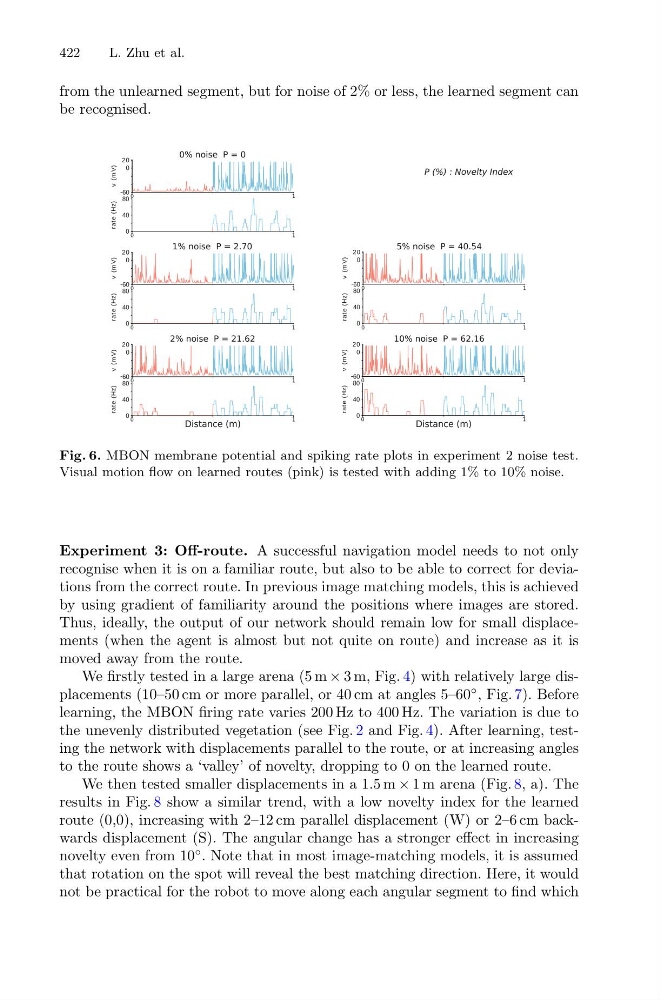
from the unlearned segment, but for noise of 2% or less, the learned segment can
be recognised.
Fig. 6. MBON membrane potential and spiking rate plots in experiment 2 noise test.
Visual motion flow on learned routes (pink) is tested with adding 1% to 10% noise.
Experiment 3: Off-route. A successful navigation model needs to not only
recognise when it is on a familiar route, but also to be able to correct for deviations from the correct route. In previous image matching models, this is achieved
by using gradient of familiarity around the positions where images are stored.
Thus, ideally, the output of our network should remain low for small displacements (when the agent is almost but not quite on route) and increase as it is
moved away from the route.
We firstly tested in a large arena (5 m × 3 m, Fig. 4) with relatively large displacements (10–50 cm or more parallel, or 40 cm at angles 5–60
◦ , Fig. 7). Before
learning, the MBON firing rate varies 200 Hz to 400 Hz. The variation is due to
the unevenly distributed vegetation (see Fig. 2 and Fig. 4). After learning, testing the network with displacements parallel to the route, or at increasing angles
to the route shows a ‘valley’ of novelty, dropping to 0 on the learned route.
We then tested smaller displacements in a 1.5 m × 1 m arena (Fig. 8, a). The
results in Fig. 8 show a similar trend, with a low novelty index for the learned
route (0,0), increasing with 2–12 cm parallel displacement (W) or 2–6 cm backwards displacement (S). The angular change has a stronger effect in increasing
novelty even from 10
◦ . Note that in most image-matching models, it is assumed
that rotation on the spot will reveal the best matching direction. Here, it would
not be practical for the robot to move along each angular segment to find which
L. Zhu et al.
from the unlearned segment, but for noise of 2% or less, the learned segment can
be recognised.
Fig. 6. MBON membrane potential and spiking rate plots in experiment 2 noise test.
Visual motion flow on learned routes (pink) is tested with adding 1% to 10% noise.
Experiment 3: Off-route. A successful navigation model needs to not only
recognise when it is on a familiar route, but also to be able to correct for deviations from the correct route. In previous image matching models, this is achieved
by using gradient of familiarity around the positions where images are stored.
Thus, ideally, the output of our network should remain low for small displacements (when the agent is almost but not quite on route) and increase as it is
moved away from the route.
We firstly tested in a large arena (5 m × 3 m, Fig. 4) with relatively large displacements (10–50 cm or more parallel, or 40 cm at angles 5–60
◦ , Fig. 7). Before
learning, the MBON firing rate varies 200 Hz to 400 Hz. The variation is due to
the unevenly distributed vegetation (see Fig. 2 and Fig. 4). After learning, testing the network with displacements parallel to the route, or at increasing angles
to the route shows a ‘valley’ of novelty, dropping to 0 on the learned route.
We then tested smaller displacements in a 1.5 m × 1 m arena (Fig. 8, a). The
results in Fig. 8 show a similar trend, with a low novelty index for the learned
route (0,0), increasing with 2–12 cm parallel displacement (W) or 2–6 cm backwards displacement (S). The angular change has a stronger effect in increasing
novelty even from 10
◦ . Note that in most image-matching models, it is assumed
that rotation on the spot will reveal the best matching direction. Here, it would
not be practical for the robot to move along each angular segment to find which