

424
L. Zhu et al.
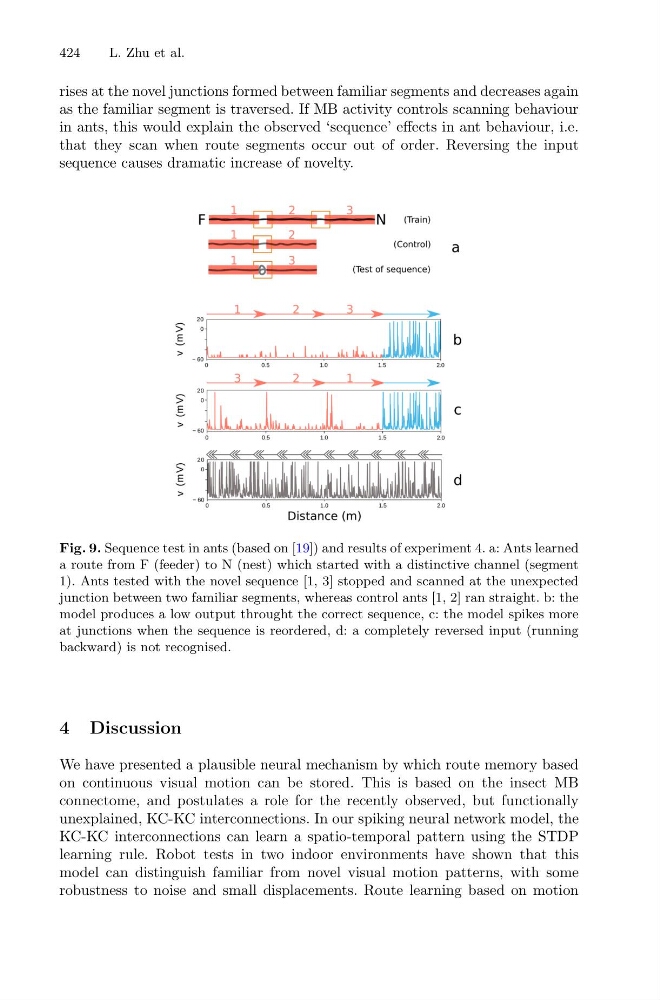
rises at the novel junctions formed between familiar segments and decreases again
as the familiar segment is traversed. If MB activity controls scanning behaviour
in ants, this would explain the observed ‘sequence’ effects in ant behaviour, i.e.
that they scan when route segments occur out of order. Reversing the input
sequence causes dramatic increase of novelty.
Fig. 9. Sequence test in ants (based on [19]) and results of experiment 4. a: Ants learned
a route from F (feeder) to N (nest) which started with a distinctive channel (segment
1). Ants tested with the novel sequence [1, 3] stopped and scanned at the unexpected
junction between two familiar segments, whereas control ants [1, 2] ran straight. b: the
model produces a low output throught the correct sequence, c: the model spikes more
at junctions when the sequence is reordered, d: a completely reversed input (running
backward) is not recognised.
4 Discussion
We have presented a plausible neural mechanism by which route memory based
on continuous visual motion can be stored. This is based on the insect MB
connectome, and postulates a role for the recently observed, but functionally
unexplained, KC-KC interconnections. In our spiking neural network model, the
KC-KC interconnections can learn a spatio-temporal pattern using the STDP
learning rule. Robot tests in two indoor environments have shown that this
model can distinguish familiar from novel visual motion patterns, with some
robustness to noise and small displacements. Route learning based on motion
L. Zhu et al.
rises at the novel junctions formed between familiar segments and decreases again
as the familiar segment is traversed. If MB activity controls scanning behaviour
in ants, this would explain the observed ‘sequence’ effects in ant behaviour, i.e.
that they scan when route segments occur out of order. Reversing the input
sequence causes dramatic increase of novelty.
Fig. 9. Sequence test in ants (based on [19]) and results of experiment 4. a: Ants learned
a route from F (feeder) to N (nest) which started with a distinctive channel (segment
1). Ants tested with the novel sequence [1, 3] stopped and scanned at the unexpected
junction between two familiar segments, whereas control ants [1, 2] ran straight. b: the
model produces a low output throught the correct sequence, c: the model spikes more
at junctions when the sequence is reordered, d: a completely reversed input (running
backward) is not recognised.
4 Discussion
We have presented a plausible neural mechanism by which route memory based
on continuous visual motion can be stored. This is based on the insect MB
connectome, and postulates a role for the recently observed, but functionally
unexplained, KC-KC interconnections. In our spiking neural network model, the
KC-KC interconnections can learn a spatio-temporal pattern using the STDP
learning rule. Robot tests in two indoor environments have shown that this
model can distinguish familiar from novel visual motion patterns, with some
robustness to noise and small displacements. Route learning based on motion