

Spatio-Temporal Memory for Navigation in a Mushroom Body Model
419
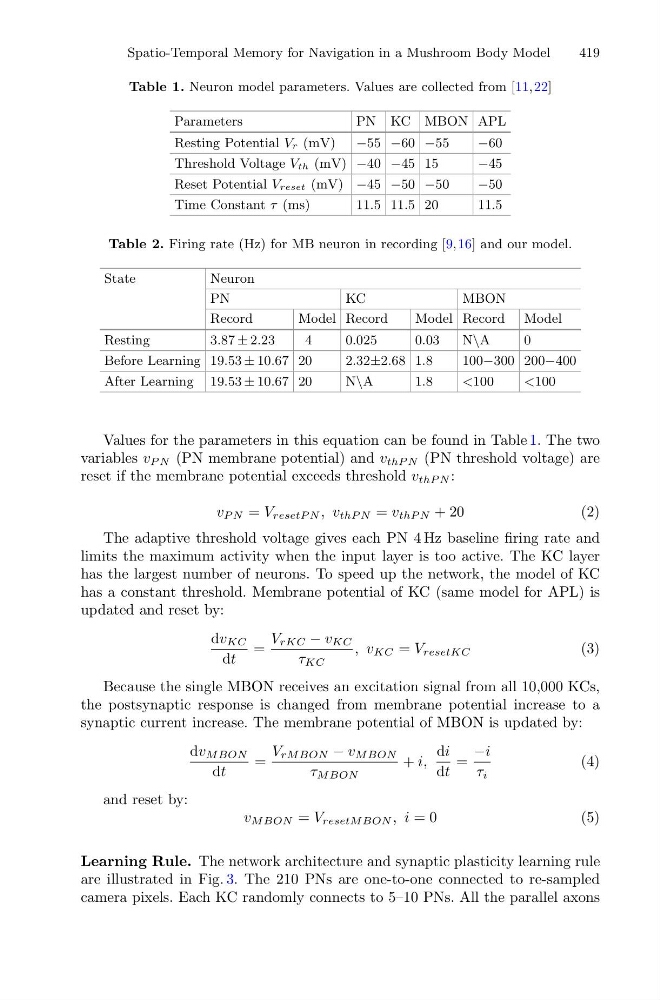
Table 1. Neuron model parameters. Values are collected from [11, 22]
Parameters
PN KC MBON APL
Resting Potential Vr (mV)
−55 −60 −55
−60
Threshold Voltage V th (mV) −40 −45 15
−45
Reset Potential Vreset (mV) −45 −50 −50
−50
Time Constant τ (ms)
11.5 11.5 20
11.5
Table 2. Firing rate (Hz) for MB neuron in recording [9, 16] and our model.
State
Neuron
PN
KC
MBON
Record
Model Record
Model Record Model
Resting
3.87 ± 2.23
4
0.025
0.03
N\A
0
Before Learning 19.53 ± 10.67 20
2.32±2.68 1.8
100−300 200−400
After Learning 19.53 ± 10.67 20
N\A
1.8
<100
<100
Values for the parameters in this equation can be found in Table 1. The two
variables v P N (PN membrane potential) and v thP N (PN threshold voltage) are
reset if the membrane potential exceeds threshold v thP N :
v P N = V resetP N , v thP N = v thP N + 20
(2)
The adaptive threshold voltage gives each PN 4 Hz baseline firing rate and
limits the maximum activity when the input layer is too active. The KC layer
has the largest number of neurons. To speed up the network, the model of KC
has a constant threshold. Membrane potential of KC (same model for APL) is
updated and reset by:
dv KC
dt
=
V rKC − v KC
τ KC
, v KC = V resetKC
(3)
Because the single MBON receives an excitation signal from all 10,000 KCs,
the postsynaptic response is changed from membrane potential increase to a
synaptic current increase. The membrane potential of MBON is updated by:
dv MBON
dt
=
V rM BON − v MBON
τ MBON
+ i,
di
dt
=
−i
τ i
(4)
and reset by:
v MBON = V resetM BON , i = 0
(5)
Learning Rule. The network architecture and synaptic plasticity learning rule
are illustrated in Fig. 3. The 210 PNs are one-to-one connected to re-sampled
camera pixels. Each KC randomly connects to 5–10 PNs. All the parallel axons
419
Table 1. Neuron model parameters. Values are collected from [11, 22]
Parameters
PN KC MBON APL
Resting Potential Vr (mV)
−55 −60 −55
−60
Threshold Voltage V th (mV) −40 −45 15
−45
Reset Potential Vreset (mV) −45 −50 −50
−50
Time Constant τ (ms)
11.5 11.5 20
11.5
Table 2. Firing rate (Hz) for MB neuron in recording [9, 16] and our model.
State
Neuron
PN
KC
MBON
Record
Model Record
Model Record Model
Resting
3.87 ± 2.23
4
0.025
0.03
N\A
0
Before Learning 19.53 ± 10.67 20
2.32±2.68 1.8
100−300 200−400
After Learning 19.53 ± 10.67 20
N\A
1.8
<100
<100
Values for the parameters in this equation can be found in Table 1. The two
variables v P N (PN membrane potential) and v thP N (PN threshold voltage) are
reset if the membrane potential exceeds threshold v thP N :
v P N = V resetP N , v thP N = v thP N + 20
(2)
The adaptive threshold voltage gives each PN 4 Hz baseline firing rate and
limits the maximum activity when the input layer is too active. The KC layer
has the largest number of neurons. To speed up the network, the model of KC
has a constant threshold. Membrane potential of KC (same model for APL) is
updated and reset by:
dv KC
dt
=
V rKC − v KC
τ KC
, v KC = V resetKC
(3)
Because the single MBON receives an excitation signal from all 10,000 KCs,
the postsynaptic response is changed from membrane potential increase to a
synaptic current increase. The membrane potential of MBON is updated by:
dv MBON
dt
=
V rM BON − v MBON
τ MBON
+ i,
di
dt
=
−i
τ i
(4)
and reset by:
v MBON = V resetM BON , i = 0
(5)
Learning Rule. The network architecture and synaptic plasticity learning rule
are illustrated in Fig. 3. The 210 PNs are one-to-one connected to re-sampled
camera pixels. Each KC randomly connects to 5–10 PNs. All the parallel axons