

420
L. Zhu et al.
of KCs terminate at the dendrite of MBON. KCs are divided into two lobes. In
each lobe, KCs are fully connected to each other by axon to axon connection.
During learning, active KCs will strengthen inhibitory connections to KCs that
fire shortly afterwards. Note this is an axon-axon inhibition, i.e., it inhibits the
output of the downstream KC onto the MBON, rather than the KC’s activation.
The KC-KC synapse weights are all 0 before learning and are altered by STDP.
Figure 3 visualises the learned KC-KC synapse based on a firing sequence example. After learning, when the same visual flow occurs, the KC firing sequence will
be the same. Excitation from KCs to MBON will be weakened, due to the inhibition generated precisely for this sequence. The output can thus be interpreted
as the (un)familiarity between current visual flow and stored memories.
3 Experiments and Results
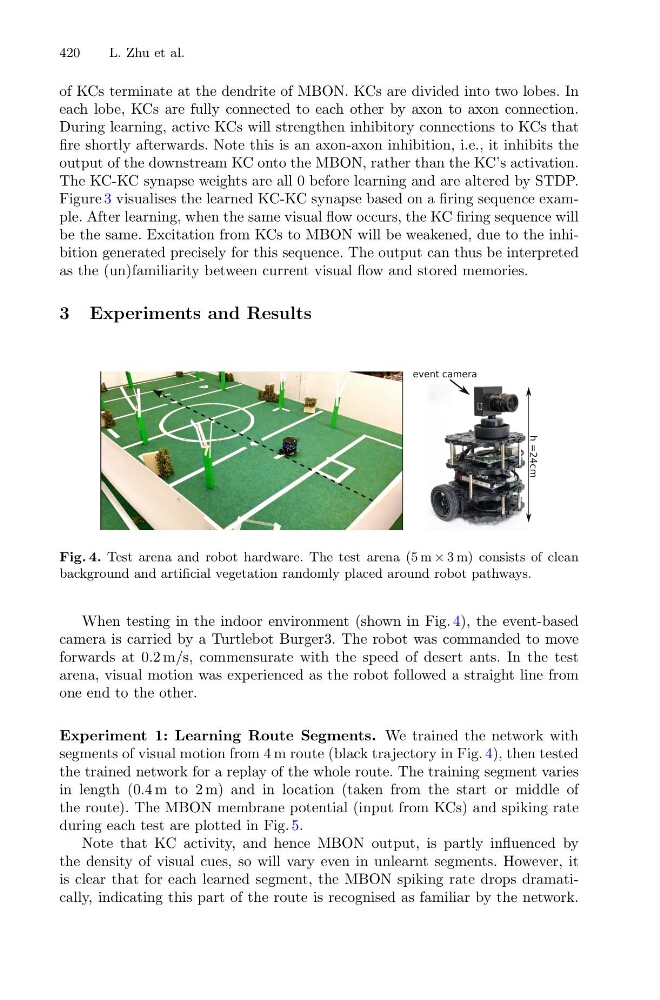
Fig. 4. Test arena and robot hardware. The test arena (5 m × 3 m) consists of clean
background and artificial vegetation randomly placed around robot pathways.
When testing in the indoor environment (shown in Fig. 4), the event-based
camera is carried by a Turtlebot Burger3. The robot was commanded to move
forwards at 0.2 m/s, commensurate with the speed of desert ants. In the test
arena, visual motion was experienced as the robot followed a straight line from
one end to the other.
Experiment 1: Learning Route Segments. We trained the network with
segments of visual motion from 4 m route (black trajectory in Fig. 4), then tested
the trained network for a replay of the whole route. The training segment varies
in length (0.4 m to 2 m) and in location (taken from the start or middle of
the route). The MBON membrane potential (input from KCs) and spiking rate
during each test are plotted in Fig. 5.
Note that KC activity, and hence MBON output, is partly influenced by
the density of visual cues, so will vary even in unlearnt segments. However, it
is clear that for each learned segment, the MBON spiking rate drops dramatically, indicating this part of the route is recognised as familiar by the network.
L. Zhu et al.
of KCs terminate at the dendrite of MBON. KCs are divided into two lobes. In
each lobe, KCs are fully connected to each other by axon to axon connection.
During learning, active KCs will strengthen inhibitory connections to KCs that
fire shortly afterwards. Note this is an axon-axon inhibition, i.e., it inhibits the
output of the downstream KC onto the MBON, rather than the KC’s activation.
The KC-KC synapse weights are all 0 before learning and are altered by STDP.
Figure 3 visualises the learned KC-KC synapse based on a firing sequence example. After learning, when the same visual flow occurs, the KC firing sequence will
be the same. Excitation from KCs to MBON will be weakened, due to the inhibition generated precisely for this sequence. The output can thus be interpreted
as the (un)familiarity between current visual flow and stored memories.
3 Experiments and Results
Fig. 4. Test arena and robot hardware. The test arena (5 m × 3 m) consists of clean
background and artificial vegetation randomly placed around robot pathways.
When testing in the indoor environment (shown in Fig. 4), the event-based
camera is carried by a Turtlebot Burger3. The robot was commanded to move
forwards at 0.2 m/s, commensurate with the speed of desert ants. In the test
arena, visual motion was experienced as the robot followed a straight line from
one end to the other.
Experiment 1: Learning Route Segments. We trained the network with
segments of visual motion from 4 m route (black trajectory in Fig. 4), then tested
the trained network for a replay of the whole route. The training segment varies
in length (0.4 m to 2 m) and in location (taken from the start or middle of
the route). The MBON membrane potential (input from KCs) and spiking rate
during each test are plotted in Fig. 5.
Note that KC activity, and hence MBON output, is partly influenced by
the density of visual cues, so will vary even in unlearnt segments. However, it
is clear that for each learned segment, the MBON spiking rate drops dramatically, indicating this part of the route is recognised as familiar by the network.