

Using Animatlab for Neuromechanical Analysis
409
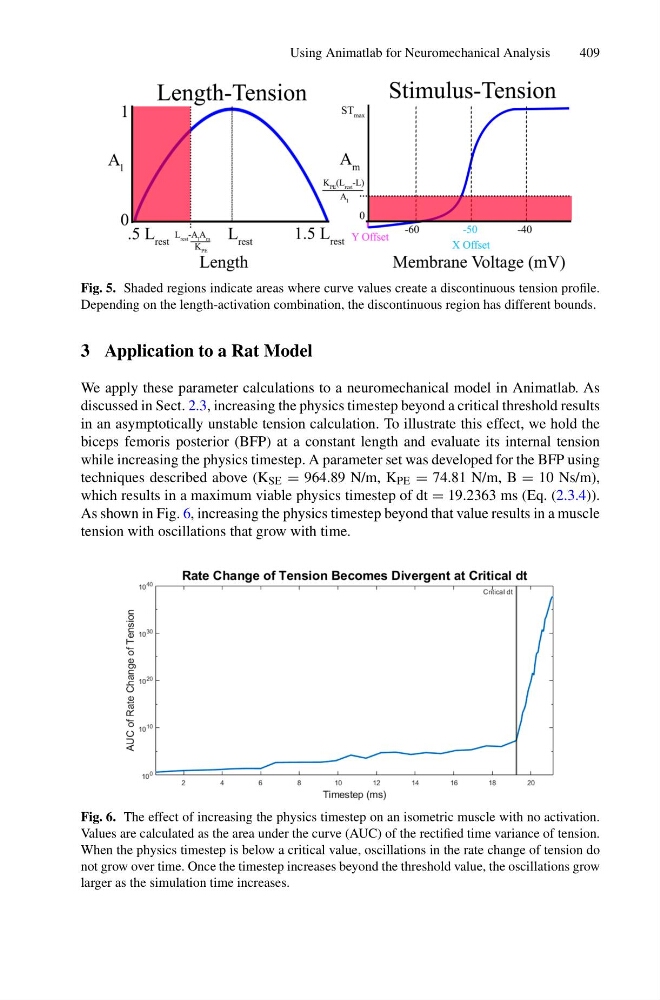
Fig. 5. Shaded regions indicate areas where curve values create a discontinuous tension profile.
Depending on the length-activation combination, the discontinuous region has different bounds.
3 Application to a Rat Model
We apply these parameter calculations to a neuromechanical model in Animatlab. As
discussed in Sect. 2.3, increasing the physics timestep beyond a critical threshold results
in an asymptotically unstable tension calculation. To illustrate this effect, we hold the
biceps femoris posterior (BFP) at a constant length and evaluate its internal tension
while increasing the physics timestep. A parameter set was developed for the BFP using
techniques described above (K SE = 964.89 N/m, K PE = 74.81 N/m, B = 10 Ns/m),
which results in a maximum viable physics timestep of dt = 19.2363 ms (Eq. (2.3.4)).
As shown in Fig. 6, increasing the physics timestep beyond that value results in a muscle
tension with oscillations that grow with time.
Fig. 6. The effect of increasing the physics timestep on an isometric muscle with no activation.
Values are calculated as the area under the curve (AUC) of the rectified time variance of tension.
When the physics timestep is below a critical value, oscillations in the rate change of tension do
not grow over time. Once the timestep increases beyond the threshold value, the oscillations grow
larger as the simulation time increases.
409
Fig. 5. Shaded regions indicate areas where curve values create a discontinuous tension profile.
Depending on the length-activation combination, the discontinuous region has different bounds.
3 Application to a Rat Model
We apply these parameter calculations to a neuromechanical model in Animatlab. As
discussed in Sect. 2.3, increasing the physics timestep beyond a critical threshold results
in an asymptotically unstable tension calculation. To illustrate this effect, we hold the
biceps femoris posterior (BFP) at a constant length and evaluate its internal tension
while increasing the physics timestep. A parameter set was developed for the BFP using
techniques described above (K SE = 964.89 N/m, K PE = 74.81 N/m, B = 10 Ns/m),
which results in a maximum viable physics timestep of dt = 19.2363 ms (Eq. (2.3.4)).
As shown in Fig. 6, increasing the physics timestep beyond that value results in a muscle
tension with oscillations that grow with time.
Fig. 6. The effect of increasing the physics timestep on an isometric muscle with no activation.
Values are calculated as the area under the curve (AUC) of the rectified time variance of tension.
When the physics timestep is below a critical value, oscillations in the rate change of tension do
not grow over time. Once the timestep increases beyond the threshold value, the oscillations grow
larger as the simulation time increases.