

408
F. Young et al.
distribution optimization process attempts to utilize muscles that are within a tension
deadzone. Avoiding the region in which valid length-activation combinations do not
generate tension is important for determining locomotion-driving muscle tension.
Muscle is only capable of generating contractile tension, a quality that is not well
reflected in spring-damper muscle models that are agnostic to force directionality. For
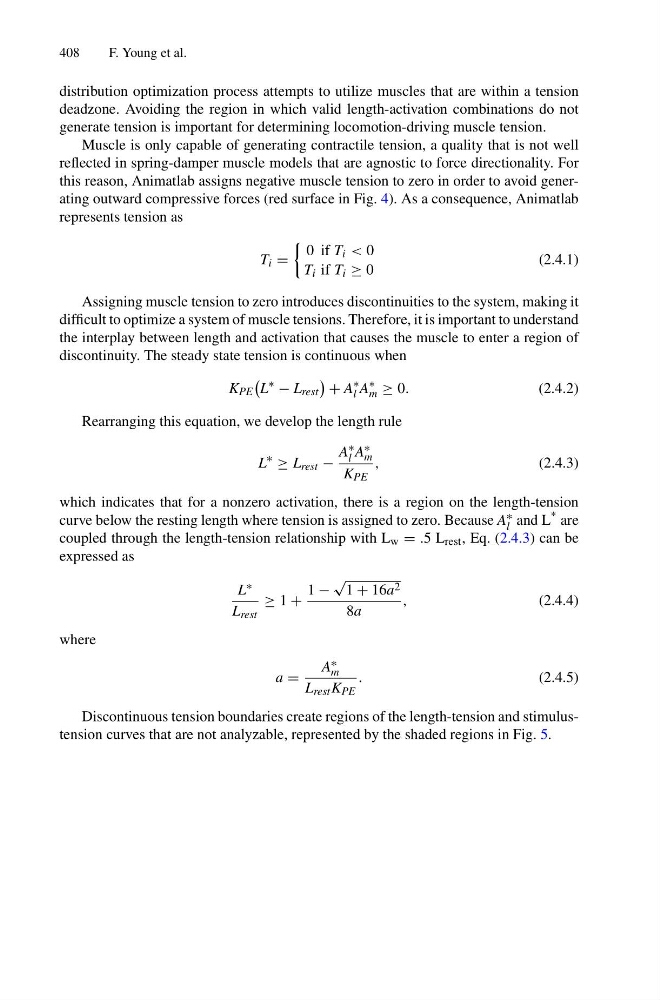
this reason, Animatlab assigns negative muscle tension to zero in order to avoid generating outward compressive forces (red surface in Fig. 4). As a consequence, Animatlab
represents tension as
T i =
0
T i
if T i < 0
if T i ≥ 0
(2.4.1)
Assigning muscle tension to zero introduces discontinuities to the system, making it
difficult to optimize a system of muscle tensions. Therefore, it is important to understand
the interplay between length and activation that causes the muscle to enter a region of
discontinuity. The steady state tension is continuous when
K PE
L
∗
− L rest
+ A
∗
l A
∗
m ≥ 0.
(2.4.2)
Rearranging this equation, we develop the length rule
L
∗
≥ L rest −
A ∗
l A ∗
m
K PE
,
(2.4.3)
which indicates that for a nonzero activation, there is a region on the length-tension
curve below the resting length where tension is assigned to zero. Because A ∗
l and L * are
coupled through the length-tension relationship with L w = .5 L rest , Eq. (2.4.3) can be
expressed as
L ∗
L rest
≥ 1 +
1 −
√
1 + 16a 2
8a
,
(2.4.4)
where
a =
A ∗
m
L rest K PE
.
(2.4.5)
Discontinuous tension boundaries create regions of the length-tension and stimulustension curves that are not analyzable, represented by the shaded regions in Fig. 5.
F. Young et al.
distribution optimization process attempts to utilize muscles that are within a tension
deadzone. Avoiding the region in which valid length-activation combinations do not
generate tension is important for determining locomotion-driving muscle tension.
Muscle is only capable of generating contractile tension, a quality that is not well
reflected in spring-damper muscle models that are agnostic to force directionality. For
this reason, Animatlab assigns negative muscle tension to zero in order to avoid generating outward compressive forces (red surface in Fig. 4). As a consequence, Animatlab
represents tension as
T i =
0
T i
if T i < 0
if T i ≥ 0
(2.4.1)
Assigning muscle tension to zero introduces discontinuities to the system, making it
difficult to optimize a system of muscle tensions. Therefore, it is important to understand
the interplay between length and activation that causes the muscle to enter a region of
discontinuity. The steady state tension is continuous when
K PE
L
∗
− L rest
+ A
∗
l A
∗
m ≥ 0.
(2.4.2)
Rearranging this equation, we develop the length rule
L
∗
≥ L rest −
A ∗
l A ∗
m
K PE
,
(2.4.3)
which indicates that for a nonzero activation, there is a region on the length-tension
curve below the resting length where tension is assigned to zero. Because A ∗
l and L * are
coupled through the length-tension relationship with L w = .5 L rest , Eq. (2.4.3) can be
expressed as
L ∗
L rest
≥ 1 +
1 −
√
1 + 16a 2
8a
,
(2.4.4)
where
a =
A ∗
m
L rest K PE
.
(2.4.5)
Discontinuous tension boundaries create regions of the length-tension and stimulustension curves that are not analyzable, represented by the shaded regions in Fig. 5.