

410
F. Young et al.
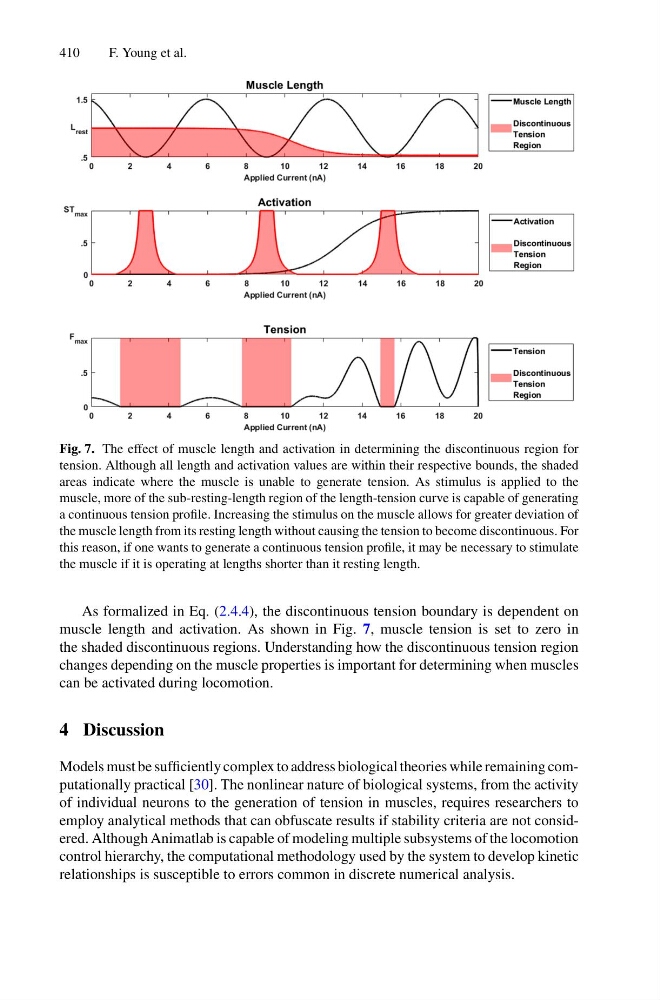
Fig. 7. The effect of muscle length and activation in determining the discontinuous region for
tension. Although all length and activation values are within their respective bounds, the shaded
areas indicate where the muscle is unable to generate tension. As stimulus is applied to the
muscle, more of the sub-resting-length region of the length-tension curve is capable of generating
a continuous tension profile. Increasing the stimulus on the muscle allows for greater deviation of
the muscle length from its resting length without causing the tension to become discontinuous. For
this reason, if one wants to generate a continuous tension profile, it may be necessary to stimulate
the muscle if it is operating at lengths shorter than it resting length.
As formalized in Eq. (2.4.4), the discontinuous tension boundary is dependent on
muscle length and activation. As shown in Fig. 7, muscle tension is set to zero in
the shaded discontinuous regions. Understanding how the discontinuous tension region
changes depending on the muscle properties is important for determining when muscles
can be activated during locomotion.
4 Discussion
Models must be sufficiently complex to address biological theories while remaining computationally practical [30]. The nonlinear nature of biological systems, from the activity
of individual neurons to the generation of tension in muscles, requires researchers to
employ analytical methods that can obfuscate results if stability criteria are not considered. Although Animatlab is capable of modeling multiple subsystems of the locomotion
control hierarchy, the computational methodology used by the system to develop kinetic
relationships is susceptible to errors common in discrete numerical analysis.
F. Young et al.
Fig. 7. The effect of muscle length and activation in determining the discontinuous region for
tension. Although all length and activation values are within their respective bounds, the shaded
areas indicate where the muscle is unable to generate tension. As stimulus is applied to the
muscle, more of the sub-resting-length region of the length-tension curve is capable of generating
a continuous tension profile. Increasing the stimulus on the muscle allows for greater deviation of
the muscle length from its resting length without causing the tension to become discontinuous. For
this reason, if one wants to generate a continuous tension profile, it may be necessary to stimulate
the muscle if it is operating at lengths shorter than it resting length.
As formalized in Eq. (2.4.4), the discontinuous tension boundary is dependent on
muscle length and activation. As shown in Fig. 7, muscle tension is set to zero in
the shaded discontinuous regions. Understanding how the discontinuous tension region
changes depending on the muscle properties is important for determining when muscles
can be activated during locomotion.
4 Discussion
Models must be sufficiently complex to address biological theories while remaining computationally practical [30]. The nonlinear nature of biological systems, from the activity
of individual neurons to the generation of tension in muscles, requires researchers to
employ analytical methods that can obfuscate results if stability criteria are not considered. Although Animatlab is capable of modeling multiple subsystems of the locomotion
control hierarchy, the computational methodology used by the system to develop kinetic
relationships is susceptible to errors common in discrete numerical analysis.