

Using Animatlab for Neuromechanical Analysis
405
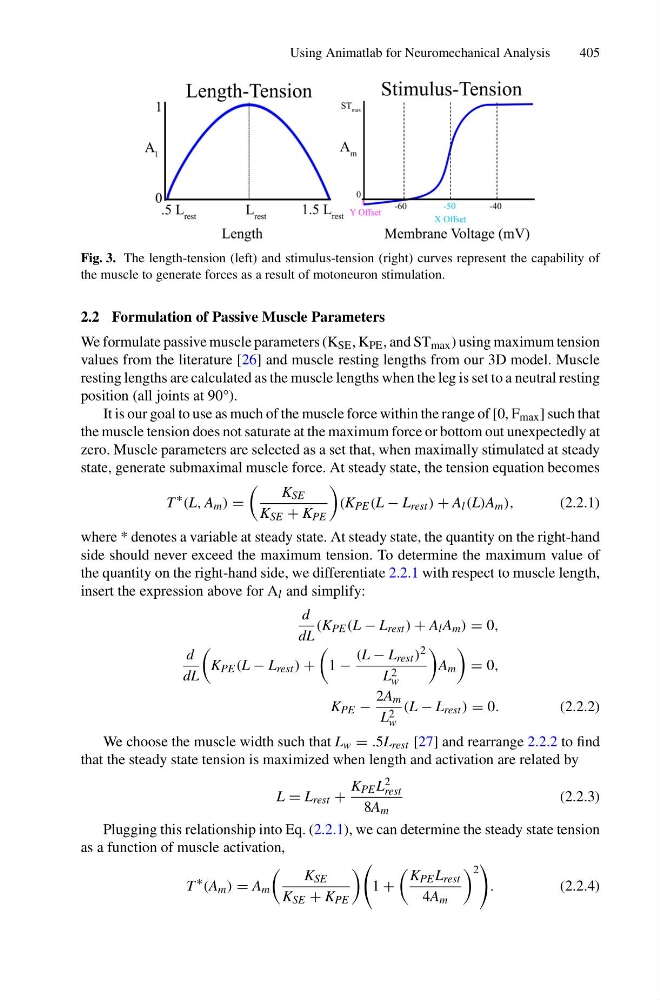
Fig. 3. The length-tension (left) and stimulus-tension (right) curves represent the capability of
the muscle to generate forces as a result of motoneuron stimulation.
2.2 Formulation of Passive Muscle Parameters
We formulate passive muscle parameters (K SE , K PE , and ST max ) using maximum tension
values from the literature [26] and muscle resting lengths from our 3D model. Muscle
resting lengths are calculated as the muscle lengths when the leg is set to a neutral resting
position (all joints at 90°).
It is our goal to use as much of the muscle force within the range of [0, F max ] such that
the muscle tension does not saturate at the maximum force or bottom out unexpectedly at
zero. Muscle parameters are selected as a set that, when maximally stimulated at steady
state, generate submaximal muscle force. At steady state, the tension equation becomes
T
∗
(L, A m ) =
K SE
K SE + K PE
(K PE (L − L rest ) + A l (L)A m ),
(2.2.1)
where * denotes a variable at steady state. At steady state, the quantity on the right-hand
side should never exceed the maximum tension. To determine the maximum value of
the quantity on the right-hand side, we differentiate 2.2.1 with respect to muscle length,
insert the expression above for A l and simplify:
d
dL
(K PE (L − L rest ) + A l A m ) = 0,
d
dL
K PE (L − L rest ) +
1 −
(L − L rest ) 2
L 2
w
A m
= 0,
K PE −
2A m
L 2
w
(L − L rest ) = 0.
(2.2.2)
We choose the muscle width such that L w = .5L rest [27] and rearrange 2.2.2 to find
that the steady state tension is maximized when length and activation are related by
L = L rest +
K PE L 2
rest
8A m
(2.2.3)
Plugging this relationship into Eq. (2.2.1), we can determine the steady state tension
as a function of muscle activation,
T
∗
(A m ) = A m
K SE
K SE + K PE
1 +
K PE L rest
4A m
2
.
(2.2.4)
405
Fig. 3. The length-tension (left) and stimulus-tension (right) curves represent the capability of
the muscle to generate forces as a result of motoneuron stimulation.
2.2 Formulation of Passive Muscle Parameters
We formulate passive muscle parameters (K SE , K PE , and ST max ) using maximum tension
values from the literature [26] and muscle resting lengths from our 3D model. Muscle
resting lengths are calculated as the muscle lengths when the leg is set to a neutral resting
position (all joints at 90°).
It is our goal to use as much of the muscle force within the range of [0, F max ] such that
the muscle tension does not saturate at the maximum force or bottom out unexpectedly at
zero. Muscle parameters are selected as a set that, when maximally stimulated at steady
state, generate submaximal muscle force. At steady state, the tension equation becomes
T
∗
(L, A m ) =
K SE
K SE + K PE
(K PE (L − L rest ) + A l (L)A m ),
(2.2.1)
where * denotes a variable at steady state. At steady state, the quantity on the right-hand
side should never exceed the maximum tension. To determine the maximum value of
the quantity on the right-hand side, we differentiate 2.2.1 with respect to muscle length,
insert the expression above for A l and simplify:
d
dL
(K PE (L − L rest ) + A l A m ) = 0,
d
dL
K PE (L − L rest ) +
1 −
(L − L rest ) 2
L 2
w
A m
= 0,
K PE −
2A m
L 2
w
(L − L rest ) = 0.
(2.2.2)
We choose the muscle width such that L w = .5L rest [27] and rearrange 2.2.2 to find
that the steady state tension is maximized when length and activation are related by
L = L rest +
K PE L 2
rest
8A m
(2.2.3)
Plugging this relationship into Eq. (2.2.1), we can determine the steady state tension
as a function of muscle activation,
T
∗
(A m ) = A m
K SE
K SE + K PE
1 +
K PE L rest
4A m
2
.
(2.2.4)