

406
F. Young et al.
When the muscle is maximally stimulated, its tension should not exceed the maximum muscle force to avoid saturation. At maximum stimulation, ST max , the necessary
tension boundary becomes
ST max
K SE
K SE + K PE
1 +
K PE L rest
4ST max
2
≤ F max .
(2.2.5)
We determine values for K SE , K PE , and ST max by using a gradient descent optimization technique to minimize the cost function ST max -F max subject to the inequality
constraint Eq. (2.2.5). This allows the stimulus-tension relationship to output any tension
in the range [0, F max ].
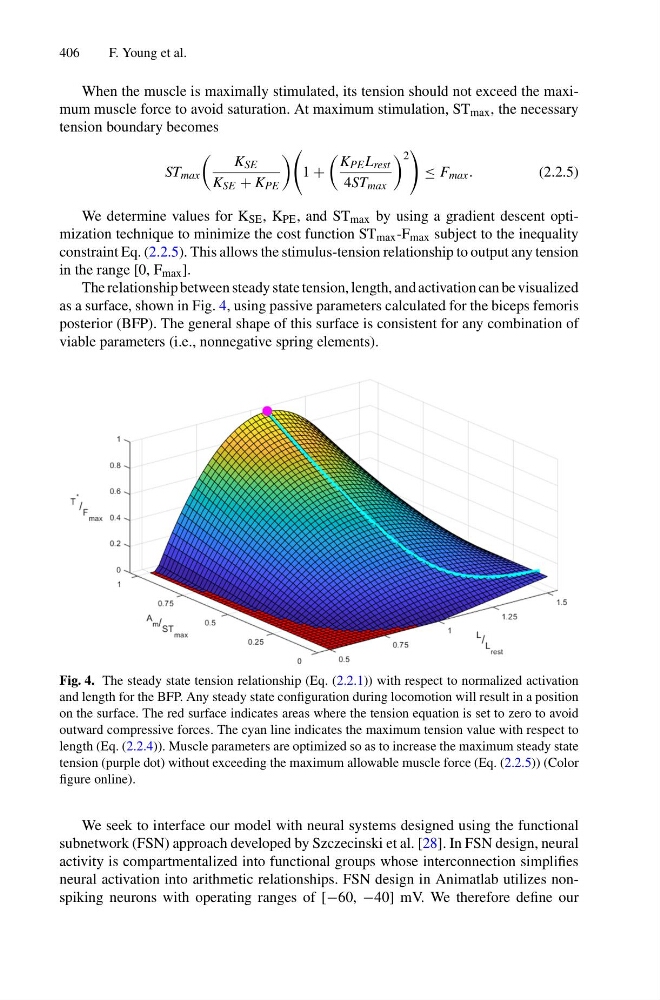
The relationship between steady state tension, length, and activation can be visualized
as a surface, shown in Fig. 4, using passive parameters calculated for the biceps femoris
posterior (BFP). The general shape of this surface is consistent for any combination of
viable parameters (i.e., nonnegative spring elements).
Fig. 4. The steady state tension relationship (Eq. (2.2.1)) with respect to normalized activation
and length for the BFP. Any steady state configuration during locomotion will result in a position
on the surface. The red surface indicates areas where the tension equation is set to zero to avoid
outward compressive forces. The cyan line indicates the maximum tension value with respect to
length (Eq. (2.2.4)). Muscle parameters are optimized so as to increase the maximum steady state
tension (purple dot) without exceeding the maximum allowable muscle force (Eq. (2.2.5)) (Color
figure online).
We seek to interface our model with neural systems designed using the functional
subnetwork (FSN) approach developed by Szczecinski et al. [28]. In FSN design, neural
activity is compartmentalized into functional groups whose interconnection simplifies
neural activation into arithmetic relationships. FSN design in Animatlab utilizes nonspiking neurons with operating ranges of [−60, −40] mV. We therefore define our
F. Young et al.
When the muscle is maximally stimulated, its tension should not exceed the maximum muscle force to avoid saturation. At maximum stimulation, ST max , the necessary
tension boundary becomes
ST max
K SE
K SE + K PE
1 +
K PE L rest
4ST max
2
≤ F max .
(2.2.5)
We determine values for K SE , K PE , and ST max by using a gradient descent optimization technique to minimize the cost function ST max -F max subject to the inequality
constraint Eq. (2.2.5). This allows the stimulus-tension relationship to output any tension
in the range [0, F max ].
The relationship between steady state tension, length, and activation can be visualized
as a surface, shown in Fig. 4, using passive parameters calculated for the biceps femoris
posterior (BFP). The general shape of this surface is consistent for any combination of
viable parameters (i.e., nonnegative spring elements).
Fig. 4. The steady state tension relationship (Eq. (2.2.1)) with respect to normalized activation
and length for the BFP. Any steady state configuration during locomotion will result in a position
on the surface. The red surface indicates areas where the tension equation is set to zero to avoid
outward compressive forces. The cyan line indicates the maximum tension value with respect to
length (Eq. (2.2.4)). Muscle parameters are optimized so as to increase the maximum steady state
tension (purple dot) without exceeding the maximum allowable muscle force (Eq. (2.2.5)) (Color
figure online).
We seek to interface our model with neural systems designed using the functional
subnetwork (FSN) approach developed by Szczecinski et al. [28]. In FSN design, neural
activity is compartmentalized into functional groups whose interconnection simplifies
neural activation into arithmetic relationships. FSN design in Animatlab utilizes nonspiking neurons with operating ranges of [−60, −40] mV. We therefore define our