

396
M. T. Whelan et al.
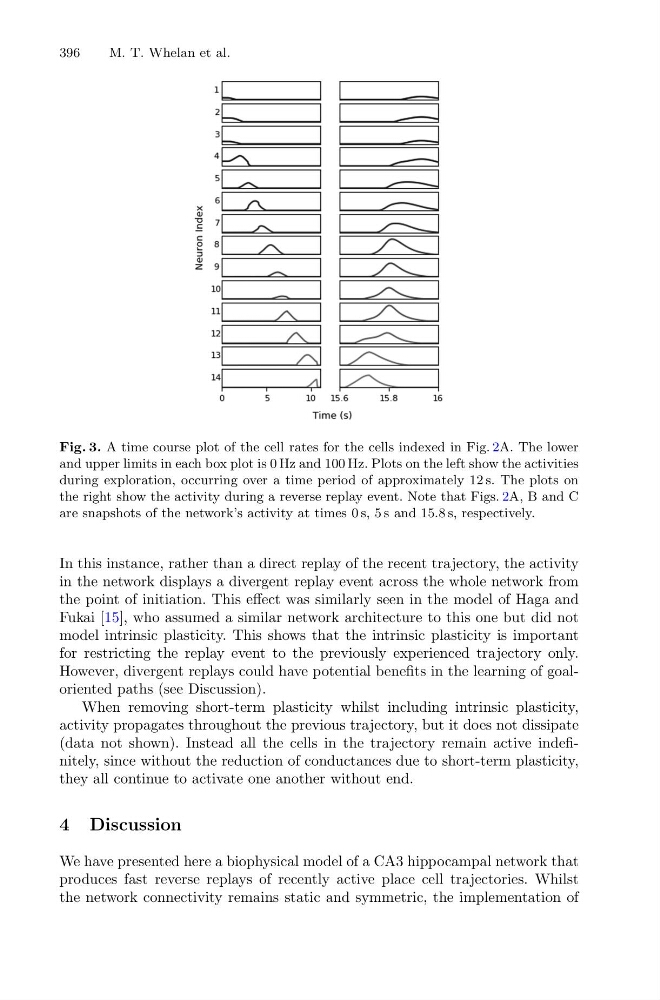
Fig. 3. A time course plot of the cell rates for the cells indexed in Fig. 2A. The lower
and upper limits in each box plot is 0 Hz and 100 Hz. Plots on the left show the activities
during exploration, occurring over a time period of approximately 12 s. The plots on
the right show the activity during a reverse replay event. Note that Figs. 2A, B and C
are snapshots of the network’s activity at times 0 s, 5 s and 15.8 s, respectively.
In this instance, rather than a direct replay of the recent trajectory, the activity
in the network displays a divergent replay event across the whole network from
the point of initiation. This effect was similarly seen in the model of Haga and
Fukai [15], who assumed a similar network architecture to this one but did not
model intrinsic plasticity. This shows that the intrinsic plasticity is important
for restricting the replay event to the previously experienced trajectory only.
However, divergent replays could have potential benefits in the learning of goaloriented paths (see Discussion).
When removing short-term plasticity whilst including intrinsic plasticity,
activity propagates throughout the previous trajectory, but it does not dissipate
(data not shown). Instead all the cells in the trajectory remain active indefinitely, since without the reduction of conductances due to short-term plasticity,
they all continue to activate one another without end.
4 Discussion
We have presented here a biophysical model of a CA3 hippocampal network that
produces fast reverse replays of recently active place cell trajectories. Whilst
the network connectivity remains static and symmetric, the implementation of
M. T. Whelan et al.
Fig. 3. A time course plot of the cell rates for the cells indexed in Fig. 2A. The lower
and upper limits in each box plot is 0 Hz and 100 Hz. Plots on the left show the activities
during exploration, occurring over a time period of approximately 12 s. The plots on
the right show the activity during a reverse replay event. Note that Figs. 2A, B and C
are snapshots of the network’s activity at times 0 s, 5 s and 15.8 s, respectively.
In this instance, rather than a direct replay of the recent trajectory, the activity
in the network displays a divergent replay event across the whole network from
the point of initiation. This effect was similarly seen in the model of Haga and
Fukai [15], who assumed a similar network architecture to this one but did not
model intrinsic plasticity. This shows that the intrinsic plasticity is important
for restricting the replay event to the previously experienced trajectory only.
However, divergent replays could have potential benefits in the learning of goaloriented paths (see Discussion).
When removing short-term plasticity whilst including intrinsic plasticity,
activity propagates throughout the previous trajectory, but it does not dissipate
(data not shown). Instead all the cells in the trajectory remain active indefinitely, since without the reduction of conductances due to short-term plasticity,
they all continue to activate one another without end.
4 Discussion
We have presented here a biophysical model of a CA3 hippocampal network that
produces fast reverse replays of recently active place cell trajectories. Whilst
the network connectivity remains static and symmetric, the implementation of