

374
S. C. van den Berg et al.
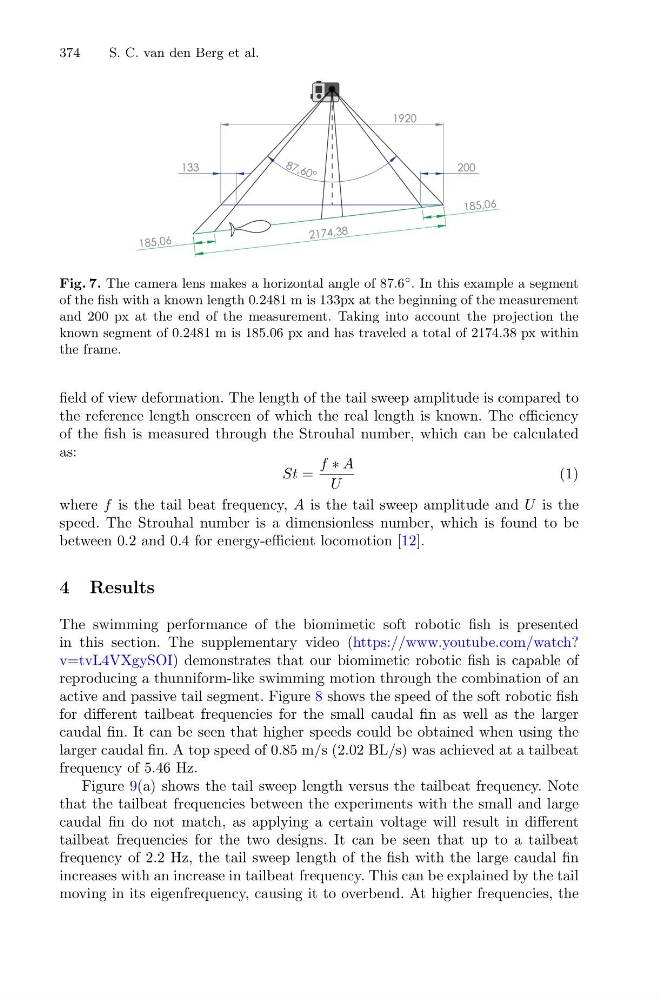
Fig. 7. The camera lens makes a horizontal angle of 87.6
◦ . In this example a segment
of the fish with a known length 0.2481 m is 133px at the beginning of the measurement
and 200 px at the end of the measurement. Taking into account the projection the
known segment of 0.2481 m is 185.06 px and has traveled a total of 2174.38 px within
the frame.
field of view deformation. The length of the tail sweep amplitude is compared to
the reference length onscreen of which the real length is known. The efficiency
of the fish is measured through the Strouhal number, which can be calculated
as:
St =
f ∗ A
U
(1)
where f is the tail beat frequency, A is the tail sweep amplitude and U is the
speed. The Strouhal number is a dimensionless number, which is found to be
between 0.2 and 0.4 for energy-efficient locomotion [12].
4 Results
The swimming performance of the biomimetic soft robotic fish is presented
in this section. The supplementary video (https://www.youtube.com/watch?
v=tvL4VXgySOI) demonstrates that our biomimetic robotic fish is capable of
reproducing a thunniform-like swimming motion through the combination of an
active and passive tail segment. Figure 8 shows the speed of the soft robotic fish
for different tailbeat frequencies for the small caudal fin as well as the larger
caudal fin. It can be seen that higher speeds could be obtained when using the
larger caudal fin. A top speed of 0.85 m/s (2.02 BL/s) was achieved at a tailbeat
frequency of 5.46 Hz.
Figure 9(a) shows the tail sweep length versus the tailbeat frequency. Note
that the tailbeat frequencies between the experiments with the small and large
caudal fin do not match, as applying a certain voltage will result in different
tailbeat frequencies for the two designs. It can be seen that up to a tailbeat
frequency of 2.2 Hz, the tail sweep length of the fish with the large caudal fin
increases with an increase in tailbeat frequency. This can be explained by the tail
moving in its eigenfrequency, causing it to overbend. At higher frequencies, the
S. C. van den Berg et al.
Fig. 7. The camera lens makes a horizontal angle of 87.6
◦ . In this example a segment
of the fish with a known length 0.2481 m is 133px at the beginning of the measurement
and 200 px at the end of the measurement. Taking into account the projection the
known segment of 0.2481 m is 185.06 px and has traveled a total of 2174.38 px within
the frame.
field of view deformation. The length of the tail sweep amplitude is compared to
the reference length onscreen of which the real length is known. The efficiency
of the fish is measured through the Strouhal number, which can be calculated
as:
St =
f ∗ A
U
(1)
where f is the tail beat frequency, A is the tail sweep amplitude and U is the
speed. The Strouhal number is a dimensionless number, which is found to be
between 0.2 and 0.4 for energy-efficient locomotion [12].
4 Results
The swimming performance of the biomimetic soft robotic fish is presented
in this section. The supplementary video (https://www.youtube.com/watch?
v=tvL4VXgySOI) demonstrates that our biomimetic robotic fish is capable of
reproducing a thunniform-like swimming motion through the combination of an
active and passive tail segment. Figure 8 shows the speed of the soft robotic fish
for different tailbeat frequencies for the small caudal fin as well as the larger
caudal fin. It can be seen that higher speeds could be obtained when using the
larger caudal fin. A top speed of 0.85 m/s (2.02 BL/s) was achieved at a tailbeat
frequency of 5.46 Hz.
Figure 9(a) shows the tail sweep length versus the tailbeat frequency. Note
that the tailbeat frequencies between the experiments with the small and large
caudal fin do not match, as applying a certain voltage will result in different
tailbeat frequencies for the two designs. It can be seen that up to a tailbeat
frequency of 2.2 Hz, the tail sweep length of the fish with the large caudal fin
increases with an increase in tailbeat frequency. This can be explained by the tail
moving in its eigenfrequency, causing it to overbend. At higher frequencies, the