

Biomimetic Design of a Soft Robotic Fish for High Speed Locomotion
375
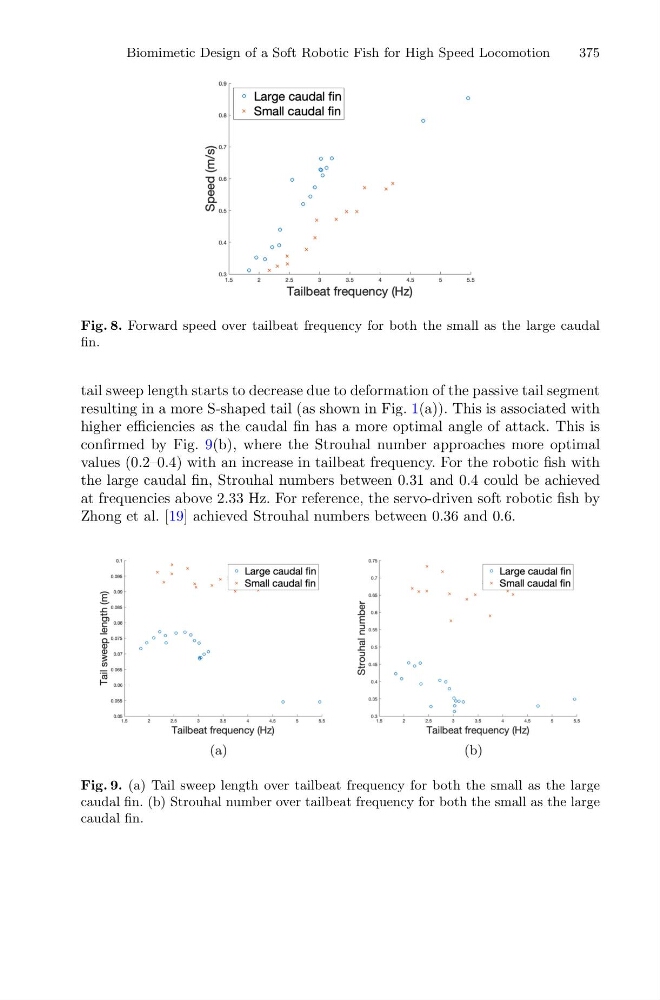
Fig. 8. Forward speed over tailbeat frequency for both the small as the large caudal
fin.
tail sweep length starts to decrease due to deformation of the passive tail segment
resulting in a more S-shaped tail (as shown in Fig. 1(a)). This is associated with
higher efficiencies as the caudal fin has a more optimal angle of attack. This is
confirmed by Fig. 9(b), where the Strouhal number approaches more optimal
values (0.2–0.4) with an increase in tailbeat frequency. For the robotic fish with
the large caudal fin, Strouhal numbers between 0.31 and 0.4 could be achieved
at frequencies above 2.33 Hz. For reference, the servo-driven soft robotic fish by
Zhong et al. [19] achieved Strouhal numbers between 0.36 and 0.6.
Fig. 9. (a) Tail sweep length over tailbeat frequency for both the small as the large
caudal fin. (b) Strouhal number over tailbeat frequency for both the small as the large
caudal fin.
375
Fig. 8. Forward speed over tailbeat frequency for both the small as the large caudal
fin.
tail sweep length starts to decrease due to deformation of the passive tail segment
resulting in a more S-shaped tail (as shown in Fig. 1(a)). This is associated with
higher efficiencies as the caudal fin has a more optimal angle of attack. This is
confirmed by Fig. 9(b), where the Strouhal number approaches more optimal
values (0.2–0.4) with an increase in tailbeat frequency. For the robotic fish with
the large caudal fin, Strouhal numbers between 0.31 and 0.4 could be achieved
at frequencies above 2.33 Hz. For reference, the servo-driven soft robotic fish by
Zhong et al. [19] achieved Strouhal numbers between 0.36 and 0.6.
Fig. 9. (a) Tail sweep length over tailbeat frequency for both the small as the large
caudal fin. (b) Strouhal number over tailbeat frequency for both the small as the large
caudal fin.