

A Plausible Mechanism for Drosophila Larva Intermittent Behavior
295
is compared to a non-activated control group as shown in Fig. 4 and described
in Table 1.
Interestingly, genetic intervention can have a large effect on the activity ratio.
When inactivating sensory neurons and to a lesser extend the mushroom body
the activity ratio is decreased (cf. BLsens > rpr/hid, MB247 > shi
ts and BLsens
> shi
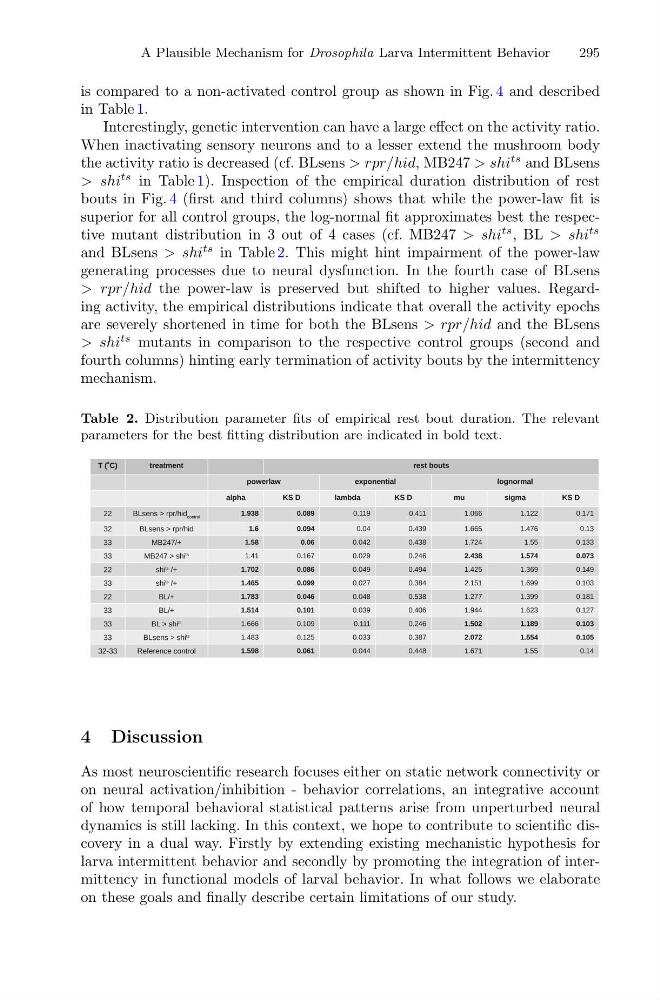
ts in Table 1). Inspection of the empirical duration distribution of rest
bouts in Fig. 4 (first and third columns) shows that while the power-law fit is
superior for all control groups, the log-normal fit approximates best the respective mutant distribution in 3 out of 4 cases (cf. MB247 > shi
ts , BL > shi
ts
and BLsens > shi
ts in Table 2. This might hint impairment of the power-law
generating processes due to neural dysfunction. In the fourth case of BLsens
> rpr/hid the power-law is preserved but shifted to higher values. Regarding activity, the empirical distributions indicate that overall the activity epochs
are severely shortened in time for both the BLsens > rpr/hid and the BLsens
> shi
ts mutants in comparison to the respective control groups (second and
fourth columns) hinting early termination of activity bouts by the intermittency
mechanism.
Table 2. Distribution parameter fits of empirical rest bout duration. The relevant
parameters for the best fitting distribution are indicated in bold text.
4 Discussion
As most neuroscientific research focuses either on static network connectivity or
on neural activation/inhibition - behavior correlations, an integrative account
of how temporal behavioral statistical patterns arise from unperturbed neural
dynamics is still lacking. In this context, we hope to contribute to scientific discovery in a dual way. Firstly by extending existing mechanistic hypothesis for
larva intermittent behavior and secondly by promoting the integration of intermittency in functional models of larval behavior. In what follows we elaborate
on these goals and finally describe certain limitations of our study.
295
is compared to a non-activated control group as shown in Fig. 4 and described
in Table 1.
Interestingly, genetic intervention can have a large effect on the activity ratio.
When inactivating sensory neurons and to a lesser extend the mushroom body
the activity ratio is decreased (cf. BLsens > rpr/hid, MB247 > shi
ts and BLsens
> shi
ts in Table 1). Inspection of the empirical duration distribution of rest
bouts in Fig. 4 (first and third columns) shows that while the power-law fit is
superior for all control groups, the log-normal fit approximates best the respective mutant distribution in 3 out of 4 cases (cf. MB247 > shi
ts , BL > shi
ts
and BLsens > shi
ts in Table 2. This might hint impairment of the power-law
generating processes due to neural dysfunction. In the fourth case of BLsens
> rpr/hid the power-law is preserved but shifted to higher values. Regarding activity, the empirical distributions indicate that overall the activity epochs
are severely shortened in time for both the BLsens > rpr/hid and the BLsens
> shi
ts mutants in comparison to the respective control groups (second and
fourth columns) hinting early termination of activity bouts by the intermittency
mechanism.
Table 2. Distribution parameter fits of empirical rest bout duration. The relevant
parameters for the best fitting distribution are indicated in bold text.
4 Discussion
As most neuroscientific research focuses either on static network connectivity or
on neural activation/inhibition - behavior correlations, an integrative account
of how temporal behavioral statistical patterns arise from unperturbed neural
dynamics is still lacking. In this context, we hope to contribute to scientific discovery in a dual way. Firstly by extending existing mechanistic hypothesis for
larva intermittent behavior and secondly by promoting the integration of intermittency in functional models of larval behavior. In what follows we elaborate
on these goals and finally describe certain limitations of our study.