

296
P. Sakagiannis et al.
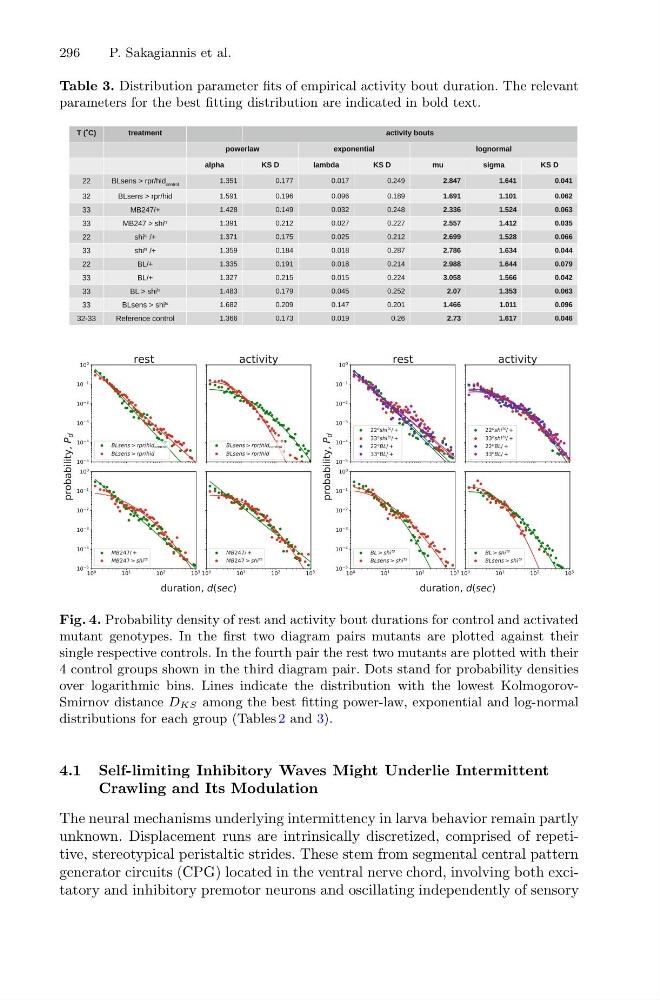
Table 3. Distribution parameter fits of empirical activity bout duration. The relevant
parameters for the best fitting distribution are indicated in bold text.
Fig. 4. Probability density of rest and activity bout durations for control and activated
mutant genotypes. In the first two diagram pairs mutants are plotted against their
single respective controls. In the fourth pair the rest two mutants are plotted with their
4 control groups shown in the third diagram pair. Dots stand for probability densities
over logarithmic bins. Lines indicate the distribution with the lowest KolmogorovSmirnov distance DKS among the best fitting power-law, exponential and log-normal
distributions for each group (Tables 2 and 3).
4.1 Self-limiting Inhibitory Waves Might Underlie Intermittent
Crawling and Its Modulation
The neural mechanisms underlying intermittency in larva behavior remain partly
unknown. Displacement runs are intrinsically discretized, comprised of repetitive, stereotypical peristaltic strides. These stem from segmental central pattern
generator circuits (CPG) located in the ventral nerve chord, involving both excitatory and inhibitory premotor neurons and oscillating independently of sensory
P. Sakagiannis et al.
Table 3. Distribution parameter fits of empirical activity bout duration. The relevant
parameters for the best fitting distribution are indicated in bold text.
Fig. 4. Probability density of rest and activity bout durations for control and activated
mutant genotypes. In the first two diagram pairs mutants are plotted against their
single respective controls. In the fourth pair the rest two mutants are plotted with their
4 control groups shown in the third diagram pair. Dots stand for probability densities
over logarithmic bins. Lines indicate the distribution with the lowest KolmogorovSmirnov distance DKS among the best fitting power-law, exponential and log-normal
distributions for each group (Tables 2 and 3).
4.1 Self-limiting Inhibitory Waves Might Underlie Intermittent
Crawling and Its Modulation
The neural mechanisms underlying intermittency in larva behavior remain partly
unknown. Displacement runs are intrinsically discretized, comprised of repetitive, stereotypical peristaltic strides. These stem from segmental central pattern
generator circuits (CPG) located in the ventral nerve chord, involving both excitatory and inhibitory premotor neurons and oscillating independently of sensory