

294
P. Sakagiannis et al.
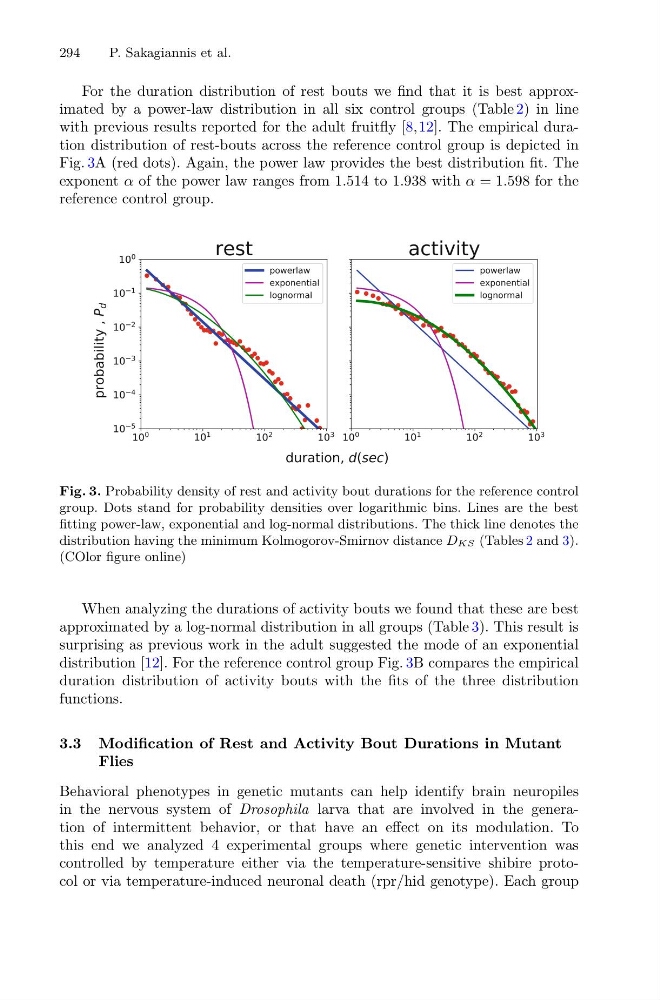
For the duration distribution of rest bouts we find that it is best approximated by a power-law distribution in all six control groups (Table 2) in line
with previous results reported for the adult fruitfly [8,12]. The empirical duration distribution of rest-bouts across the reference control group is depicted in
Fig. 3A (red dots). Again, the power law provides the best distribution fit. The
exponent α of the power law ranges from 1.514 to 1.938 with α = 1.598 for the
reference control group.
Fig. 3. Probability density of rest and activity bout durations for the reference control
group. Dots stand for probability densities over logarithmic bins. Lines are the best
fitting power-law, exponential and log-normal distributions. The thick line denotes the
distribution having the minimum Kolmogorov-Smirnov distance DKS (Tables 2 and 3).
(COlor figure online)
When analyzing the durations of activity bouts we found that these are best
approximated by a log-normal distribution in all groups (Table 3). This result is
surprising as previous work in the adult suggested the mode of an exponential
distribution [12]. For the reference control group Fig. 3B compares the empirical
duration distribution of activity bouts with the fits of the three distribution
functions.
3.3 Modification of Rest and Activity Bout Durations in Mutant
Flies
Behavioral phenotypes in genetic mutants can help identify brain neuropiles
in the nervous system of Drosophila larva that are involved in the generation of intermittent behavior, or that have an effect on its modulation. To
this end we analyzed 4 experimental groups where genetic intervention was
controlled by temperature either via the temperature-sensitive shibire protocol or via temperature-induced neuronal death (rpr/hid genotype). Each group
P. Sakagiannis et al.
For the duration distribution of rest bouts we find that it is best approximated by a power-law distribution in all six control groups (Table 2) in line
with previous results reported for the adult fruitfly [8,12]. The empirical duration distribution of rest-bouts across the reference control group is depicted in
Fig. 3A (red dots). Again, the power law provides the best distribution fit. The
exponent α of the power law ranges from 1.514 to 1.938 with α = 1.598 for the
reference control group.
Fig. 3. Probability density of rest and activity bout durations for the reference control
group. Dots stand for probability densities over logarithmic bins. Lines are the best
fitting power-law, exponential and log-normal distributions. The thick line denotes the
distribution having the minimum Kolmogorov-Smirnov distance DKS (Tables 2 and 3).
(COlor figure online)
When analyzing the durations of activity bouts we found that these are best
approximated by a log-normal distribution in all groups (Table 3). This result is
surprising as previous work in the adult suggested the mode of an exponential
distribution [12]. For the reference control group Fig. 3B compares the empirical
duration distribution of activity bouts with the fits of the three distribution
functions.
3.3 Modification of Rest and Activity Bout Durations in Mutant
Flies
Behavioral phenotypes in genetic mutants can help identify brain neuropiles
in the nervous system of Drosophila larva that are involved in the generation of intermittent behavior, or that have an effect on its modulation. To
this end we analyzed 4 experimental groups where genetic intervention was
controlled by temperature either via the temperature-sensitive shibire protocol or via temperature-induced neuronal death (rpr/hid genotype). Each group